
Atualização da diretriz do NICE do Reino Unido: corticosteroides adjuvantes para pneumonia adquirida na comunidade grave (NG250)
A diretriz atualizada do National Institute for Health and Care Excellence (NICE) do Reino Unido sobre pneumonia (NG250) recomenda considerar o uso adjuvante de corticosteroides sistêmicos para adultos internados em hospitais com pneumonia adquirida na comunidade (PAC) grave.
Para pacientes com escore CURB-65 de 3 a 5, juntamente com avaliação clínica indicando doença grave, um curto ciclo de corticosteroides sistêmicos pode ser adicionado à antibioticoterapia apropriada, a menos que haja contraindicação. Isto representa uma mudança em relação às orientações anteriores do Reino Unido, que não recomendavam o uso rotineiro de corticosteroides.
Na prática diária:
Avalie a gravidade utilizando o CURB-65 em conjunto com o julgamento clínico.
Considere o uso adjuvante de corticosteroides para pacientes internados com PAC grave.
Não utilize corticosteroides rotineiramente em casos de doença de baixa ou moderada gravidade, ou em pacientes tratados na comunidade.
Pondere os potenciais benefícios, incluindo a redução da mortalidade e uma recuperação clínica mais rápida, em relação aos riscos, como hiperglicemia e infecção secundária.
Resumo
Definição
História e exame físico
Principais fatores diagnósticos
- tosse com aumento da produção de escarro
- dispneia
- dor torácica pleurítica
- calafrios ou sudorese noturna
- febre
- achados anormais no exame respiratório
- confusão
- presença de fatores de risco
Outros fatores diagnósticos
- mialgia
- mal-estar
- anorexia
- letargia
- agravamento de condições pré-existentes
- faringite
- cefaleia
- náuseas
- dor abdominal
- diarreia
Fatores de risco
- idade >65 anos
- residência em um ambiente de cuidados médicos
- doença respiratória crônica
- exposição à fumaça de cigarro
- uso/abuso de álcool
- higiene bucal ineficiente
- uso de medicamentos antiácidos
- contato com crianças
- Infecção pelo vírus da imunodeficiência humana (HIV)
- sexo masculino
- diabetes mellitus
- doença renal crônica
- doença hepática crônica
- Doença cardíaca crônica
- uso de opioides, corticosteroides inalatórios, antipsicóticos, medicamentos antidiabéticos
Investigações diagnósticas
Primeiras investigações a serem solicitadas
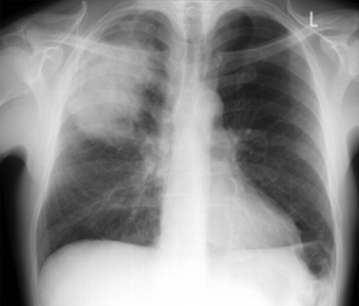
- radiografia torácica
- oximetria de pulso
- gasometria arterial
- ureia e eletrólitos
- hemograma completo
- proteína C-reativa
- testes da função hepática
Investigações a serem consideradas
- hemocultura
- cultura de escarro
- teste de antígeno urinário para Streptococcus pneumoniae
- teste de antígeno urinário para Legionella pneumophila
- reação em cadeia da polimerase e/ou testes sorológicos
- Teste para SARS-CoV-2 (reação em cadeia da polimerase ou antígeno)
- TC do tórax
- ultrassonografia do pulmão
- toracocentese e cultura do líquido pleural
- angiografia pulmonar por tomografia computadorizada (APTC)
- broncoscopia
- procalcitonina sérica
Algoritmo de tratamento
Colaboradores
Consultores especialistas
Amy Binnion, BSc (Biochemistry), MBBS, MRCP, PhD
Consultant Respiratory Physician
Respiratory Medicine Institution
Nottingham University Hospitals NHS Trust
Nottingham
UK
Declarações
AB has attended a conference fully funded for all delegates by industry sponsorship from multiple sponsors.
Acknowledgements
BMJ Best Practice would like to gratefully acknowledge the previous team of expert contributors, whose work has been retained in parts of the content:
Jonathan Bennett MD
Honorary Professor of Respiratory Sciences
University of Leicester
Respiratory Consultant
Glenfield Hospital
Leicester
UK
Catia Cilloniz MSc, PhD
Post-doctoral Research
Pneumology Department
Hospital Clinic of Barcelona
CIBERES
IDIBAPS
Barcelona
Spain
Antoni Torres MD, PhD
Professor of Medicine
Director
Pulmonary Intensive Care Unit
Respiratory Institute
Hospital Clinic of Barcelona
Barcelona
Spain
Declarações
JB declares that he has no competing interests. CC and AT are each authors of a number of references cited in this topic.
Revisores
Wei Shen Lim
Consultant Respiratory Physician and Honorary Professor of Medicine
Nottingham University Hospitals NHS Trust
Nottingham
UK
Declarações
WSL was chairman of the British Thoracic Society community-acquired pneumonia guidelines committee and a member of the guideline development group for the National Institute for Health and Care Excellence pneumonia guidelines. His institution has received unrestricted investigator-initiated research funding from Pfizer for a multicentre study of pneumococcal pneumonia in which he was the chief investigator, and research funding from the National Institute for Health Research for studies in pneumonia in which he was the principal investigator. He is also an author of at least one reference cited in the topic.
Créditos aos pareceristas
Os tópicos do BMJ Best Practice são constantemente atualizados, seguindo os desenvolvimentos das evidências e das diretrizes. Os pareceristas aqui listados revisaram o conteúdo pelo menos uma vez durante a história do tópico.
Declarações
As afiliações e declarações dos pareceristas referem--se ao momento da revisão.
Referências
Principais artigos
Lim WS, Baudouin SV, George RC, et al; Pneumonia Guidelines Committee of the BTS Standards of Care Committee. British Thoracic Society guidelines for the management of community acquired pneumonia in adults: update 2009. Thorax. 2009 Oct;64(suppl 3):iii1-55.Texto completo Resumo
British Thoracic Society. 2015 - Annotated BTS guideline for the management of CAP in adults (2009) summary of recommendations. Jan 2015 [internet publication].Texto completo
O'Driscoll BR, Howard LS, Earis J, et al. BTS guideline for oxygen use in adults in healthcare and emergency settings. Thorax. 2017 Jun;72 (suppl 1):ii1-90.Texto completo Resumo
National Institute for Health and Care Excellence. Pneumonia in adults: diagnosis and management. July 2022 [internet publication].Texto completo
National Institute for Health and Care Excellence. Pneumonia: diagnosis and management. Sep 2025 [internet publication].Texto completo
National Institute for Health and Care Excellence. Pneumonia (community-acquired): antimicrobial prescribing. Sep 2019 [internet publication].Texto completo
Artigos de referência
Uma lista completa das fontes referenciadas neste tópico está disponível aqui.
O uso deste conteúdo está sujeito ao nosso aviso legal