
Tests
1st tests to order
CBC
Test
Order in patients with a nonspecific viral illness and a history of exposure to rodent excreta.
During the prodromal phase, thrombocytopenia with a supporting epidemiology is suggestive of hantavirus infection. The degree of thrombocytopenia may be prognostic of poor outcome.[10]
Circulating immunoblast cells constituting >10% of the total lymphocyte count are highly suggestive of hantavirus infection.[65]
Hemoconcentration as indicated by an elevated Hb and hematocrit (Hct) is a marker for capillary leak and may signal the beginning of the cardiopulmonary phase.[5]
Result
platelet count <150 x 10³/microliter is an early clue; leukocytosis with immunoblasts; elevated Hb and Hct
chest x-ray
Test
May be normal or suggestive of early interstitial edema in the early pulmonary phase. It can show diffuse interstitial edema early in the cardiopulmonary phase progressing to severe diffuse pulmonary edema with or without effusions.[5][77][Figure caption and citation for the preceding image starts]: Bilateral fluffy pulmonary infiltrates in hantavirus pulmonary syndromeCDC Public Health Image Library (PHIL), Loren Ketai, MD [Citation ends].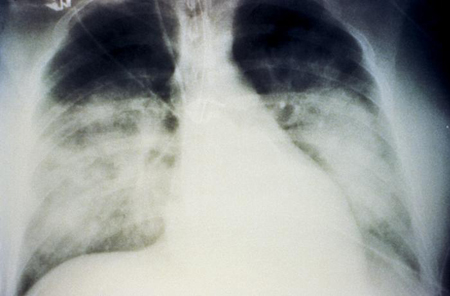
Result
normal in early disease; diffuse interstitial edema; severe diffuse pulmonary edema with or without effusions
serology
Test
Recommended to confirm the diagnosis.[57][66][67] Order if the clinical syndrome and epidemiology are suggestive of hantavirus infection.
Enzyme-linked immunosorbent assay (ELISA) immunoglobulin (Ig) M-capture and IgG serologies for hantavirus are recommended. Indirect immunofluorescence assay (IFA) may also be used.[68]
Detection of hantavirus-specific IgM, or rising titers of hantavirus-specific IgG, confirms the diagnosis.[69] Patients uniformly have antibodies of IgM class, and many have antibodies of IgG class, by the time the symptoms are evident.
A negative result does not rule out the diagnosis, particularly in the first 72 hours. Repeat testing should be considered 24 to 48 hours later (or up to 72 hours after, depending on guidance) if the clinical suspicion is high but the initial test is negative.[68][71]
The potential cross-reactivity with cocirculating hantaviruses should be considered, depending on local epidemiology.[68]
Combining serology with molecular testing is highly sensitive for diagnosis, and may be considered where available.[72]
Tests are available through local public health authorities. Specimens should be collected and handled according to local safety procedures.
Result
positive for IgM or IgG orthohantavirus antibodies
reverse transcriptase polymerase chain reaction (RT-PCR)
Test
Recommended to confirm the diagnosis.[57][66][67][70] Order if the clinical syndrome and epidemiology are suggestive of hantavirus infection.
The recommended specimen is whole blood. Serum or plasma may also be used. Other specimens (e.g., urine, saliva/gingival swab, semen, cerebrospinal fluid) may be considered if necessary.[68]
Determines the specific type of hantavirus causing the infection. May detect viral RNA before antibodies appear, and is more sensitive in the early acute stages of illness.[70]
A negative result does not rule out the diagnosis, particularly in the first 72 hours. Repeat testing should be considered 24 to 48 hours later (or up to 72 hours after, depending on guidance) if the clinical suspicion is high but the initial test is negative.[68][71]
Combining RT-PCR with serology is highly sensitive for diagnosis, and may be considered where available.[72]
Tests are available through local public health authorities. Specimens should be collected and handled according to local safety procedures.
Result
positive for orthohantavirus RNA
Tests to consider
ABG
Test
Metabolic acidosis may occur during the cardiopulmonary phase.[51]
Result
cardiopulmonary phase: hypoxia, metabolic acidosis
serum lactate
ECG
Test
During the cardiopulmonary phase, the ECG may show arrhythmias ranging from a sinus bradycardia to ventricular fibrillation.
Result
arrhythmia
echocardiogram
Test
During the cardiopulmonary phase, the patient will have a decreased left ventricular ejection fraction.
Result
decreased left ventricular ejection fraction
flow-directed pulmonary artery catheter (Swan-Ganz catheter)
Test
During the cardiopulmonary phase, a decreased cardiac index and increased peripheral resistance is seen, distinguishing the shock from septic shock, which has a low systemic resistance and high cardiac output. Peripheral resistance and cardiac index is assessed using a flow-directed pulmonary artery catheter. A cardiac index of <2.5 L/minute/m² is one of the criteria for instituting extracorporeal membrane oxygenation (ECMO).[58][73][75]
Alternative methods for measuring cardiac index (e.g., transpulmonary thermodilution catheter) may be available in specialist centers.[74]
Result
decreased cardiac index, increased peripheral vascular resistance
lung biopsy
Test
May be performed either transbronchially at bronchoscopy or by video-assisted thoracoscopic surgery in patients with unexplained rapidly progressive pulmonary disease.
Immunohistochemical staining for hantavirus RNA shows diffuse endothelial cell staining.[75][76] This is available as a research test through the Centers for Disease Control and Prevention (CDC).
Result
intra-alveolar edema with an interstitial infiltrate of immunoblasts
Emerging tests
virus isolation
Test
Hantavirus isolation in cell culture is not a routine procedure for laboratory diagnosis. Virus isolation requires specialized expertise and Biosafety 3 laboratory facilities. Nevertheless, Andes virus (ANDV) has been isolated in cell culture from the blood of patients and from organs of those with fatal disease.[4]
Result
positive for orthohantavirus
Use of this content is subject to our disclaimer