Summary
Definition
History and exam
Key diagnostic factors
- presença de fatores de risco
- tosse intratável
- febre
- dispneia
- sibilância
- hipóxia
- estertores
- rebaixamento do nível de consciência
- cianose
- broncoespasmo
Risk factors
- disfunção da deglutição
- doença cerebrovascular
- nível de consciência comprometido (pontuação < 9 da escala de coma de Glasgow)
- uso indevido de substâncias
- durante anestesia geral (ou outros procedimentos orofaríngeos) ou na unidade de terapia intensiva
- distúrbio gastrointestinal
- idade avançada
- tosse fraca
- doença mais grave
- estudos com bário do trato gastrointestinal superior
- sexo masculino
- presença de uma sonda de alimentação
- cânceres de cabeça e pescoço
- politraumatismo
- doença do refluxo gastroesofágico
- posição supina
- obesidade
- medicamentos que reduzem o tônus dos esfíncteres esofágicos
- medicamentos que atrasam o esvaziamento gástrico
Diagnostic tests
1st tests to order
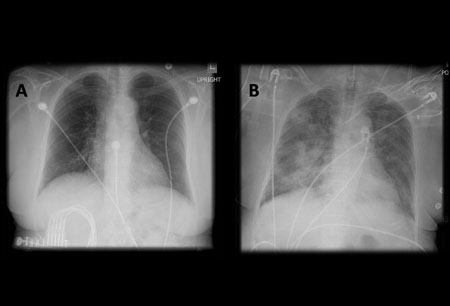
- radiografia torácica
- Exames de sangue
Tests to consider
- tomografia computadorizada (TC) do tórax
- broncoscopia
- gasometria arterial
Treatment algorithm
pneumonite por aspiração
pneumonite sem resolução após 48 horas
Contributors
Expert advisers
Jonathan Bennett, MD
Honorary Professor of Respiratory Sciences
University of Leicester
Respiratory Consultant
Glenfield Hospital
Leicester
UK
Biography
JB is deputy medical director of RCP Invited Service Reviews, and speaker at national meetings for organisations including the British Thoracic Society, Primary Care Respiratory Society, and Society for Cardiothoracic Surgery.
Disclosures
JB declares that he has no competing interests.
Melvyn Jenkins-Welch, MBBS, BSc, MSc, FRCA, FFICM
Consultant Critical Care Medicine
Cardiff and Vale ULHB
Cardiff
UK
Disclosures
MJW declares that he has no competing interests.
Acknowledgements
BMJ Best Practice would like to gratefully acknowledge the previous expert contributor, whose work has been retained in parts of the content:
Madison Macht, MD
Volunteer Clinical Faculty
Division of Pulmonary Sciences and Critical Care Medicine
University of Colorado Denver
Aurora
CO
Disclosures
MM declares that he has no competing interests.
Peer reviewers
David G. Smithard, BSc, MB, MD, FRCP, FRCSLT (Hon)
Visiting Professor
University of Greenwich
Consultant in Elderly Medicine
Queen Elizabeth Hospital
Lewisham and Greenwich NHS Trust
Greenwich
UK
Disclosures
DGS declares that he has no competing interests.
Peer reviewer acknowledgements
BMJ Best Practice topics are updated on a rolling basis in line with developments in evidence and guidance. The peer reviewers listed here have reviewed the content at least once during the history of the topic.
Disclosures
Peer reviewer affiliations and disclosures pertain to the time of the review.
References
Key articles
Marik PE. Aspiration pneumonitis and aspiration pneumonia. N Engl J Med. 2001 Mar 1;344(9):665-71. Abstract
British Thoracic Society. Diagnosis and management of aspiration pneumonia. Mar 2023 [internet publication].Full text
Reference articles
A full list of sources referenced in this topic is available to users with access to all of BMJ Best Practice.
Differentials
- Síndrome do desconforto respiratório agudo
- Exacerbação da asma
- Exacerbação da doença pulmonar obstrutiva crônica (DPOC)
More DifferentialsGuidelines
- Diagnosis and management of aspiration pneumonia
- ACR appropriateness criteria: dysphagia
More Guidelines Log in or subscribe to access all of BMJ Best Practice
Use of this content is subject to our disclaimer