Resumo
Definição
História e exame físico
Principais fatores diagnósticos
- presença de fatores de risco
- tosse
- dispneia
Outros fatores diagnósticos
- história de vômitos
- taquipneia
- hálito com odor desagradável
- crepitações
- expectoração espumosa ou purulenta
- febre
- dor torácica pleurítica
- delirium
- apetite reduzido
- mobilidade reduzida
- debilitação geral
Fatores de risco
- disfunção da deglutição
- nível de consciência prejudicado
- doença gastrointestinal
- procedimentos anestésicos gerais ou orofaríngeos
- idade avançada
- tosse fraca
- presença de uma sonda de alimentação
- cânceres de cabeça e pescoço
- politraumatismo
- posição reclinada durante alimentação enteral
- higiene bucal ineficiente
- dificuldades de aprendizagem
Investigações diagnósticas
Primeiras investigações a serem solicitadas
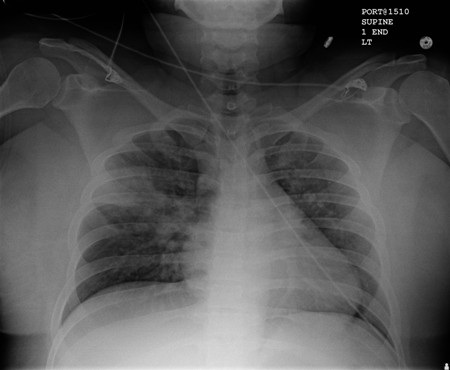
- radiografia torácica
- hemograma completo
- ureia e eletrólitos
- testes da função hepática
- Proteína C-reativa
- coloração de Gram de expectoração
- cultura de escarro
Investigações a serem consideradas
- gasometria arterial
- broncoscopia
Algoritmo de tratamento
todos os pacientes
Colaboradores
Consultores especialistas
Jonathan Bennett, MD
Honorary Professor of Respiratory Sciences
University of Leicester
Respiratory Consultant
Glenfield Hospital
Leicester
UK
Biografia
JB is Chair of the British Thoracic Society (BTS). He is also deputy medical director RCP Invited service Reviews, and speaker at National Society (eg., BTS), Primary Care respiratory Society, Society Cardiothoracic Surgeons meetings.
Declarações
JB declares that he has no competing interests.
Claire Vella, MD, MRCP
Clinical Fellow Lung Cancer and Interventional Pulmonology
Glenfield Hospital
Leicester
UK
Declarações
CV declares that she has no competing interests.
Agradecimentos
BMJ Best Practice would like to gratefully acknowledge the previous expert contributor, whose work has been retained in parts of the content:
Michael J. Lanspa, MD
Adjunct Associate Professor
Division of Pulmonary and Critical Care Medicine
Intermountain Medical Center
University of Utah
Salt Lake City
UT
Declarações
MJL declares that he has no competing interests.
Revisores
David G. Smithard, BSc, MB, MD, FRCP, FRCSLT (Hon)
Visiting Professor
University of Greenwich
Consultant in Elderly Medicine
Queen Elizabeth Hospital
Lewisham and Greenwich NHS Trust
Greenwich
UK
Declarações
DGS declares that he has no competing interests.
Créditos aos pareceristas
Os tópicos do BMJ Best Practice são constantemente atualizados, seguindo os desenvolvimentos das evidências e das diretrizes. Os pareceristas aqui listados revisaram o conteúdo pelo menos uma vez durante a história do tópico.
Declarações
As afiliações e declarações dos pareceristas referem--se ao momento da revisão.
Referências
Principais artigos
Simpson AJ, Allen JL, Chatwin M, et al. BTS clinical statement on aspiration pneumonia. Thorax. 2023 Feb;78(suppl 1):s3-21.Texto completo Resumo
National Institute for Health and Care Excellence. Stroke and transient ischaemic attack in over 16s: diagnosis and initial management. April 2022 [internet publication].Texto completo
National Institute for Health and Care Excellence. Pneumonia (community-acquired): antimicrobial prescribing. September 2019 [internet publication].Texto completo
National Institute for Health and Care Excellence. Pneumonia (hospital-acquired): antimicrobial prescribing. September 2019 [internet publication].Texto completo
Artigos de referência
Uma lista completa das fontes referenciadas neste tópico está disponível para os usuários com acesso total ao BMJ Best Practice.
Diagnósticos diferenciais
- Pneumonia adquirida na comunidade (PAC)
- Pneumonia hospitalar
- Edema pulmonar
Mais Diagnósticos diferenciaisDiretrizes
- Pneumonia (community-acquired): antimicrobial prescribing
- Pneumonia (hospital-acquired): antimicrobial prescribing
Mais DiretrizesCalculadoras
Escore CURB-65 de gravidade de uma pneumonia.
Mais CalculadorasFolhetos informativos para os pacientes
Pneumonia
Mais Folhetos informativos para os pacientes Conectar-se ou assinar para acessar todo o BMJ Best Practice
O uso deste conteúdo está sujeito ao nosso aviso legal