Resumo
Definição
História e exame físico
Principais fatores diagnósticos
- palpitações
- frequência de pulso irregular
- fatores de risco
Outros fatores diagnósticos
- dispneia
- hipotensão sintomática
- dor/aperto/desconforto torácico
- fadiga
- ansiedade
- comprometimento cognitivo
- tontura
- poliúria
- ruídos adventícios
- sons cardíacos adicionais
- pressão venosa jugular elevada
- evidência de acidente vascular cerebral (AVC)
- pré-síncope e síncope
Fatores de risco
- idade mais avançada
- hipertensão
- insuficiência cardíaca
- diabetes mellitus
- apneia obstrutiva do sono
- obesidade
- doença arterial coronariana
- doença valvar
- outras doenças cardíacas
- consumo regular e intenso de bebidas alcoólicas
- cirurgia cardíaca ou torácica
- outras arritmias atriais
- AVC/ataque isquêmico transitório prévio
- hipertireoidismo
- níveis atléticos de atividade física
- Doença pulmonar obstrutiva crônica (DPOC)
- tabagismo
Investigações diagnósticas
Primeiras investigações a serem solicitadas
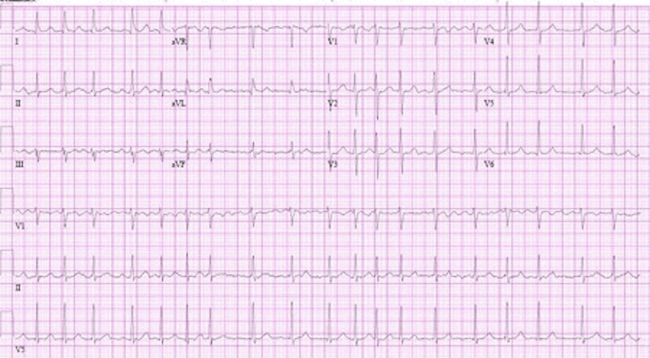
- eletrocardiograma (ECG)
- Hemograma completo
- coagulograma
- eletrólitos, ureia e creatinina
- função tireoidiana
- radiografia torácica
- ecocardiografia transtorácica (ETT)
Investigações a serem consideradas
- troponina cardíaca
- gasometria arterial
- proteína C-reativa
- peptídeo natriurético do tipo B (PNB)/fragmento N-terminal do peptídeo natriurético do tipo B (NT-proPNB)
- TFHs
- velocidade de hemossedimentação
- ecocardiografia transesofágica (ETE)
- telemetria para pacientes hospitalizados ou monitoramento por Holter de 24 horas
- angiografia coronariana (TC ou convencional) ou teste ergométrico
- ressonância nuclear magnética cardíaca (RNMC) tardia com contraste de gadolínio
- tomografia computadorizada (TC) cerebral
- ressonância nuclear magnética (RNM) cranioencefálica
- Angiografia pulmonar por tomografia computadorizada (APTC)
Algoritmo de tratamento
hemodinamicamente instável
hemodinamicamente estável: início <24 horas
hemodinamicamente estável: início ≥24 horas ou incerto
após a estabilização
Colaboradores
Consultores especialistas
Shrilla Banerjee, MD, FRCP
Consultant Interventional Cardiologist
East Surrey Hospital
Surrey and Sussex Healthcare NHS Trust
UK
Declarações
SB has received speaker fees for educational lectures (presentation content was her own) and meeting participation from Menarini, Edwards Lifesciences, Abbott Vascular, and Shockwave IVL. She has also participated in an Advisory Board for Sahajanand Medical Technologies Limited. SB has received travel sponsorship from Biosensors International to attend the PCR meeting in Paris in 2022. She has prepared a manuscript on coronary microvascular dysfunction for Abbott for Cardiovascular News (no royalties).
F. Aaysha Cader, MBBS, MD (Cardiology), MRCP, MSc Clinical Trials (Oxon), FACC, FSCAI, FAPSC
Cardiology Specialist Registrar
Kettering General Hospital NHS Foundation Trust
UK
Declarações
FAC declares that she has no competing interests.
Moad El-Haddad, MBBCh, MRCP (UK)
Cardiology Registrar ST5
Freeman Hospital
Newcastle upon Tyne Hospitals NHS Foundation Trust
UK
Declarações
MEH declares that he has no competing interests.
Agradecimentos
BMJ Best Practice would like to gratefully acknowledge the previous team of expert contributors, whose work is retained in parts of the content:
Arti N. Shah, MS, MD
Director
Cardiac Electrophysiology
Elmhurst Hospital Center
Elmhurst
Assistant Professor of Medicine
Mount Sinai School of Medicine
New York
NY
ANS is an author of a number of references cited in this topic.
Bharat K. Kantharia MD, FRCP, FAHA, FACC, FESC, FHRS
Cardiovascular and Heart Rhythm Consultant
Attending and Consultant Cardiac Electrophysiologist
Mount Sinai Hospitals
New York Methodist Hospital
New York
NY
West Houston Medical Center
Memorial Hermann Hospital
Houston
TX
BKK is an author of a number of references cited in this topic.
Resham Baruah MBBS, BSc, MRCP, PhD
Consultant Cardiologist
Chelsea and Westminster Hospital and the Royal Brompton and Harefield NHS Trust
London
UK
RB has received honorarium/speaker fees from Novartis and Boehringer Ingleheim.
Adam D. Hartley MBBS, BSc, MRCP
Wellcome Trust Clinical Research Fellow
Imperial College London
Specialist Registrar in Cardiology
Imperial College Healthcare NHS Trust
London
UK
ADH declares that he has no competing interests.
Revisores
Gregory Lip, MD, FRCP, DFM, FACC, FESC, FEHRA
Price-Evans Professor of Cardiovascular Medicine
University of Liverpool
Senior Investigator
National Institute for Health Research
UK
Distinguished Professor
Faculty of Medicine
Aalborg University
Denmark
Adjunct Professor
Yonsei University
Seoul
South Korea
Declarações
GL is a consultant for Bayer/Janssen, BMS/Pfizer, Medtronic, Boehringer Ingelheim, Novartis, Verseon, and Daiichi-Sankyo. He is a speaker for Bayer, BMS/Pfizer, Medtronic, Boehringer Ingelheim, and Daiichi-Sankyo. No fees are directly received personally. GL is an author of a number of references cited in this topic.
Créditos aos pareceristas
Os tópicos do BMJ Best Practice são constantemente atualizados, seguindo os desenvolvimentos das evidências e das diretrizes. Os pareceristas aqui listados revisaram o conteúdo pelo menos uma vez durante a história do tópico.
Declarações
As afiliações e declarações dos pareceristas referem--se ao momento da revisão.
Referências
Principais artigos
Van Gelder IC, Rienstra M, Bunting KV, et al. 2024 ESC Guidelines for the management of atrial fibrillation developed in collaboration with the European Association for Cardio-Thoracic Surgery (EACTS). Eur Heart J. 2024 Sep 29;45(36):3314-414.Texto completo Resumo
National Institute for Health and Care Excellence. Atrial fibrillation: diagnosis and management. June 2021 [internet publication].Texto completo
Artigos de referência
Uma lista completa das fontes referenciadas neste tópico está disponível para os usuários com acesso total ao BMJ Best Practice.
Diagnósticos diferenciais
- Flutter atrial
- Síndrome de Wolff-Parkinson-White
- Taquicardia atrial
Mais Diagnósticos diferenciaisDiretrizes
- 2024 ESC guidelines for the management of atrial fibrillation
- Atrial fibrillation: diagnosis and management
Mais DiretrizesCalculadoras
Escore CHA₂DS₂-VA para risco de AVC na fibrilação atrial
Escala de coma de Glasgow
Mais CalculadorasVideos
Como realizar uma demonstração animada do ECG
Demonstração animada de uma cardioversão elétrica (por corrente contínua)
Mais vídeosFolhetos informativos para os pacientes
Fibrilação atrial: o que é?
Mais Folhetos informativos para os pacientes Conectar-se ou assinar para acessar todo o BMJ Best Practice
O uso deste conteúdo está sujeito ao nosso aviso legal