Medial collateral ligament injury
Resumo
Definição
The medial collateral ligament (MCL) is a supporting structure on the medial part of the knee joint. [Figure caption and citation for the preceding image starts]: Medial collateral ligament (right knee)Created by Sanjeev Bhatia, MD; used with permission [Citation ends].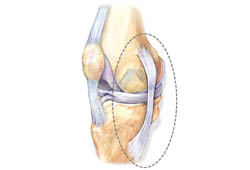 Its primary function is to resist valgus (twisting outward away from the midline) and external rotation forces of the tibia in relation to the femur. The mechanism for MCL injury is typically a large valgus and/or external rotation force that is suddenly placed on the knee joint. Injuries to the MCL range in severity from a few torn fibers to complete disunity of the ligament.
História e exame físico
Principais fatores diagnósticos
- injury due to excessive or repetitive valgus loading of MCL
- medial knee pain
- joint effusion
- tenderness
- laxity on valgus stress testing
Outros fatores diagnósticos
- ecchymosis
- audible pop or tearing sensation at time of injury
- difficulty walking
- instability symptoms of knee
- mechanical knee symptoms
- knee deformity
- positive anterior drawer test
- positive posterior drawer test
- positive Lachman test
- positive pivot shift test
- joint line tenderness
- chronic pain
Fatores de risco
- participation in activities involving valgus stress at the knee joint
- age 20 to 35 years
- age 55 to 70 years
- weak muscles that cross the medial aspect of knee
Investigações diagnósticas
Primeiras investigações a serem solicitadas
- plain x-rays of knee
- stress x-rays of knee
Investigações a serem consideradas
- MRI of knee
Novos exames
- diagnostic ultrasound
Algoritmo de tratamento
isolated grade I injury
isolated grade II injury
isolated grade III injury
MCL + anterior cruciate ligament (ACL) combined injury
MCL + nonanterior cruciate ligament (ACL) combined injury
persistent high-grade valgus laxity after ≥3 months
Colaboradores
Autores
Sanjeev Bhatia, MD

Director, Hip & Knee Joint Preservation Center
Northwestern Medicine Central DuPage Hospital
Northwestern University Feinberg School of Medicine
Warrenville
IL
Declarações
SB receives publication royalties from the following Nova publication: Ligamentous Injuries of the Knee. SB has stock ownership in: AI Digital Ventures, LLC; Edge Surgical; TDA Ventures, LLC; and Joint Preservation Innovations, LLC. SB is on the Board of Directors for AI Digital Ventures, LLC and Joint Preservation Innovations, LLC. He also holds patents pertaining to bone resection related technology. He has received other financial or material support from Smith & Nephew and Graymont Medical, LLC, and has been a paid speaker for the latter. SB also is a board or committee member for the American Academy of Orthopaedic Surgeons and the Arthroscopy Association of North America.
Nikhil N. Verma, MD

Professor
Department of Orthopedic Surgery
Section of Sports Medicine
Rush University Medical Center
Chicago
IL
Declarações
NNV declares the following competing interests: American Orthopaedic Society for Sports Medicine: board or committee member; American Shoulder and Elbow Surgeons: board or committee member; Arthrex, Inc: research support; Arthroscopy: editorial or governing board; publishing royalties, financial or material support; Arthroscopy Association Learning Center Committee: board or committee member; Arthrosurface: research support; Cymedica: stock or stock options; DJ Orthopaedics: research support; Journal of Knee Surgery: editorial or governing board; Minivasive: paid consultant, stock or stock options; Omeros: stock or stock options; Orthospace: paid consultant; Ossur: research support; SLACK Incorporated: editorial or governing board; Smith & Nephew: IP royalties, paid consultant; Smith & Nephew, Athletico, ConMed Linvatec, Miomed, Mitek: research support; Vindico Medical-Orthopedics Hyperguide: publishing royalties, financial or material support.
Revisores
Jason M. Scopp, MD
Director
Joint Preservation Center at Peninsula Orthopedic Associates
Salisbury
MD
Declarações
JMS declares that he has no competing interests.
Créditos aos pareceristas
Os tópicos do BMJ Best Practice são constantemente atualizados, seguindo os desenvolvimentos das evidências e das diretrizes. Os pareceristas aqui listados revisaram o conteúdo pelo menos uma vez durante a história do tópico.
Declarações
As afiliações e declarações dos pareceristas referem--se ao momento da revisão.
Referências
Principais artigos
O'Donoghue DH. An analysis of end results of surgical treatment of major injuries to the ligaments of the knee. J Bone Joint Surg. 1955 Jan;37-A(1):1-13. Resumo
American Medical Association, Committee on the Medical Aspects of Sports. Standard nomenclature of athletic injuries. Physical Therapy. 1969 Nov;49(11):1323.Texto completo
Fetto JF, Marshall JL. Medial collateral ligament injuries of the knee: a rationale for treatment. Clin Orthop Relat Res. 1978 May;(132):206-18. Resumo
Warren RF, Marshall JL. Injuries of the anterior cruciate and medial collateral ligaments of the knee. A long-term follow-up of 86 cases - part II. Clin Orthop Relat Res. 1978 Oct;(136):198-211. Resumo
Phisitkul P, James SL, Wolf BR, et al. MCL injuries of the knee: current concepts review. Iowa Orthop J. 2006 Feb;26:77-90.Texto completo Resumo
American College of Radiology. ACR appropriateness criteria: acute trauma to the knee. 2019 [internet publication].Texto completo
Wijdicks CA, Griffith CJ, Johansen S, et al. Injuries to the medial collateral ligament and associated medial structures of the knee. J Bone Joint Surg Am. 2010 May;92(5):1266-80. Resumo
Halinen J, Lindahl J, Hirvensalo E, et al. Operative and nonoperative treatments of medial collateral ligament rupture with early anterior cruciate ligament reconstruction: a prospective randomized study. Am J Sports Med. 2006 Jul;34(7):1134-40. Resumo
Marchant MH Jr, Tibor LM, Sekiya JK, et al. Management of medial-sided knee injuries, part 1: medial collateral ligament. Am J Sports Med. 2011 May;39(5):1102-13. Resumo
Giannotti BF, Rudy T, Graziano J. The non-surgical management of isolated medial collateral injuries of the knee. Sports Med Arthrosc. 2006 Jun;14(2):74-7. Resumo
Artigos de referência
Uma lista completa das fontes referenciadas neste tópico está disponível para os usuários com acesso total ao BMJ Best Practice.
Diagnósticos diferenciais
- Medial meniscus tear
- Soft tissue contusion of the medial knee
- Tibial plateau fracture
Mais Diagnósticos diferenciaisDiretrizes
- The posteromedial corner of the knee: an international expert consensus statement on diagnosis, classification, treatment, and rehabilitation
- Treatment of combined injuries to the ACL and the MCL complex: a consensus statement of the Ligament Injury Committee of the German Knee Society (DKG)
Mais Diretrizes Conectar-se ou assinar para acessar todo o BMJ Best Practice
O uso deste conteúdo está sujeito ao nosso aviso legal