Resumo
Definição
História e exame físico
Principais fatores diagnósticos
- aneurisma do septo atrial
- afecções cardíacas congênitas
- acidente vascular cerebral (AVC) em idades <60 anos
- exame cardíaco anormal
- trombose venosa profunda
Outros fatores diagnósticos
- sintomas de descompressão relacionados ao mergulho
- sensação de frio no membro
- dor no membro
- dispneia na posição vertical na síndrome de platipneia-ortodeoxia
Fatores de risco
- aneurisma do septo atrial
- afecções cardíacas congênitas
- história familiar de enxaqueca
- enxaqueca
- história familiar do FOP
- apneia obstrutiva do sono
Investigações diagnósticas
Primeiras investigações a serem solicitadas
- ecocardiografia transtorácica com Doppler colorido e injeção de contraste
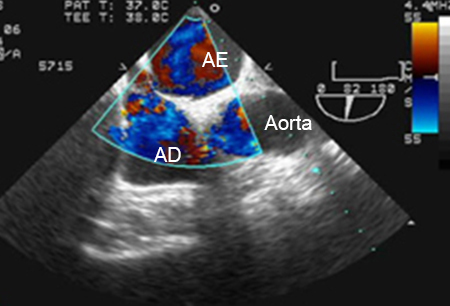
- ecocardiografia transesofágica com Doppler colorido e injeção de contraste
Investigações a serem consideradas
- ecocardiografia intracardíaca
- ultrassonografia do membro inferior
- ressonância nuclear magnética (RNM) do membro inferior
- ecocardiografia transesofágica com mesa inclinável
Novos exames
- Doppler transcraniano
Algoritmo de tratamento
assintomático com baixo risco de eventos trombóticos (e sem ocupação de alto risco)
assintomático com alto risco de evento trombótico (não em profissão de alto risco)
AVC criptogênico
profissão de alto risco
Colaboradores
Autores
Kul Aggarwal, MD, MRCP, FACC

Professor of Clinical Medicine
University of Missouri
Columbia
MO
Declarações
KA is the author of a reference cited in this topic.
Poorna R Karuparthi, MD, FACC
Clinical Assistant Professor
University of Missouri Hospital
Division of Cardiology
University of Missouri
Columbia
MO
Disclosures
PRK declares that he has no competing interests.
Acknowledgements
Professor Kul Aggarwal and Poorna R Karuparthi would like to gratefully acknowledge Dr Vibhuti Singh, a previous contributor to this topic.
Disclosures
VS declares that he has no competing interests.
Peer reviewers
Navin Nanda, MD
Professor of Medicine
Director Heart Station and Echocardiography Laboratories
University of Alabama at Birmingham
Birmingham
AL
Disclosures
NN declares that he has no competing interests.
Andrew Turley, MB ChB
Cardiology Specialist Registrar
The James Cook University Hospital
Middlesbrough
UK
Disclosures
AT declares that he has no competing interests.
Peer reviewer acknowledgements
BMJ Best Practice topics are updated on a rolling basis in line with developments in evidence and guidance. The peer reviewers listed here have reviewed the content at least once during the history of the topic.
Disclosures
Peer reviewer affiliations and disclosures pertain to the time of the review.
References
Key articles
Silvestry FE, Cohen MS, Armsby LB, et al. Guidelines for the echocardiographic assessment of atrial septal defect and patent foramen ovale: from the American Society of Echocardiography and Society for Cardiac Angiography and Interventions. J Am Soc Echocardiogr. 2015 Aug;28(8):910-58.Full text Abstract
Meier B, Kalesan B, Mattle HP, et al. Percutaneous closure of patent foramen ovale in cryptogenic embolism. N Engl J Med. 2013 Mar 21;368(12):1083-91. Abstract
Reference articles
A full list of sources referenced in this topic is available to users with access to all of BMJ Best Practice.
Differentials
- Malformação arteriovenosa (MAV) no pulmão
More DifferentialsGuidelines
- 2020 ESC guidelines for the management of adult congenital heart disease
- 2021 guideline for the prevention of stroke in patients with stroke and transient ischemic attack
More Guidelines Log in or subscribe to access all of BMJ Best Practice
Use of this content is subject to our disclaimer