Resumo
Definição
História e exame físico
Principais fatores diagnósticos
- hemorragia digestiva
Outros fatores diagnósticos
- idade >60 anos
- dispneia
- fadiga
- palidez
- taquicardia
- hipotensão
Fatores de risco
- insuficiência renal crônica/doença renal em estágio terminal
- Doença de von Willebrand
- estenose aórtica
- esclerodermia
- doença cardiovascular
- idade mais avançada
Investigações diagnósticas
Primeiras investigações a serem solicitadas
- Hemograma completo
- tipagem sanguínea e prova cruzada
- ureia e eletrólitos
- estado de coagulação
- Endoscopia digestiva alta (EDA)
- enteroscopia convencional
- colonoscopia
Investigações a serem consideradas
- enteroscopia por cápsula sem fio
- Angiotomografia
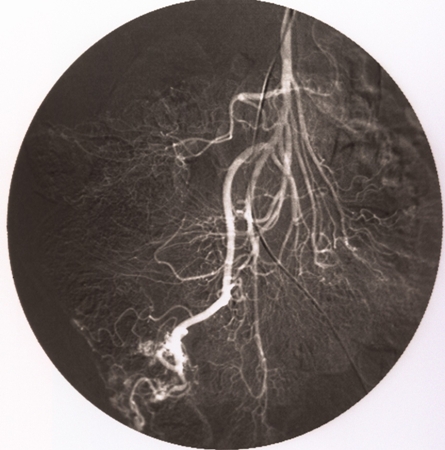
- angiografia mesentérica seletiva
- cintilografia com o radionuclídeo tecnécio Tc-99m
- enterografia por tomografia computadorizada (TC)
- enteroscopia assistida por dispositivo
Novos exames
- angiografia por ressonância magnética
Algoritmo de tratamento
pacientes hemodinamicamente instáveis (hemorragia intensa)
pacientes hemodinamicamente estáveis
sangramento recorrente
Colaboradores
Autores
Reena Sidhu, MD, FRCP
Consultant Gastroenterologist
Royal Hallamshire Hospital
Sheffield Teaching Hospitals NHS Foundation Trust
Hon Professor
Division of Clinical Medicine
School of Medicine and Population Health
University of Sheffield
Sheffield
UK
Declarações
RS has received speaker fees and congress travel grants (Dr Falk 2021 & 2023). RS has attended ANx Robotica symposium 2023. RS is an author of a reference cited in this topic.
Nicoletta Nandi, MD
Clinical Fellow
Academic Unit of Gastroenterology
Sheffield Teaching Hospitals NHS Foundation Trust
Sheffield
UK
Declarações
NN declares that she has no competing interests.
Agradecimentos
Prof Reena Sidhu and Dr Nicoletta Nandi would like to gratefully acknowledge Dr Aidan Shaw, Dr Heather Lee, and Dr William Speake, previous contributors to this topic.
Declarações
AS, HL, and WS declare that they have no competing interests.
Revisores
Brooks D. Cash, MD, AGAF, FACG, FACP, FASGE
BMJ Best Practice Gastroenterology expert panel member
Professor of Medicine
University of Texas Health Science Center at Houston
Houston
TX
Declarações
BDC declares that he has no competing interests.
Créditos aos pareceristas
Os tópicos do BMJ Best Practice são constantemente atualizados, seguindo os desenvolvimentos das evidências e das diretrizes. Os pareceristas aqui listados revisaram o conteúdo pelo menos uma vez durante a história do tópico.
Declarações
As afiliações e declarações dos pareceristas referem--se ao momento da revisão.
Referências
Principais artigos
Gerson LB, Fidler JL, Cave DR, et al. ACG clinical guideline: diagnosis and management of small bowel bleeding. Am J Gastroenterol. 2015 Sep;110(9):1265-87; quiz 1288.Texto completo Resumo
Sengupta N, Kastenberg DM, Bruining DH, et al. The role of imaging for GI bleeding: ACG and SAR consensus recommendations. Radiology. 2024 Mar;310(3):e232298. Resumo
Triantafyllou K, Gkolfakis P, Gralnek IM, et al. Diagnosis and management of acute lower gastrointestinal bleeding: European Society of Gastrointestinal Endoscopy (ESGE) guideline. Endoscopy. 2021 Aug;53(8):850-68.Texto completo Resumo
Artigos de referência
Uma lista completa das fontes referenciadas neste tópico está disponível para os usuários com acesso total ao BMJ Best Practice.
Diagnósticos diferenciais
- Doença diverticular
- Câncer colorretal
- Tumores estromais gastrointestinais (TEGI) e leiomiomas:
Mais Diagnósticos diferenciaisDiretrizes
- The role of imaging for GI bleeding: ACG and SAR consensus recommendations
- Management of patients with acute lower gastrointestinal bleeding
Mais Diretrizes Conectar-se ou assinar para acessar todo o BMJ Best Practice
O uso deste conteúdo está sujeito ao nosso aviso legal