Resumo
Definição
História e exame físico
Principais fatores diagnósticos
- presença de fatores de risco
- apresentação na primeira infância
Outros fatores diagnósticos
- taquipneia/dispneia
- deficit no crescimento
- intolerância ao exercício
- pressão de pulso ampliada
- sopro contínuo do tipo mecânico/sopro de Gibson em lactentes nascidos a termo
- apneia
- pressão arterial (PA) diastólica baixa
- irritabilidade
- diaforese
- aumento dos sintomas respiratórios com infecção do trato respiratório superior
- sopro auscultado apenas durante a sístole
- precórdio hiperdinâmico
- frêmito sistólico
- terceira bulha cardíaca auscultada no ápice
- ruflar mesodiastólico no ápice
- pulsos periféricos amplos
- estertores pulmonares
Fatores de risco
- prematuridade
- rubéola materna
- sexo feminino
- síndrome do desconforto respiratório (SDR)
- altitudes elevadas
- história familiar
- raça negra
Investigações diagnósticas
Primeiras investigações a serem solicitadas
- radiografia torácica
- eletrocardiograma (ECG)
- ecocardiograma
Investigações a serem consideradas
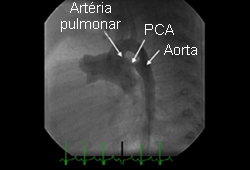
- cateterismo cardíaco e angiografia
Algoritmo de tratamento
lactentes prematuros: hemodinamicamente estáveis
lactentes prematuros: hemodinamicamente significativa
lactentes prematuros: contraindicação à farmacoterapia ou alterações hemodinâmicas persistentes sem resposta clínica à farmacoterapia inicial
lactentes nascidos a termo e crianças: ductos pequenos a moderados
lactentes nascidos a termo e crianças: ductos grandes e/ou bebês sintomáticos muito pequenos para o fechamento com dispositivo
adultos
Colaboradores
Autores
Kenneth M. Coca, MD
Pediatric Cardiology Fellow
Johns Hopkins All Children’s Hospital
Saint Petersburg
FL
Declarações
KMC declares that he has no competing interests.
Joyce T. Johnson, MD, MS
Director, Fetal Cardiology
Johns Hopkins All Children’s Hospital
Saint Petersburg
FL
Declarações
JTJ declares that she has no competing interests.
Agradecimentos
Dr Kenneth M. Coca and Dr Joyce T. Johnson would like to gratefully acknowledge Dr Anji T. Yetman and Dr Nelangi M. Pinto, previous contributors to this topic.
Declarações
ATY declares that she has no competing interests.
Revisores
Michael Cheung, BSc (Hons), MB ChB, MRCP, FRACP
Acting Head
Department of Cardiology
Royal Children's Hospital
Melbourne
Australia
Declarações
MC declares that he has no competing interests.
Rajat Bhatt, MD
Assistant Professor
Internal Medicine
Texas Tech University Health Sciences Center (TTUHSC)
Lubbock
TX
Declarações
RB declares that he has no competing interests.
Henry M. Sondheimer, MD
Professor of Pediatrics
Clinical Director
Pediatric Cardiology
The Children's Hospital
Denver
CO
Declarações
HMS declares that he has no competing interests.
Créditos aos pareceristas
Os tópicos do BMJ Best Practice são constantemente atualizados, seguindo os desenvolvimentos das evidências e das diretrizes. Os pareceristas aqui listados revisaram o conteúdo pelo menos uma vez durante a história do tópico.
Declarações
As afiliações e declarações dos pareceristas referem--se ao momento da revisão.
Referências
Principais artigos
Baumgartner H, De Backer J, Babu-Narayan SV, et al. 2020 ESC guidelines for the management of adult congenital heart disease. Eur Heart J. 2021 Feb 11;42(6):563-645.Texto completo
Ambalavanan N, Aucott SW, Salavitabar A, et al. Patent ductus arteriosus in preterm infants. Pediatrics. 2025 May 1;155(5):e2025071425.Texto completo Resumo
Wilson WR, Gewitz M, Lockhart PB, et al. Prevention of viridans group streptococcal infective endocarditis: a scientific statement from the American Heart Association. Circulation. 2021 May 18;143(20):e963-78.Texto completo Resumo
John AS, Jackson JL, Moons P, et al. Advances in managing transition to adulthood for adolescents with congenital heart disease: a practical approach to transition program design: a scientific statement from the American Heart Association. J Am Heart Assoc. 2022 Apr 5;11(7):e025278.Texto completo Resumo
Artigos de referência
Uma lista completa das fontes referenciadas neste tópico está disponível para os usuários com acesso total ao BMJ Best Practice.
Diagnósticos diferenciais
- Zumbido venoso
- Fístula arterial coronariana
- Derivações no lado esquerdo (defeito do septo ventricular, defeito do septo atrioventricular)
Mais Diagnósticos diferenciaisDiretrizes
- Patent ductus arteriosus in preterm infants
- Pulmonary hypertension in congenital heart disease: a scientific statement
Mais Diretrizes Conectar-se ou assinar para acessar todo o BMJ Best Practice
O uso deste conteúdo está sujeito ao nosso aviso legal