Resumo
Definição
A má rotação intestinal é um termo utilizado para descrever todo um espectro de distúrbios de rotação e fixação que podem ocorrer durante o desenvolvimento embrionário.
As preocupações patológicas mais significativas nos casos de má rotação são a ausência de fixação intestinal no retroperitônio e uma base mesentérica estreita do intestino médio que predispõe à torção do intestino delgado na forma de volvo de intestino médio. Isso cria uma obstrução abrupta do duodeno, resultando em vômitos biliosos (verde-escuros).[Figure caption and citation for the preceding image starts]: Má rotação com volvo causando obstrução completa do duodeno que não corre à esquerda, como observado no exame contrastado do trato gastrointestinal superiorDo acervo de Dr. S.D. St Peter [Citation ends].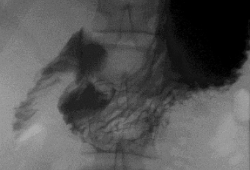
Se a torção na base também obstrui o fluxo da artéria mesentérica superior, todo o intestino delgado e o cólon proximal podem se tornar agudamente isquêmicos e subsequentemente necróticos dentro de algumas horas. Ligações cecais anormais à cavidade peritoneal superior direita (isto é, bandas de Ladd) podem cruzar a segunda porção do duodeno criando uma obstrução extraluminal de baixo grau do duodeno, que pode se manifestar com sinais de obstrução parcial.
Pacientes com má rotação apresentam risco de volvo e devem ser identificados sempre que possível, para permitir uma terapia apropriada.
História e exame físico
Principais fatores diagnósticos
- vômitos biliosos
- dor abdominal
Outros fatores diagnósticos
- lactentes com idade <1 ano
- exame abdominal normal
- distensão abdominal
- desconforto abdominal
- taquicardia com hipertensão
- taquicardia com hipotensão
- taquipneia
- perda de peso
- sangue escuro na fralda
Fatores de risco
- anormalidades embriológicas
Investigações diagnósticas
Primeiras investigações a serem solicitadas
- séries do trato gastrointestinal superior com contraste
- radiografias abdominais simples
Investigações a serem consideradas
- ultrassonografia
- radiografia do trato gastrointestinal inferior com contraste
- TC abdominal (com contraste oral e intravenoso)
- Gasometria arterial (incluindo lactato)
- Coagulação, tipagem e reserva de sangue ou prova cruzada
- Ureia e eletrólitos
- Hemograma completo
- proteína C-reativa
Algoritmo de tratamento
obstrução com isquemia
obstrução sem isquemia
volvo parcial ou intermitente ou bandas de Ladd obstrutivas
má rotação questionável ou achado assintomático
Colaboradores
Autores
Michael Stanton, MB BS, MD, FRCS (Paed Surg)
Consultant Paediatric Surgeon and Honorary Senior Lecturer
Department of Paediatric Surgery
University Hospital Southampton
Southampton
UK
Declarações
MS declares that he has no competing interests.
Agradecimentos
Dr Michael Stanton would like to gratefully acknowledge Dr Stephen Shew, Dr S.D. St Peter, Dr Fizan Abdullah, and Dr Omar Karim, previous contributors to this topic.
Declarações
SS is the author of two references cited in this topic. SDSP is the co-author of one reference cited in this topic. FA and OK declared that they had no competing interests.
Revisores
Casey M. Calkins, MD
Assistant Professor of Pediatric Surgery
The Medical College of Wisconsin
Children's Hospital and Health System
Milwaukee
WI
Declarações
CC declares that he has no competing interests.
Steve Rothenberg, MD
Chief of Pediatric Surgery
Chairman Department of Pediatrics
The Rocky Mountain Hospital for Children at Presbyterian/St. Luke's
Denver
CO
Declarações
SR declares that he has no competing interests.
KuoJen Tsao, MD
Assistant Professor
Department of Pediatric Surgery
University of Texas Health Science Center at Houston
Houston
TX
Declarações
KT declares that he has no competing interests.
Eric Nicholls, MD
Consultant Paediatric Surgeon
Paediatric Surgery
St George's Hospital
London
UK
Declarações
EN declares that he has no competing interests.
Créditos aos pareceristas
Os tópicos do BMJ Best Practice são constantemente atualizados, seguindo os desenvolvimentos das evidências e das diretrizes. Os pareceristas aqui listados revisaram o conteúdo pelo menos uma vez durante a história do tópico.
Declarações
As afiliações e declarações dos pareceristas referem--se ao momento da revisão.
Referências
Principais artigos
Shew SB. Surgical concerns in malrotation and midgut volvulus. Pediatr Radiol. 2009;39(suppl 2):S167-71. Resumo
Expert Panel on Pediatric Imaging, Alazraki AL, Rigsby CK, et al. ACR appropriateness criteria® vomiting in infants. J Am Coll Radiol. 2020 Nov;17(11s):S505-15.Texto completo Resumo
Graziano K, Islam S, Dasgupta R, et al. Asymptomatic malrotation: diagnosis and surgical management: an American Pediatric Surgical Association outcomes and evidence based practice committee systematic review. J Pediatr Surg. 2015 Oct;50(10):1783-90. Resumo
Ooms N, Matthyssens LE, Draaisma JM, et al. Laparoscopic treatment of intestinal malrotation in children. Eur J Pediatr Surg. 2016 Aug;26(4):376-81.Texto completo Resumo
Artigos de referência
Uma lista completa das fontes referenciadas neste tópico está disponível para os usuários com acesso total ao BMJ Best Practice.
Diagnósticos diferenciais
- Atresia/membrana duodenal
- Intussuscepção
- Refluxo gastroesofágico
Mais Diagnósticos diferenciaisDiretrizes
- ACR appropriateness criteria® vomiting in infants
- Clinical practice guidelines for antimicrobial prophylaxis in surgery
Mais DiretrizesVideos
Demonstração animada da inserção de sonda nasogástrica
Mais vídeos Conectar-se ou assinar para acessar todo o BMJ Best Practice
O uso deste conteúdo está sujeito ao nosso aviso legal