Resumo
Definição
História e exame físico
Principais fatores diagnósticos
- vômitos
- passagem explosiva de fezes/gases
- distensão abdominal
- eliminação tardia de mecônio
- deficit no crescimento
- constipação crônica
Outros fatores diagnósticos
- febre
- diarreia
- sangue nas fezes
- desconforto abdominal
- choque séptico
- perfuração cecal ou apendicular
- síndrome do tampão meconial
Fatores de risco
- Síndrome de Down
- sexo masculino
- história familiar
- Síndrome de Shan-Waardenburg
- Síndrome de Mowat-Wilson
- Síndrome de Haddad
- Neoplasia endócrina múltipla tipo 2 (NEM2)
Investigações diagnósticas
Primeiras investigações a serem solicitadas
- radiografia abdominal simples
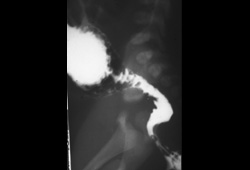
- enema com contraste
Investigações a serem consideradas
- biópsia retal
- manometria anorretal
Algoritmo de tratamento
doença de segmento curto/segmento longo: sem enterocolite
doença de segmento curto/segmento longo: com enterocolite
aganglionose colônica total
Colaboradores
Autores
Lily S. Cheng, MD
Assistant Professor
University of Virginia
Charlottesville
VA
Declarações
LSC is the co-author of a reference cited in this topic.
Kristy Lynn Rialon, MD
Associate Professor of Surgery
Division of Pediatric Surgery
Texas Children’s Hospital
Baylor College of Medicine
Houston
TX
Declarações
KLR declares that she has no competing interests.
Agradecimentos
Dr Lily S. Cheng and Dr Kristy Lynn Rialon would like to gratefully acknowledge Dr Andrea Bischoff and Dr Alberto Peña, the previous contributors to this topic. AB and AP are co-authors of several references cited in this topic.
Revisores
Ivo de Blaauw, MD, PHD
Pediatric Surgeon
Radboud University Nijmegen
Academic Medical Center
Nijmegen
Netherlands
Declarações
IdB declares that he has no competing interests.
Jose Manuel Tovilla, MD
Colorectal Pediatric Surgeon
Chief of the Colorectal Clinic
Hospital Infantil de Mexico Federico Gomez
Mexico
Declarações
JMT declares that he has no competing interests.
Daniel P. Doody, MD
Pediatric Surgeon
Department of Pediatric Surgery
Massachusetts General Hospital
Boston
MA
Declarações
DPD declares that he has no competing interests.
Créditos aos pareceristas
Os tópicos do BMJ Best Practice são constantemente atualizados, seguindo os desenvolvimentos das evidências e das diretrizes. Os pareceristas aqui listados revisaram o conteúdo pelo menos uma vez durante a história do tópico.
Declarações
As afiliações e declarações dos pareceristas referem--se ao momento da revisão.
Referências
Principais artigos
Montalva L, Cheng LS, Kapur R, et al. Hirschsprung disease. Nat Rev Dis Primers. 2023 Oct 12;9(1):54. Resumo
Kawaguchi AL, Guner YS, Sømme S, et al. Management and outcomes for long-segment Hirschsprung disease: a systematic review from the APSA outcomes and evidence based practice committee. J Pediatr Surg. 2021 Sep;56(9):1513-23.Texto completo Resumo
Gosain A, Frykman PK, Cowles RA, et al. Guidelines for the diagnosis and management of Hirschsprung-associated enterocolitis. Pediatr Surg Int. 2017 May;33(5):517-21.Texto completo Resumo
Kyrklund K, Sloots CEJ, de Blaauw I, et al. ERNICA guidelines for the management of rectosigmoid Hirschsprung's disease. Orphanet J Rare Dis. 2020 Jun 25;15(1):164.Texto completo Resumo
Granström AL, Irvine W, Hoel AT, et al. Ernica clinical consensus statements on total colonic and intestinal aganglionosis. J Pediatr Surg. 2024 Oct;59(10):161565.Texto completo Resumo
Artigos de referência
Uma lista completa das fontes referenciadas neste tópico está disponível para os usuários com acesso total ao BMJ Best Practice.
Diagnósticos diferenciais
- Síndrome do tampão meconial
- Fibrose cística (íleo meconial)
- Síndrome do cólon esquerdo curto
Mais Diagnósticos diferenciaisDiretrizes
- ERNICA clinical consensus statements on total colonic and intestinal aganglionosis
- Management and outcomes for long-segment Hirschsprung disease: a systematic review from the APSA outcomes and evidence based practice committee
Mais Diretrizes Conectar-se ou assinar para acessar todo o BMJ Best Practice
O uso deste conteúdo está sujeito ao nosso aviso legal