Resumo
Definição
História e exame físico
Principais fatores diagnósticos
- presença de fatores de risco
- dor na tuberosidade tibial
- sensibilidade localizada
Outros fatores diagnósticos
- limitação da atividade
- edema localizado
- calor localizado
- proeminência da tuberosidade tibial
- dor na tuberosidade com extensão do joelho contra resistência
Fatores de risco
- homens adolescentes
- participação em atividades atléticas
- história de doença de Osgood-Schlatter no joelho contralateral
- posição elevada da patela (patela alta)
- inserção tibial mais ampla/mais proximal do tendão patelar
- aumento da torção tibial externa
Investigações diagnósticas
Primeiras investigações a serem solicitadas
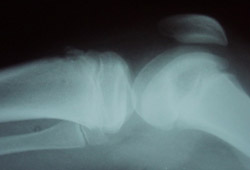
- radiografias simples
Investigações a serem consideradas
- ultrassonografia
- RNM
Algoritmo de tratamento
estágio inicial
progressivo ou estágio avançado
persistência da dor no final da adolescência ou na fase adulta
Colaboradores
Autores
Alexander Golant, MD

Attending Physician
Department of Orthopaedics and Rehabilitation
New York-Presbyterian-Queens
Flushing
Assistant Professor of Clinical Orthopaedic Surgery
Weill Medical College of Cornell University
New York
NY
Declarações
AG declares that he has no competing interests.
Jeffrey Rosen, MD
Chairman
Department of Orthopaedics and Rehabilitation
New York-Presbyterian-Queens
Flushing
Associate Professor of Clinical Orthopaedic Surgery
Weill Medical College of Cornell University
New York
NY
Declarações
JR is an author of a reference cited in this topic.
Agradecimentos
Dr Jeffrey Rosen and Dr Alexander Golant would like to gratefully acknowledge the assistance of Jonathan Naysan. JN declares that he has no competing interests.
Revisores
Paul M. Sethi, MD
Orthopedic Surgeon
Orthopedic and Neurosurgery Specialists PC
Greenwich
CT
Declarações
PMS declares that he has no competing interests.
Andreas Roposch, MD, MSc, FRCS
Consultant Orthopaedic Surgeon
Reader in Clinical Epidemiology and Surgery
UCL Institute of Child Health and Great Ormond Street Hospital for Children NHS Trust
London
UK
Declarações
AR declares that he has no competing interests.
Créditos aos pareceristas
Os tópicos do BMJ Best Practice são constantemente atualizados, seguindo os desenvolvimentos das evidências e das diretrizes. Os pareceristas aqui listados revisaram o conteúdo pelo menos uma vez durante a história do tópico.
Declarações
As afiliações e declarações dos pareceristas referem--se ao momento da revisão.
Referências
Principais artigos
Gholve PA, Scher DM, Khakharia S, et al. Osgood Schlatter syndrome. Curr Opin Pediatr. 2007;19:44-50. Resumo
Pihlajamäki HK, Mattila VM, Parviainen M, et al. Long-term outcome of surgical treatment of unresolved Osgood-Schlatter disease in young men. J Bone Joint Surg Am. 2009;91:2350-2358. Resumo
Artigos de referência
Uma lista completa das fontes referenciadas neste tópico está disponível para os usuários com acesso total ao BMJ Best Practice.
Diagnósticos diferenciais
- Fratura da tuberosidade tibial
- Hipertrofia do coxim gorduroso/pinçamento (doença de Hoffa)
- Apofisite de tração do polo patelar inferior (síndrome de Sinding-Larsen e Johansson)
Mais Diagnósticos diferenciais Conectar-se ou assinar para acessar todo o BMJ Best Practice
O uso deste conteúdo está sujeito ao nosso aviso legal