Resumo
Definição
A ictiose é um termo descritivo para pele seca e escamosa que, em alguns casos, pode assemelhar-se a escamas de peixe (o termo "ichthys" em grego significa "peixe"). As ictioses hereditárias são um grupo de doenças caracterizadas pela descamação da pele como parte do quadro clínico. O defeito subjacente, o modo de herança, a natureza e a extensão da descamação diferem entre os vários tipos. Por conta dessas diferenças, a investigação e o tratamento variam dependendo do quadro clínico.
A ictiose também pode ser adquirida como resultado de doenças subjacentes ou do uso de determinados medicamentos.[Figure caption and citation for the preceding image starts]: Descamação espessa do tipo placa do membro inferior de um paciente com ictiose vulgarDo acervo do Dr. Timothy Patton; usado com permissão [Citation ends].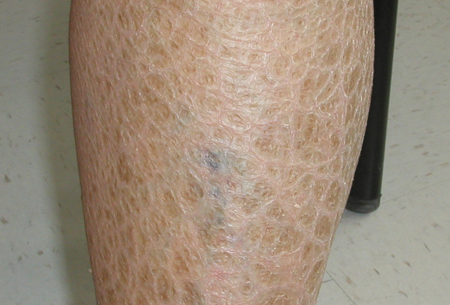
Em 2025, propôs-se a terminologia Epidermal Differentiation Disorders (EDDs) para substituir o termo ictiose, uma vez que ela descreve de forma mais adequada essa ampla família de doenças e sua patogênese.[1]
História e exame físico
Principais fatores diagnósticos
- descamação
- alterações cutâneas no nascimento (ictiose congênita)
- início na primeira infância (na ictiose vulgar e na ictiose ligada ao cromossomo X)
- início na fase adulta (na ictiose adquirida)
- sexo masculino
- história familiar de ictiose
Outros fatores diagnósticos
- história de atopia
- história de doença sistêmica associada
- história de infecção associada
- uso de determinados medicamentos
- história de linfoma ou outra neoplasia maligna
- alopecia e ectrópio na ictiose lamelar
- criptorquidia e opacidades corneanas
- surdez, deficiência intelectual, defeitos nos membros, epilepsia, baixa estatura
Fatores de risco
- história familiar positiva
- consanguinidade parental
- uso de determinados medicamentos
- história de linfoma ou outra neoplasia maligna
- história de doença sistêmica associada
- história de HIV ou hanseníase
Investigações diagnósticas
Primeiras investigações a serem solicitadas
- teste genético
- sulfato de colesterol sérico
- eletroforese de lipoproteínas
- atividade da esteroide sulfatase
Investigações a serem consideradas
- ácido fitânico sérico
- estudos de imagem ou outros exames
Algoritmo de tratamento
ictiose primária (genética)
ictiose secundária (adquirida)
Colaboradores
Autores
Fernanda Bellodi Schmidt, MD
Assistant Professor
Director of Pediatric Dermatology
Dr. Phillip Frost Department of Dermatology and Cutaneous Surgery
University of Miami Miller School of Medicine
Miami, FL
Declarações
FBS is a principal investigator in an ichthyosis clinical trial sponsored by Timber Pharmaceuticals and is a principal investigator in an epidermolysis bullosa clinical trial sponsored by Anterogen Co. FBS lectures on various topics within the area of paediatric dermatology at the World Congress of Pediatric Dermatology, American Academy of Dermatology Annual Conference, American Academy of Dermatology Innovation Academy, and Masters of Pediatric Dermatology.
Elisa Secamilli, MD, PhD
Assistant Professor
Director of Pediatric Dermatology
Division of Dermatology, Department of Internal Medicine
University of Campinas
Brazil
Declarações
ES has no competing interests.
Agradecimentos
Dr Fernanda Schmidt and Dr Elisa Secamilli would like to gratefully acknowledge Dr Timothy Patton, Dr Brittany Craiglow, and Dr Moise Levy, previous contributors to this topic.
Declarações
TP declared that he had no competing interests. BC declared that she is a member of the Foundation for Ichthyosis and Related Skin Types Advisory Board. BC is an author of a reference cited in this topic. MLL declared that he is the Drug Monitoring Committee Chair for Amgen, is on the advisory board for Arcutis, Pelthos, and Regeneron, has participated or will participate as an investigator for Castle Creek, Janssen, and Rheacell, and is a section editor and author for UpToDate. MLL also holds a patent for ‘Identification of Mutations in the Nemo Gene in Human Incontinentia Pigmenti’ (US patent #6,824,972).
Revisores
David Cassarino, MD, PhD
Assistant Professor
Department of Pathology and Laboratory Medicine
University of California
Los Angeles, CA
Declarações
DC declares that he has no competing interests.
Thierry Simonart, MD, PhD
Physician
Department of Dermatology
Erasme University Hospital
Brussels
Belgium
Declarações
TS declares that he has no competing interests.
Créditos aos pareceristas
Os tópicos do BMJ Best Practice são constantemente atualizados, seguindo os desenvolvimentos das evidências e das diretrizes. Os pareceristas aqui listados revisaram o conteúdo pelo menos uma vez durante a história do tópico.
Declarações
As afiliações e declarações dos pareceristas referem--se ao momento da revisão.
Referências
Principais artigos
Akiyama M, Choate K, Hernández-Martín Á, et al. Nonsyndromic epidermal differentiation disorders: a new classification toward pathogenesis-based therapy. Br J Dermatol. 2025 Sep 18;193(4):619-41.Texto completo Resumo
Butala S, Mazereeuw-Hautier J, Paller AS. Ichthyosis: presentation and management. Curr Opin Pediatr. 2023 Aug 1;35(4):467-74. Resumo
Oji V, Tadini G, Akiyama M, et al. Revised nomenclature and classification of inherited ichthyoses: results of the First Ichthyosis Consensus Conference in Sorèze 2009. J Am Acad Dermatol. 2010 Oct;63(4):607-41. Resumo
Mazereeuw-Hautier J, Paller AS, Dreyfus I, et al. Management of congenital ichthyoses: guidelines of care: part one: 2024 update. Br J Dermatol. 2025 Jun 20;193(1):16-27. Resumo
Mazereeuw-Hautier J, Paller AS, O'Toole E, et al. Management of congenital ichthyoses: guidelines of care: part two: 2024 update. Br J Dermatol. 2025 Jun 20;193(1):28-43. Resumo
Artigos de referência
Uma lista completa das fontes referenciadas neste tópico está disponível para os usuários com acesso total ao BMJ Best Practice.
Diagnósticos diferenciais
- Dermatite esteatótica (eczema craquele)
- Dermatite atópica
- Psoríase
Mais Diagnósticos diferenciaisDiretrizes
- Management of congenital ichthyoses: guidelines of care: part one: 2024 update
- Management of congenital ichthyoses: guidelines of care: part two: 2024 update
Mais Diretrizes Conectar-se ou assinar para acessar todo o BMJ Best Practice
O uso deste conteúdo está sujeito ao nosso aviso legal