Resumo
Definição
O AAA é uma dilatação patológica permanente da aorta com um diâmetro >1.5 vez o diâmetro anteroposterior (AP) esperado para esse segmento, considerando o sexo e o tamanho corporal do paciente.[1][2] O limiar mais comumente adotado é um diâmetro de 3 cm ou mais.[2][3] Mais de 90% dos aneurismas se originam abaixo das artérias renais.[4]
[Figure caption and citation for the preceding image starts]: Ultrassonografia de aneurisma da aorta abdominal (AAA) de 3.8 x 4.2 cmUniversity of Michigan, mais especificamente os casos do Dr. Upchurch, representando os Departamentos de Cirurgia vascular e Radiologia [Citation ends].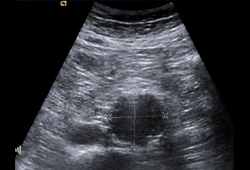
História e exame físico
Principais fatores diagnósticos
- presença de fatores de risco
- massa abdominal pulsátil e palpável
Outros fatores diagnósticos
- dor abdominal, nos flancos ou nas costas
- hipotensão
- perda de consciência
- palidez
- distensão abdominal
- febre
Fatores de risco
- tabagismo
- história familiar/hereditária
- envelhecimento
- sexo masculino (prevalência)
- sexo feminino (ruptura)
- distúrbios congênitos/do tecido conjuntivo
- hiperlipidemia
- Doença pulmonar obstrutiva crônica (DPOC)
- aterosclerose (ou seja, doença arterial coronariana [DAC], doença arterial oclusiva periférica)
- hipertensão
- obesidade central
- não diabético
- uso de antibióticos fluoroquinolonas
- aneurismas em qualquer outra parte do corpo
Investigações diagnósticas
Primeiras investigações a serem solicitadas
- ultrassonografia aórtica
Investigações a serem consideradas
- angiotomografia (ATG)
- prova cruzada
- exames de coagulação
- velocidade de hemossedimentação (VHS)/proteína C-reativa
- Hemograma completo
- hemoculturas
- tomografia computadorizada por emissão de pósitrons (PET-CT)
Algoritmo de tratamento
aneurisma roto da aorta abdominal (AAA)
aneurisma da aorta abdominal (AAA) sintomático, mas não roto
achado incidental de aneurisma da aorta abdominal (AAA) assintomático: <5.5 cm (mas não >4.0 cm e crescendo rapidamente)
achado incidental de aneurisma da aorta abdominal (AAA) assintomático: ≥5.5 cm (ou >4.0 cm e crescendo rapidamente)
Colaboradores
Consultores especialistas
Greg McMahon, MD, FRCS
Consultant Vascular Surgeon
University Hospitals of Leicester NHS Trust
Honorary Lecturer, College of Life Sciences
University of Leicester
Leicester
UK
Declarações
GM has received honoraria from Gore Medical and Terumo Aortic, manufacturers of abdominal aortic aneurysm stent grafts, for educational and training activities.
Acknowledgements
BMJ Best Practice would like to gratefully acknowledge the previous expert contributors, whose work has been retained in parts of the content:
Matt J. Bown MB BCh, MD, FRCS, PGCert (Bioinformatics)
Professor of Vascular Surgery
Department of Cardiovascular Sciences
University of Leicester, Leicester Royal Infirmary
Leicester
UK
Andrew Duncan MBBS, BSc, MRCS
Honorary Research Fellow
Department of Cardiovascular Sciences
University of Leicester
Leicester
UK
Declarações
MJB has grant funding from the British Heart Foundation and the National Institute for Health Research. AD declares that he has no competing interests.
Revisores
Ian Chetter, MBChb, FRCS (eng), MD, FRCS (Gen surg), PGCert Medical Ultrasound, PGDip Clinical Education
Chair of Surgery
University of Hull
Honorary Consultant Vascular Surgeon
Hull University Teaching Hospitals NHS Trust
Hull
UK
Declarações
IC declares he has no competing interests
Créditos aos pareceristas
Os tópicos do BMJ Best Practice são constantemente atualizados, seguindo os desenvolvimentos das evidências e das diretrizes. Os pareceristas aqui listados revisaram o conteúdo pelo menos uma vez durante a história do tópico.
Declarações
As afiliações e declarações dos pareceristas referem--se ao momento da revisão.
Editores
Annabel Sidwell
Section Editor, BMJ Best Practice
Declarações
AS declares that she has no competing interests.
Rachel Wheeler
Lead Section Editor, BMJ Best Practice
Declarações
RW declares that she has no competing interests.
Adam Mitchell
Drug Editor, BMJ Best Practice
Declarações
AM declares that he has no competing interests.
Julie Costello
Comorbidities Editor, BMJ Best Practice
Declarações
JC declares that she has no competing interests.
Referências
Principais artigos
Wanhainen A, Van Herzeele I, Bastos Goncalves F, et al. Editor's choice - European Society for Vascular Surgery (ESVS) 2024 clinical practice guidelines on the management of abdominal aorto-iliac artery aneurysms. Eur J Vasc Endovasc Surg. 2024 Feb;67(2):192-331.Texto completo Resumo
National Institute for Health and Care Excellence. Abdominal aortic aneurysm: diagnosis and management. March 2020 [internet publication].Texto completo
Royal College of Emergency Medicine. Management and transfer of patients with a diagnosis of ruptured abdominal aortic aneurysm to a specialist vascular centre. January 2019 [internet publication].Texto completo
Artigos de referência
Uma lista completa das fontes referenciadas neste tópico está disponível para os usuários com acesso total ao BMJ Best Practice.
Diagnósticos diferenciais
- Diverticulite
- Cólica ureteral
- Síndrome do intestino irritável (SII)
Mais Diagnósticos diferenciaisDiretrizes
- Abdominal aortic aneurysm: diagnosis and management
- Management and transfer of patients with a diagnosis of ruptured abdominal aortic aneurysm to a specialist vascular centre
Mais DiretrizesVideos
Intubação traqueal - Vídeo de demonstração
Ventilação com ressuscitador manual ("bolsa-válvula-máscara") - Vídeo de demonstração
Mais vídeosFolhetos informativos para os pacientes
Aneurisma da aorta abdominal
Mais Folhetos informativos para os pacientes Conectar-se ou assinar para acessar todo o BMJ Best Practice
O uso deste conteúdo está sujeito ao nosso aviso legal