Resumo
Definição
Este tópico aborda a parada cardíaca em adultos. A parada cardíaca súbita é um estado repentino de falha circulatória em decorrência do comprometimento da função sistólica cardíaca. É a resultado de 4 distúrbios no ritmo cardíaco: fibrilação ventricular, taquicardia ventricular (TV) sem pulso, atividade elétrica sem pulso e assistolia. Torsades de pointes é um subgrupo de TV polimórfica em pacientes com um intervalo QT prolongado subjacente, algumas vezes relacionado a hipomagnesemia.[Figure caption and citation for the preceding image starts]: Taquicardia ventricular monomórficaDo acervo pessoal do Dr. A. Askari e Dr. A. Krishnaswamy; usado com permissão [Citation ends]. [Figure caption and citation for the preceding image starts]: Torsades de pointesDo acervo pessoal do Dr. A. Askari; usado com permissão [Citation ends].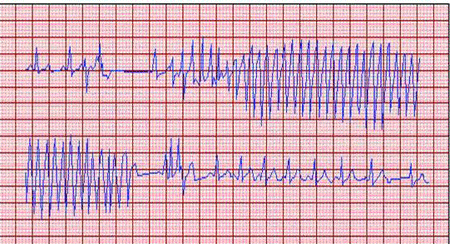
História e exame físico
Principais fatores diagnósticos
- paciente sem resposta clínica
- ausência de respiração normal
- ausência de circulação
- distúrbio do ritmo cardíaco
Fatores de risco
- doença arterial coronariana (DAC)
- disfunção ventricular esquerda
- idade
- cardiomiopatia hipertrófica (CMH)
- displasia arritmogênica do ventrículo direito (DAVD)
- síndrome do QT longo (SQTL)
- medicamentos que prolongam o intervalo QT ou causam distúrbios eletrolíticos
- emergência médica ou cirúrgica aguda
- intoxicação
- Síndrome de Brugada
- valvopatia cardíaca
- tabagismo
- história de transtornos alimentares
Investigações diagnósticas
Primeiras investigações a serem solicitadas
- monitoramento cardíaco contínuo
- Hemograma completo
- eletrólitos séricos
- gasometria arterial
- biomarcadores cardíacos
- ultrassonografia no local de atendimento (POCUS)
Investigações a serem consideradas
- eletrocardiograma (ECG)
- angiografia coronariana
- ecocardiograma
- teste ergométrico
- radiografia torácica
- análise toxicológica
- ressonância nuclear magnética cardíaca
- angiotomografia coronária
- eletrocardiograma de alta resolução (ECGAR)
- estudo eletrofisiológico
Algoritmo de tratamento
parada cardíaca não presenciada
ritmos chocáveis (taquicardia ventricular sem pulso ou fibrilação ventricular)
ritmos não chocáveis (atividade elétrica sem pulso ou assistolia)
retorno da circulação espontânea
sem retorno da circulação espontânea
Colaboradores
Autores
John Wink, MD
Emergency Physician
Alberta Health Services
Alberta
Canada
Declarações
JW declares that he has no competing interests.
Eddy Lang, MD
Professor and Department Head of Emergency Medicine
Cumming School of Medicine
University of Calgary
Alberta Health Services
Calgary
Canada
Declarações
EL declares that he has no competing interests.
Agradecimentos
Dr John Wink and Professor Eddy Lang would like to gratefully acknowledge Dr Amar Krishnaswamy and Dr Arman T. Askari, previous contributors to this topic.
Declarações
AK and ATA declare that they have no competing interests.
Revisores
Vaikom Mahadevan, MD
Professor of Medicine
Division of Cardiology
University of California
San Francisco
CA
Declarações
VM declares that he has no competing interests.
Anthony Aizer, MD, MS
Instructor
NYU Department of Medicine (Cardiology)
Leon H Charney Heart Rhythm Center and New York University
New York
NY
Declarações
AA declares that he has no competing interests.
Massimo F. Piepoli, MD, PhD, FESC
Honorary Clinical Senior Lecturer/Consultant
Department of Cardiology
Imperial College London
London
UK
Declarações
MFP declares that he has no competing interests.
Créditos aos pareceristas
Os tópicos do BMJ Best Practice são constantemente atualizados, seguindo os desenvolvimentos das evidências e das diretrizes. Os pareceristas aqui listados revisaram o conteúdo pelo menos uma vez durante a história do tópico.
Declarações
As afiliações e declarações dos pareceristas referem--se ao momento da revisão.
Referências
Principais artigos
Panchal AR, Bartos JA, Cabañas JG, et al. Part 3: adult basic and advanced life support: 2020 American Heart Association guidelines for cardiopulmonary resuscitation and emergency cardiovascular care. Circulation. 2020 Oct 20;142(16_suppl_2):S366-468.Texto completo Resumo
Martin SS, Aday AW, Allen NB, et al. 2025 heart disease and stroke statistics: a report of US and global data from the American Heart Association. Circulation. 2025 Feb 25;151(8):e41-660.Texto completo Resumo
Zeppenfeld K, Tfelt-Hansen J, de Riva M, et al. 2022 ESC Guidelines for the management of patients with ventricular arrhythmias and the prevention of sudden cardiac death. Eur Heart J. 2022 Oct 21;43(40):3997-4126.Texto completo Resumo
Al-Khatib SM, Stevenson WG, Ackerman MJ, et al. 2017 AHA/ACC/HRS guideline for management of patients with ventricular arrhythmias and the prevention of sudden cardiac death. Circulation. 2018 Sep 25;138(13):e272-391.Texto completo Resumo
Greif R, Bray JE, Djärv T, et al. 2024 International consensus on cardiopulmonary resuscitation and emergency cardiovascular care science with treatment recommendations: summary from the basic life support; advanced life support; pediatric life support; neonatal life support; education, implementation, and teams; and first aid task forces. Resuscitation. 2024 Dec;205:110414.Texto completo Resumo
Nolan JP, Sandroni C, Böttiger BW, et al. European Resuscitation Council and European Society of Intensive Care Medicine guidelines 2021: post-resuscitation care. Resuscitation. 2021 Apr;161:220-69.Texto completo Resumo
Artigos de referência
Uma lista completa das fontes referenciadas neste tópico está disponível para os usuários com acesso total ao BMJ Best Practice.
Diretrizes
- Critical care management of patients after cardiac arrest: a scientific statement from the American Heart Association and Neurocritical Care Society
- 2024 International consensus on cardiopulmonary resuscitation and emergency cardiovascular care science with treatment recommendations
Mais DiretrizesFolhetos informativos para os pacientes
Via aérea nasofaríngea (tubo de respiração no nariz)
Ventilação com ressuscitador manual ("bolsa-válvula-máscara")
Mais Folhetos informativos para os pacientesVideos
Punção de artéria radial - Vídeo de demonstração
Punção de artéria femoral - Vídeo de demonstração
Mais vídeos Conectar-se ou assinar para acessar todo o BMJ Best Practice
O uso deste conteúdo está sujeito ao nosso aviso legal