Resumo
Definição
A pitiríase rósea (PR) é uma doença cutânea inflamatória de etiologia incerta, embora um agente infeccioso desconhecido tenha sido sugerido. A PR manifesta-se como uma erupção inflamatória aguda e autolimitada, caracterizada na maioria dos pacientes por uma lesão grande e única, o "medalhão", seguida pela erupção de lesões ovais pápulo-escamosas menores.[Figure caption and citation for the preceding image starts]: Medalhão com distribuição clássica na parte superior do troncoDo acervo de Daniela Kroshinsky, MD, MPH; usado com permissão [Citation ends].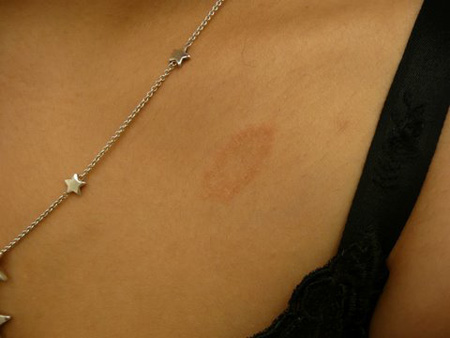 [Figure caption and citation for the preceding image starts]: Imagem ampliada do medalhãoDo acervo de Daniela Kroshinsky, MD, MPH; usado com permissão [Citation ends].
História e exame físico
Principais fatores diagnósticos
- medalhão
- prurido
- idade entre 10 e 35 anos
- duração de 2 a 12 semanas
- escama
- localizada no tronco e nos membros superiores
- padrão de distribuição no estilo de "árvore de natal"
- localizada na face, palmas das mãos, solas dos pés, mucosa
- erupção cutânea recorrente de aguda à subaguda
Outros fatores diagnósticos
- prazo de 2 semanas entre o medalhão e as novas lesões
- sexo feminino
- sintomas prodrômicos
- alteração na pigmentação (casos graves/pele de cor escura)
Fatores de risco
- idade entre 10 e 35 anos
- sexo feminino
Investigações diagnósticas
Investigações a serem consideradas
- biópsia de pele
- títulos de antiestreptolisina O
- microscopia com preparação de hidróxido de potássio (KOH) ou cultura fúngica
- reagina plasmática rápida/teste Venereal Disease Research Laboratory (VDRL)
Algoritmo de tratamento
sintomas leves a moderados
doença grave ou refratária
refratário a todos os outros tratamentos
Colaboradores
Autores
Daniela Kroshinsky, MD, MPH

Director of Inpatient Dermatology
Associate Professor of Dermatology
Massachusetts General Hospital
Harvard School of Medicine
Boston
MA
Declarações
DK declares that she has no competing interests.
Agradecimentos
Dr Dean S. Morrell would like to gratefully acknowledge Dr Eve Lowenstein, Dr Ladan Shahabi, and Dr John English, previous reviewers of this topic.
Revisores
Dean S. Morrell, MD
Clinical Professor
Department of Dermatology
University of North Carolina
Chapel Hill
NC
Declarações
DSM declares that he has no competing interests.
Créditos aos pareceristas
Os tópicos do BMJ Best Practice são constantemente atualizados, seguindo os desenvolvimentos das evidências e das diretrizes. Os pareceristas aqui listados revisaram o conteúdo pelo menos uma vez durante a história do tópico.
Declarações
As afiliações e declarações dos pareceristas referem--se ao momento da revisão.
Referências
Principais artigos
Chuh A, Lee A, Zawar V, et al. Pityriasis rosea - an update. Indian J Dermatol Venereol Leprol. 2005 Sep-Oct;71(5):311-5.Texto completo Resumo
Chuh A, Zawar V, Lee A. Atypical presentations of pityriasis rosea: case presentations. J Eur Acad Dermatol Venereol. 2005 Jan;19(1):120-6. Resumo
Contreras-Ruiz J, Peternel S, Jiménez Gutiérrez C, et al. Interventions for pityriasis rosea. Cochrane Database Syst Rev. 2019 Oct 30;2019(10):CD005068.Texto completo Resumo
Artigos de referência
Uma lista completa das fontes referenciadas neste tópico está disponível para os usuários com acesso total ao BMJ Best Practice.
Diagnósticos diferenciais
- Sífilis secundária
- Psoríase gutata
- Tinha do corpo
Mais Diagnósticos diferenciaisDiretrizes
- Pityriasis rosea: diagnosis and treatment
- Pityriasis rosea: diagnosis and treatment
Mais Diretrizes Conectar-se ou assinar para acessar todo o BMJ Best Practice
O uso deste conteúdo está sujeito ao nosso aviso legal