Resumo
Definição
História e exame físico
Principais fatores diagnósticos
- sintomas constitucionais
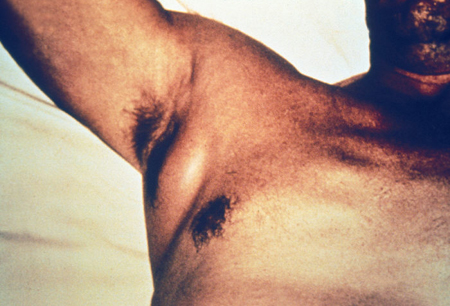
- linfadenite (peste bubônica)
- hemoptise (peste pneumônica)
- diarreia (yersiniose)
- dor abdominal (yersiniose)
Outros fatores diagnósticos
- dor torácica pleurítica (peste pneumônica)
- dispneia (peste pneumônica)
- Faringite (yersinose)
Fatores de risco
- exposição a pulgas (peste)
- residência ou viagem para uma área endêmica (peste)
- contato com animais infectados (peste)
- bioterrorismo (peste)
- crianças pequenas (yersiniose)
- consumo de produtos suínos crus ou malcozidos (yersiniose)
- exposição a pessoas com peste (peste)
- hemocromatose (yersiniose)
- doença hepática crônica, diabetes, alcoolismo (yersiniose)
Investigações diagnósticas
Primeiras investigações a serem solicitadas
- hemocultura (peste)
- cultura de aspirado do bubão (peste bubônica)
- cultura de escarro (peste pneumônica)
- cultura de líquido cefalorraquidiano (peste septicêmica)
- cultura de amostra de swab da garganta (peste faríngea)
- detecção de antígeno (peste)
- contagem leucocitária (peste)
- radiografia torácica (peste pneumônica)
- coprocultura (yersiniose)
Investigações a serem consideradas
- sorologia (peste ou yersiniose)
- reação em cadeia da polimerase (peste)
Algoritmo de tratamento
peste pneumônica ou septicêmica: adultas não gestantes e crianças
peste bubônica ou faríngea: adultas não gestantes e crianças
peste pneumônica, septicêmica, bubônica ou faríngea: gestante
peste meníngea
yersiniose
Colaboradores
Autores
John Williams, MRCP, DTM&H, Dip HIV Med

Consultant Infectious Diseases Physician
Department of Infection and Travel Medicine
The James Cook University Hospital
Middlesbrough
UK
Declarações
JW declares that he has no competing interests.
Revisores
Vladimir L. Motin, PhD
Professor
Pathology/Microbiology and Immunology
University of Texas Medical Branch
Galveston, TX
Declarações
VLM declares that he has no competing interests.
Waleed Javaid, MD, FACP, FIDSA
Associate Professor
Medical Director of Infection Control
Infectious Disease
Department of Medicine
SUNY Upstate Medical University
Syracuse, NY
Declarações
WJ declares that he has no competing interests.
Alistair Leanord, BSc, MBChB, MD, DTM&H, FRCPath
Consultant Microbiologist
Microbiology Department
Southern General Hospital
Glasgow
UK
Declarações
AL declares that he has no competing interests.
Janak Koirala, MD
Associate Professor of Medicine
Division of Infectious Diseases
Department of Internal Medicine
Southern Illinois University School of Medicine
Springfield, IL
Declarações
JK declares that he has no competing interests.
Créditos aos pareceristas
Os tópicos do BMJ Best Practice são constantemente atualizados, seguindo os desenvolvimentos das evidências e das diretrizes. Os pareceristas aqui listados revisaram o conteúdo pelo menos uma vez durante a história do tópico.
Declarações
As afiliações e declarações dos pareceristas referem--se ao momento da revisão.
Referências
Principais artigos
World Health Organization. Manual for plague surveillance, diagnosis, prevention and control. Geneva: World Health Oranization; 2024.
Nelson CA, Meaney-Delman D, Fleck-Derderian S, et al. Antimicrobial treatment and prophylaxis of plague: recommendations for naturally acquired infections and bioterrorism response. MMWR Recomm Rep. 2021 Jul 16;70(3):1-27.Texto completo Resumo
Centers for Disease Control and Prevention. Clinical testing and diagnosis for plague. May 2024 [internet publication].Texto completo
Centers for Disease Control and Prevention. Clinical care of plague. May 2024 [internet publication].Texto completo
Artigos de referência
Uma lista completa das fontes referenciadas neste tópico está disponível para os usuários com acesso total ao BMJ Best Practice.
Diagnósticos diferenciais
- Sepse Gram-negativa
- Pneumonia bacteriana
- Doença por arranhadura do gato
Mais Diagnósticos diferenciaisDiretrizes
- Plague: epidemiology, outbreaks and guidance
- Clinical overview of yersiniosis
Mais DiretrizesFolhetos informativos para os pacientes
Pneumonia
Apendicite
Mais Folhetos informativos para os pacientes Conectar-se ou assinar para acessar todo o BMJ Best Practice
O uso deste conteúdo está sujeito ao nosso aviso legal