Resumo
Definição
A hidrocele é um acúmulo de fluidos serosos entre as camadas da membrana (túnica vaginal) que envolvem o testículo ou ao longo do cordão espermático. Raramente, pode ocorrer uma coleção de fluidos similar em mulheres ao longo do canal de Nuck. Há 2 tipos de hidroceles: comunicante e não comunicante (simples).
Nas hidroceles comunicantes, um conduto peritoniovaginal patente conecta o peritônio com a túnica vaginal, o que permite que o líquido peritoneal flua livremente entre ambas as estruturas. Se a conexão for grande, o conteúdo abdominal (intestino, bexiga ou omento) pode entrar na virilha, e essa complicação é denominada hérnia inguinal. As hérnias inguinais são classificadas em diretas ou indiretas, com base na relação do saco com a artéria epigástrica inferior. Em uma hérnia inguinal direta, o saco herniário está localizado medialmente à artéria e ao anel inguinal profundo. Em uma hérnia inguinal indireta, o saco herniário fica lateral à artéria.
Uma hidrocele simples ou não comunicante ocorre quando o conduto peritoniovaginal está fechado e uma quantidade maior de fluido está sendo produzida pela túnica vaginalis em relação à que está sendo absorvida.[Figure caption and citation for the preceding image starts]: Hidrocele comunicanteCriado pelo BMJ Group [Citation ends]. [Figure caption and citation for the preceding image starts]: Hidrocele não comunicanteCriado pelo BMJ Group [Citation ends].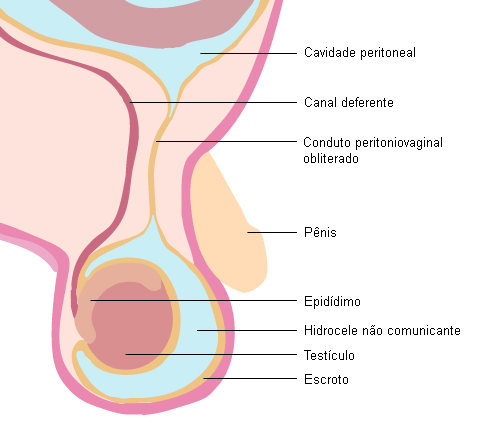
História e exame físico
Principais fatores diagnósticos
- presença de fatores de risco
- massa escrotal
- transiluminação
- aumento da massa escrotal após atividade
- variação na massa escrotal durante o dia
Fatores de risco
- sexo masculino
- prematuridade e baixo peso ao nascer
- lactentes <6 meses de idade
- lactentes cujos testículos descem relativamente tarde
- aumento de líquido ou pressão intraperitoneal
- inflamação ou lesão dentro do escroto
- câncer de testículo
- doenças do tecido conjuntivo
- varicocelectomia
- filariose
- exposição materna a bifenil polibromado
Investigações diagnósticas
Primeiras investigações a serem solicitadas
- diagnóstico clínico
Investigações a serem consideradas
- ultrassonografia
Algoritmo de tratamento
crianças
adolescentes
adultos
Colaboradores
Autores
Barry A. Kogan, MD

Professor of Surgery and Pediatrics
Albany Medical College
Albany
NY
Declarações
BAK declares that he has no competing interests.
Erim Erdem, MD

Professor of Urology
Mersin University School of Medicine
Department of Urology
Mersin
Turkey
Declarações
EE declares that he has no competing interests.
Revisores
Kyle Rove, MD
Assistant Professor
Pediatric Urology
Children's Hospital Colorado
CO
Declarações
KR declares that he is an Abbvie site investigator.
Edmund Sabanegh, MD
Director
Center for Male Fertility
Glickman Urological and Kidney Institute
Cleveland
OH
Declarações
ES declares that he has no competing interests.
Daniel H. Williams, IV, MD
Assistant Professor
Department of Urology
Head
Section of Male Infertility and Andrology
University of Wisconsin School of Medicine and Public Health
Madison
WI
Declarações
DHW declares that he has no competing interests.
Marcus Drake, MA, DM, FRCS (Urol)
Senior Lecturer in Urology
University of Bristol
Bristol
UK
Declarações
MD declares that he has no competing interests.
Créditos aos pareceristas
Os tópicos do BMJ Best Practice são constantemente atualizados, seguindo os desenvolvimentos das evidências e das diretrizes. Os pareceristas aqui listados revisaram o conteúdo pelo menos uma vez durante a história do tópico.
Declarações
As afiliações e declarações dos pareceristas referem--se ao momento da revisão.
Referências
Principais artigos
Dagur G, Gandhi J, Suh Y, et al. Classifying hydroceles of the pelvis and groin: an overview of etiology, secondary complications, evaluation, and management. Curr Urol. 2017 Apr;10(1):1-14.Texto completo Resumo
European Association of Urology. EAU guidelines on paediatric urology. Mar 2023 [internet publication].Texto completo
Artigos de referência
Uma lista completa das fontes referenciadas neste tópico está disponível para os usuários com acesso total ao BMJ Best Practice.
Diagnósticos diferenciais
- Hérnia inguinal
- Câncer de testículo
- Epididimite
Mais Diagnósticos diferenciaisDiretrizes
- EAU guidelines on paediatric urology
- IPEG guidelines for inguinal hernia and hydrocele
Mais Diretrizes Conectar-se ou assinar para acessar todo o BMJ Best Practice
O uso deste conteúdo está sujeito ao nosso aviso legal