Resumo
Definição
História e exame físico
Principais fatores diagnósticos
- presença de fatores de risco
- dor
- edema ou inchaço
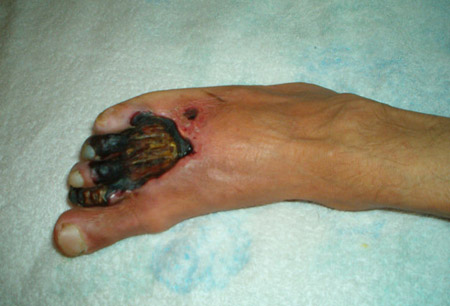
- descoloração da pele
- crepitação (gangrena gasosa)
Outros fatores diagnósticos
- pulso pedioso diminuído e índice tornozelo-braquial (gangrena isquêmica)
- febre baixa e calafrios (gangrena infecciosa)
Fatores de risco
- diabetes mellitus
- aterosclerose (gangrena isquêmica)
- tabagismo (gangrena isquêmica)
- doença renal
- abuso de álcool e drogas
- neoplasia maligna
- trauma ou cirurgia abdominal (gangrena infecciosa)
- feridas infectadas (gangrena infecciosa)
- imunossupressão (gangrena infecciosa)
- desnutrição (gangrena infecciosa)
- estados hipercoaguláveis (gangrena isquêmica)
- aplicação prolongada de torniquetes (gangrena isquêmica)
- MRSA adquirido na comunidade
Investigações diagnósticas
Primeiras investigações a serem solicitadas
- Hemograma completo
- perfil metabólico completo
- lactato desidrogenase (LDH) sérico
- painel da coagulação
- hemoculturas
- proteína C-reativa sérica
- radiografias simples
- tomografia computadorizada (TC) do local afetado
- ressonância nuclear magnética (RNM) do local afetado
- ultrassonografia com Doppler
Investigações a serem consideradas
- exploração cirúrgica e biópsia de pele
- Angiotomografia
- angiografia por ressonância magnética (ARM)
- tomografia computadorizada (TC) do tórax e abdome
- anticorpos antinucleares (ANA), anticoagulante lúpico, anticardiolipina e anticorpos antibeta-2-glicoproteína-1
- aglutininas a frio séricas
- criofibrinogênio sérico
- crioglobulina plasmática
Algoritmo de tratamento
fasciite necrosante aguardando confirmação de resultados de cultura microbiana e sensibilidade
fasciite necrosante do tipo I confirmada (polimicrobiana)
fasciite necrosante do tipo II (monomicrobiana) confirmada
gangrena gasosa
gangrena isquêmica
Colaboradores
Autores
Jason Jacob, MD
Attending Physician
Assistant Director
Department of Medicine
Hartford Hospital
Hartford
CT
Declarações
JJ declares that he has no competing interests.
Robert J. Gionfriddo, DO
Assistant Director
Department of Medicine
Hartford Hospital
Hartford
CT
Declarações
RJG declares that he has no competing interests.
Agradecimentos
Dr Jason Jacob and Dr Robert J. Gionfriddo would like to gratefully acknowledge Dr William Tennant, Dr Badr Aljabri, Dr Mohammed Al-Omran, Dr Jose Contreras-Ruiz, and Dr Iris Galvan-Martinez, the previous contributors to this topic.
Disclosures
WT, BA, MA, JC, and IG declare that they have no competing interests.
Peer reviewers
Meryl Davis, MD
Consultant Vascular Surgeon
Royal Free Hampstead
London
UK
Disclosures
MD declares that she has no competing interests.
Charles Fox, MD
Vascular Surgeon
Department of Surgery
Walter Reed Army Medical Center
Washington
DC
Disclosures
CF declares that he has no competing interests.
Peer reviewer acknowledgements
BMJ Best Practice topics are updated on a rolling basis in line with developments in evidence and guidance. The peer reviewers listed here have reviewed the content at least once during the history of the topic.
Disclosures
Peer reviewer affiliations and disclosures pertain to the time of the review.
References
Key articles
Kihiczak GG, Schwartz RA, Kapila R. Necrotizing fasciitis: a deadly infection. J Eur Acad Dermatol Venereol. 2006 Apr;20(4):365-9.Full text Abstract
Stevens DL, Bisno AL, Chambers HF, et al. Practice guidelines for the diagnosis and management of skin and soft tissue infections: 2014 update by the infectious diseases society of America. Clin Infect Dis. 2014 Jul 15;59(2):e10-52.Full text Abstract
Nicolasora N, Kaul DR. Infectious disease emergencies. Med Clin North Am. 2008 Mar;92(2):427-41. Abstract
Bradbury AW, Adam DJ, Bell J, et al; BASIL trial Participants. Bypass versus Angioplasty in Severe Ischaemia of the Leg (BASIL) trial: an intention-to-treat analysis of amputation-free and overall survival in patients randomized to a bypass surgery-first or a balloon angioplasty-first revascularization strategy. J Vasc Surg. 2010 May;51(5 Suppl):5-17S. Abstract
Norgren L, Hiatt WR, Dormandy JA, et al.; TASC II Working Group. Inter-society consensus for the management of peripheral arterial disease (TASC II). J Vasc Surg. 2007 Jan;45 Suppl S:S5-67.Full text Abstract
Reference articles
A full list of sources referenced in this topic is available to users with access to all of BMJ Best Practice.
Differentials
- Lesões cutâneas por estafilococos
- Erisipela
- Celulite
More DifferentialsGuidelines
- 2024 ACC/AHA/AACVPR/APMA/ABC/SCAI/SVM/SVN/SVS/SIR/VESS guideline for the management of lower extremity peripheral artery disease
- Surgical site infections: prevention and treatment
More GuidelinesPatient information
Diabetes do tipo 2: devo tomar insulina?
Diabetes: o que posso fazer para me manter saudável?
More Patient information Log in or subscribe to access all of BMJ Best Practice
Use of this content is subject to our disclaimer