Established atrial fibrillation
Resumen
Definición
AF is a supraventricular tachycardia with uncoordinated atrial activation and ineffective atrial contraction.[1][2] Diagnosis requires ECG documentation. ECG characteristics include irregularly irregular RR intervals (where atrioventricular conduction is present); absence of distinct P waves; irregular atrial activations.[1][2][Figure caption and citation for the preceding image starts]: Atrial fibrillation: P waves are not discernible; the ventricular (QRS complexes) rate is irregularly irregularFrom the collection of Dr Arti N. Shah [Citation ends].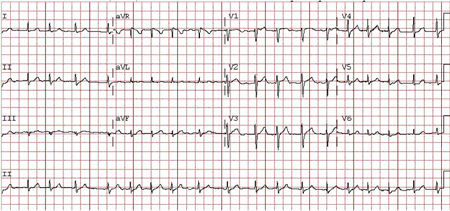 It is primarily defined based on duration and frequency of episodes; therefore, established AF could be paroxysmal, persistent, or permanent, and even new onset if detected for the first time.
For details on new-onset AF, please see New-onset atrial fibrillation.
Clinical AF is symptomatic or asymptomatic AF that is documented by surface ECG.
Subclinical AF is detection of the arrhythmia in individuals who do not have symptoms attributable to AF and in whom there is no previous ECG documenting AF. This includes AF detected by implantable or wearable devices.
Atrial high-rate episodes (AHREs) are defined as events detected by cardiac implantable electronic devices that exceed the programmed detection rate limit set by the device and can be used to define the burden of disease in established AF. AHREs require visual inspection to confirm AF and exclude other atrial arrhythmias, artifact, or oversensing.[1][2]
Anamnesis y examen
Principales factores de diagnóstico
- presence of cardiovascular risk factors
- presence of noncardiovascular risk factors
- palpitations
- tachycardia
- irregular pulse
Otros factores de diagnóstico
- stroke
- shortness of breath
- fatigue
- chest pain
- dizziness
- syncope
- hypotension
- elevated jugular venous pressure
- murmur or gallop rhythm
- rales
- decrease in mentation or listlessness
Factores de riesgo
- hypertension
- coronary artery disease (CAD)
- congestive heart failure
- advancing age
- diabetes mellitus
- valvular disease
- hypertrophic cardiomyopathy
- alcohol misuse
- presence of other arrhythmias
- smoking
- obesity
- sleep-disordered breathing (SDB)
- chronic obstructive pulmonary disease (COPD)
- chronic kidney disease (CKD)
- sedentary lifestyle
- thyroid disease
- autonomic neuronal dysfunction
- caffeine misuse
- cancer
- working long hours
- excessive exercise
- height
- air pollution
- migraine
Pruebas diagnósticas
Primeras pruebas diagnósticas para solicitar
- ECG
- thyroid profile
- echocardiogram
- serum electrolytes (including serum magnesium) and BUN
Pruebas diagnósticas que deben considerarse
- serum aminotransferases
- prolonged ECG monitoring
- fasting blood glucose or HbA1c
- screening for sleep-disordered breathing (SDB)
Algoritmo de tratamiento
paroxysmal or persistent AF: hemodynamically unstable
paroxysmal or persistent AF and hemodynamically stable: rate-control strategy selected
paroxysmal or persistent AF and hemodynamically stable: rhythm-control strategy selected
permanent AF
Colaboradores
Autores
Arti N. Shah, MS, MD
Assistant Professor of Medicine
Mount Sinai School of Medicine
New York
NY
Divulgaciones
ANS declares that she has no competing interests.
Bharat K. Kantharia, MD, FRCP, FAHA, FACC, FESC, FHRS
President, Cardiovascular and Heart Rhythm Consultants
Clinical Professor of Medicine
Icahn School of Medicine at Mount Sinai
Attending and Consultant Cardiac Electrophysiologist
Mount Sinai and New York Presbyterian Hospitals
New York
NY
Divulgaciones
BKK declares that he has no competing interests. BKK is an author of a reference cited in this topic.
Revisores por pares
Andrew R.J. Mitchell, BM, MD, FRCP, FESC, FACC
Consultant Cardiologist
Jersey General Hospital
St Helier
Jersey
Channel Islands
Divulgaciones
ARJM declares that he has no competing interests.
Diwakar Jain, MD, FACC, FRCP, FASNC
Professor of Medicine (Cardiology)
Westchester Medical Center
Valhalla
NY
Divulgaciones
DJ declares that he has no competing interests.
Konstadinos Plestis, MD, FACS
Associate Professor
Department of Cardiothoracic Surgery
Mount Sinai Medical Center
New York
NY
Divulgaciones
KP declares that he has no competing interests.
Agradecimiento de los revisores por pares
Los temas de BMJ Best Practice se actualizan de forma continua de acuerdo con los desarrollos en la evidencia y en las guías. Los revisores por pares listados aquí han revisado el contenido al menos una vez durante la historia del tema.
Divulgaciones
Las afiliaciones y divulgaciones de los revisores por pares se refieren al momento de la revisión.
Referencias
Artículos principales
Hindricks G, Potpara T, Dagres N, et al. 2020 ESC guidelines for the diagnosis and management of atrial fibrillation developed in collaboration with the European Association for Cardio-Thoracic Surgery (EACTS). Eur Heart J. 2021 Feb 1;42(5):373-498.Texto completo
National Institute for Health and Care Excellence. Atrial fibrillation: diagnosis and management. Jun 2021 [internet publication].Texto completo
Sharma M, Cornelius VR, Patel JP, et al. Efficacy and harms of direct oral anticoagulants in the elderly for stroke prevention in atrial fibrillation and secondary prevention of venous thromboembolism: systematic review and meta-analysis. Circulation. 2015 Jul 21;132(3):194-204.Texto completo Resumen
Lip GY, Haguenoer K, Saint-Etienne C, et al. Relationship of the SAMe-TT₂R₂ score to poor-quality anticoagulation, stroke, clinically relevant bleeding, and mortality in patients with atrial fibrillation. Chest. 2014 Sep;146(3):719-26. Resumen
Kuck KH, Brugada J, Furnkranz A, et al; FIRE AND ICE Investigators. Cryoballoon or radiofrequency ablation for paroxysmal atrial fibrillation. N Engl J Med. 2016 Jun 9;374(23):2235-45.Texto completo Resumen
Luik A, Radzewtiz A, Kieser M, et al. Cryoballoon versus open irrigated radiofrequency ablation in patients with paroxysmal atrial fibrillation: the prospective, randomized, controlled, noninferiority FreezeAF Study. Circulation. 2015 Oct 6;132(14):1311-9.Texto completo Resumen
Del-Carpio Munoz F, Gharacholou SM, Munger TM, et al. Meta-analysis of renal function on the safety and efficacy of novel oral anticoagulants for atrial fibrillation. Am J Cardiol. 2016 Jan 1;117(1):69-75. Resumen
Artículos de referencia
Una lista completa de las fuentes a las que se hace referencia en este tema está disponible para los usuarios con acceso a todo BMJ Best Practice.
Diferenciales
- Atrial flutter with variable atrioventricular (AV) conduction
- Multifocal atrial tachycardia
- Atrial tachycardia with variable AV conduction
Más DiferencialesGuías de práctica clínica
- 2024 European Heart Rhythm Association/Heart Rhythm Society/Asia Pacific Heart Rhythm Society/Latin American Heart Rhythm Society expert consensus statement on catheter and surgical ablation of atrial fibrillation
- ACR appropriateness criteria: preprocedural planning for left atrial procedures in atrial fibrillation
Más Guías de práctica clínicaFolletos para el paciente
Atrial fibrillation
Atrial fibrillation: what are the treatment options?
Más Folletos para el pacienteCalculadoras
Atrial Fibrillation CHA(2)DS(2)-VASc Score for Stroke Risk
ORBIT Bleeding Risk Score
მეტი CalculadorasVideos
How to perform an ECG: animated demonstration
მეტი ვიდეოები შედით სისტემაში ან გამოიწერეთ BMJ Best Practice
ამ მასალის გამოყენება ექვემდებარება ჩვენს განცხადებას