Resumen
Definición
Anamnesis y examen
Principales factores de diagnóstico
- presencia de factores de riesgo
- trombosis venosa superficial (TVS), trombosis venosa profunda o embolia pulmonar previas
- enrojecimiento/eritema de la piel suprayacente
- piel suprayacente caliente
- dolor/sensible a la palpación sobre la vena afectada
- inflamación/edema del área circundante
- masa palpable similar a un cordón
- desarrollo de los síntomas en horas y días
- signos/síntomas de trombosis venosa profunda (TVP) o embolia pulmonar (EP) concomitantes
Otros factores de diagnóstico
- venas varicosas
- antecedentes de trastornos trombofílicos
- enfermedades autoinmunes (p. ej., enfermedad de Behcet y enfermedad de Buerger)
- instrumentación venosa reciente (p. ej., escleroterapia)
- administración de fármacos por vía intravenosa y canulación venosa reciente
- febrícula
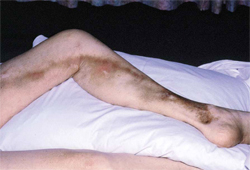
- cambios en la pigmentación
Factores de riesgo
- venas varicosas
- trastornos trombofílicos
- enfermedades autoinmunes (p. ej., enfermedad de Behcet y enfermedad de Buerger)
- antecedentes de trombosis venosa superficial (TVS)
- sexo femenino
- escleroterapia
- cateterismo intravenoso
- neoplasia maligna
- embarazo
- uso de anticonceptivos orales (ACO) y tratamiento de reposición hormonal
- edad avanzada
- antecedentes previos de tromboembolia venosa (TEV), incluidas trombosis venosa profunda y EP
- obesidad
- inmovilización prolongada (p. ej., viajes en avión de larga distancia)
- Tipo de sangre
Pruebas diagnósticas
Primeras pruebas diagnósticas para solicitar
- ecografía Doppler
Pruebas diagnósticas que deben considerarse
- biopsia
- angiografía por tomografía computarizada (TC) pulmonar
- gammagrafía de ventilación y perfusión (VQ)
- angiografía pulmonar convencional
- evaluación para detectar neoplasia maligna
- cribado de trombofilia
Algoritmo de tratamiento
extensión a la vena femoral o a la vena poplítea, trombo ≤3 de la unión safenofemoral o safenopoplítea, o TVP o EP concomitantes
no embarazadas: TVS de ≥5 cm de longitud dentro de la vena superficial axial y a >3 cm de la unión safenofemoral o safenopoplítea
no embarazadas: TVS de <5 cm de longitud dentro de la vena superficial axial o trombo solo dentro de las venas varicosas tributarias
embarazadas: TVS (de cualquier tamaño) dentro de la vena axial o tributaria
vena safena incompetente con venas varicosas asociadas o TVS recurrente
Colaboradores
Autores
Sherry Scovell, MD, FACS
Vascular and Endovascular Surgeon
Massachusetts General Hospital
Assistant Professor of Surgery, Part Time
Harvard Medical School
Boston
MA
Divulgaciones
SS is an author for UpToDate, which is compensated. SS declares that she has no conflicts of interest with medical or pharmaceutical companies.
Agradecimientos
Dr Sherry Scovell would like to gratefully acknowledge Professor Vicky Tagalakis, a previous contributor to this topic.
Divulgaciones
VT has received reimbursement for advisory board work for Servier and Pzifer. Both of these companies are makers of anticoagulants. VT has received an investigator-initiated grant from Sanofi, manufacturer of Enoxaparin.
Revisores por pares
Francois Becker, MD, PhD
Consultant
Division of Angiology and Hemostasis
University Hospital of Geneva
Geneva
Switzerland
Divulgaciones
FB declares that he has no competing interests.
Michael Bromberg, MD, PhD
Professor of Medicine
Section of Hematology
Director of Hematologic Malignancies
Temple University School of Medicine
Philadelphia
PA
Divulgaciones
MB declares that he has no competing interests.
Louis Aledort, MD
The Mary Weinfeld Professor of Clinical Research in Hemophilia
Mount Sinai School of Medicine
New York
NY
Divulgaciones
LA declares that he has no competing interests.
Agradecimiento de los revisores por pares
Los temas de BMJ Best Practice se actualizan de forma continua de acuerdo con los desarrollos en la evidencia y en las guías. Los revisores por pares listados aquí han revisado el contenido al menos una vez durante la historia del tema.
Divulgaciones
Las afiliaciones y divulgaciones de los revisores por pares se refieren al momento de la revisión.
Referencias
Artículos principales
Stevens SM, Woller SC, Kreuziger LB, et al. Antithrombotic therapy for VTE disease: second update of the CHEST guideline and expert panel report. Chest. 2021 Dec;160(6):e545-608.Texto completo Resumen
Kakkos SK, Gohel M, Baekgaard N, et al. Editor's Choice - European Society for Vascular Surgery (ESVS) 2021 clinical practice guidelines on the management of venous thrombosis. Eur J Vasc Endovasc Surg. 2021 Jan;61(1):9-82.Texto completo Resumen
Thrombosis Canada. Superficial thrombophlebitis, superficial vein thrombosis. Aug 2023 [internet publication].Texto completo
Di Nisio M, Wichers IM, Middeldorp S. Treatment for superficial thrombophlebitis of the leg. Cochrane Database Syst Rev. 2018 Feb 25;(2):CD004982.Texto completo Resumen
Artículos de referencia
Una lista completa de las fuentes a las que se hace referencia en este tema está disponible para los usuarios con acceso a todo BMJ Best Practice.
Diferenciales
- Trombosis venosa profunda
- Celulitis
- Linfedema
Más DiferencialesGuías de práctica clínica
- European Society for Vascular Surgery (ESVS) 2023 clinical practice guidelines on antithrombotic therapy for vascular diseases
- Superficial thrombophlebitis, superficial vein thrombosis
Más Guías de práctica clínicaFolletos para el paciente
Trombosis venosa profunda
Varices: ¿qué son?
Más Folletos para el paciente Inicie sesión o suscríbase para acceder a todo el BMJ Best Practice
El uso de este contenido está sujeto a nuestra cláusula de exención de responsabilidad