Resumen
Definición
Anamnesis y examen
Principales factores de diagnóstico
- mecanismo concordante de la lesión
- dolor cervical
- Factores de riesgo
Otros factores de diagnóstico
- Nivel de consciencia reducido
- parestesia en las extremidades
- debilidad motora
- pérdida sensorial
- disfunción intestinal o de la vejiga
- Priapismo
- déficit de pares craneales
- signo de Hoffman
- Signo de Babinski
- shock neurogénico
- sección medular
Factores de riesgo
- sexo masculino
- sexo femenino (lesión por latigazo cervical)
- Edad 18-40 o >65 años
- un mecanismo peligroso de lesión
- lesiones traumáticas que distraen
- falta de preparación o de consciencia respecto del riesgo de choque
- rotación de la cabeza en el momento del choque
- cirugía o traumatismo previo de la columna cervical
- alteración craneal, espinal o de otro tipo preexistente
Pruebas diagnósticas
Primeras pruebas diagnósticas para solicitar
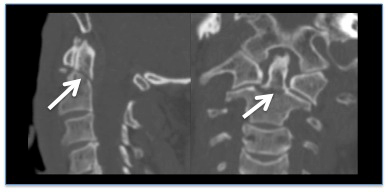
- tomografía computarizada de alta resolución de la columna cervical
Pruebas diagnósticas que deben considerarse
- TC de toda la columna vertebral
- resonancia magnética (IRM) de la columna cervical
Algoritmo de tratamiento
sospecha de lesión de la columna cervical
lesión confirmada de la columna cervical
lesión simple por esguince de cuello o latigazo cervical
Colaboradores
Consejeros especializados
Dr Ram Hariharan, FRCP
Consultant
Yorkshire Regional Spinal Injuries Centre
Pinderfields Hospital
Aberford road
Mid Yorkshire Teaching Hospitals NHS Trust
Wakefield
UK
Divulgaciones
RH declares that he has no competing interests.
Acknowledgements
BMJ Best Practice would like to gratefully acknowledge the previous expert contributors, whose work has been retained in parts of the content:
Christopher S. Ahuja, MD
Research Fellow
Division of Neurosurgery
Department of Surgery
University of Toronto
Ontario
Canada
Michael G. Fehlings, MD, PhD, FRCS(C), FACS
Professor Division of Neurosurgery
Director of Neuroscience Program
University of Toronto
Krembil Chair in Neural Repair and Regeneration
Medical Director
Krembil Neuroscience Center
Toronto Western Hospital
Ontario
Canada
Muhammad Dherijha MBBS, MRCS
ST8 Neurosurgery
Health Education Northwest
Manchester Clinical Neuroscience Centre
Salford
UK
Divulgaciones
CSA declares that he has no competing interests. MGF served as a consultant for Zimmer, In Vivo Therapeutics, and Pfizer. He receives institutional fellowship grant support from AOSpine, Medtronic, and Depuy-Synthes. MD declares that he has no competing interests.
Revisores por pares
Jonathan Lucas, MBBS, FRCS (Eng), FRCS (Orth&Tr)
Head of Service - Paediatric Spinal and Orthopaedic Surgery
Consultant Spinal Surgeon
Guys and St Thomas’ NHS Foundation Trust
Evelina London Children’s Hospital
Guys Hospital
London
UK
Divulgaciones
JL is an Education Consultant to Nuvasive Inc. in the subject of paediatric spinal deformity surgery.
Agradecimiento de los revisores por pares
Los temas de BMJ Best Practice se actualizan de forma continua de acuerdo con los desarrollos en la evidencia y en las guías. Los revisores por pares listados aquí han revisado el contenido al menos una vez durante la historia del tema.
Divulgaciones
Las afiliaciones y divulgaciones de los revisores por pares se refieren al momento de la revisión.
Editores
Helena Delgado-Cohen
Section Editor, BMJ Best Practice
Divulgaciones
HDC declares that she has no competing interests.
Susan Mayor
Lead Section Editor, BMJ Best Practice
Divulgaciones
SM works as a freelance medical journalist and editor, video editorial director and presenter, and communications trainer. In this capacity, she has been paid, and continues to be paid, by a wide range of organisations for providing these skills on a professional basis. These include: NHS organisations, including the National Institute for Health and Care Excellence, NHS Choices, NHS Kidney Care, and others; publishers and medical education companies, including the BMJ Group, the Lancet group, Medscape, and others; professional organisations, including the British Thoracic Oncology Group, the European Society for Medical Oncology, the National Confidential Enquiry into Patient Outcome and Death, and others; charities and patients’ organisations, including the Roy Castle Lung Cancer Foundation and others; pharmaceutical companies, including Bayer, Boehringer Ingelheim, Novartis, and others; and communications agencies, including Publicis, Red Healthcare and others. She has no stock options or shares in any pharmaceutical or healthcare companies; however, she invests in a personal pension, which may invest in these types of companies. She is managing director of Susan Mayor Limited, the company name under which she provides medical writing and communications services.
Rachel Wheeler
Lead Section Editor, BMJ Best Practice
Divulgaciones
RW declares that she has no competing interests.
Annabel Sidwell
Comorbidities Editor, BMJ Best Practice
Divulgaciones
AS declares that she has no competing interests.
Adam Mitchell
Drug Editor, BMJ Best Practice
Divulgaciones
AM declares that he has no competing interests.
Referencias
Artículos principales
National Institute for Health and Care Excellence. Spinal injury: assessment and initial management. Feb 2016 [internet publication].Texto completo
National Institute for Health and Care Excellence. Spinal injury: assessment and initial management. Methods, evidence and recommendations. Feb 2016 [internet publication].Texto completo
Artículos de referencia
Una lista completa de las fuentes a las que se hace referencia en este tema está disponible para los usuarios con acceso a todo BMJ Best Practice.
Diferenciales
- Dolor cervical no traumático
- Enfermedad degenerativa de columna cervical
- Tortícolis adquirida
Más DiferencialesGuías de práctica clínica
- Head injury: assessment and early management
- Spinal injury: assessment and initial management
Más Guías de práctica clínicaCalculadoras
Escala de Coma de Glasgow
Más CalculadorasFolletos para el paciente
Latigazo cervical
Más Folletos para el paciente Inicie sesión o suscríbase para acceder a todo el BMJ Best Practice
El uso de este contenido está sujeto a nuestra cláusula de exención de responsabilidad