Infección por herpes zóster
Summary
Definition
History and exam
Key diagnostic factors
- presencia de factores de riesgo
- dolor localizado en un dermatoma
- prurito
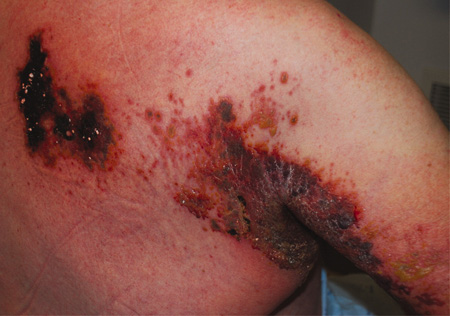
- erupción
- ulceración corneal
Other diagnostic factors
- fiebre
- cefalea
- malestar general
- fatiga
- dolor sin erupción
Risk factors
- >50 años de edad
- sexo femenino
- VIH
- uso crónico de corticosteroides
- quimioterapia
- neoplasias malignas
- raza blanca
- determinadas afecciones agudas o crónicas
- vacunación contra otras enfermedades infecciosas
Diagnostic tests
1st tests to order
- diagnóstico clínico
Tests to consider
- reacción en cadena de la polimerasa (PCR)
- inmunohistoquímica
- cultivo del líquido vesicular
- prueba del VIH
Treatment algorithm
síntomas agudos: inmunocompetente
dolor posherpético
Contributors
Authors
Phuc Le, PhD, MPH
Assistant Professor
Center for Value-Based Care Research
Medicine Institute
Cleveland Clinic
Cleveland
OH
Disclosures
PL declares that she has no competing interests.
Michael Rothberg, MD, MPH
Professor
Center for Value-Based Care Research
Medicine Institute
Cleveland Clinic
Cleveland
OH
Disclosures
MR declares that he has no competing interests.
Acknowledgements
Dr Phuc Le and Dr Michael Rothberg would like to gratefully acknowledge Dr Kenneth J. Smith and Dr Linda Kalilani, the previous contributors to this topic.
Disclosures
KJS and LK declare that they have no competing interests.
Peer reviewers
Julius Atashili, MD, MPH
Department of Epidemiology
Division of General Medicine and Epidemiology
UNC at Chapel Hill
Chapel Hill
NC
Disclosures
JA declares that he has no competing interests.
Ken Mutton, MB, BS, FRCPA, FRCPath
Consultant Virologist
Manchester Royal Infirmary
Manchester
UK
Disclosures
KM declares that he has no competing interests.
Peer reviewer acknowledgements
BMJ Best Practice topics are updated on a rolling basis in line with developments in evidence and guidance. The peer reviewers listed here have reviewed the content at least once during the history of the topic.
Disclosures
Peer reviewer affiliations and disclosures pertain to the time of the review.
References
Key articles
Dworkin RH, Johnson RW, Breuer J, et al. Recommendations for the management of herpes zoster. Clin Infect Dis. 2007 Jan 1;44 Suppl 1:S1-26.Full text Abstract
National Institutes of Health, Centers for Disease Control and Prevention, HIV Medicine Association, and Infectious Diseases Society of America. Panel on Guidelines for the Prevention and Treatment of Opportunistic Infections in Adults and Adolescents with HIV. Guidelines for the prevention and treatment of opportunistic infections in adults and adolescents with HIV: varicella-zoster virus. 2022 [internet publication].Full text
Dooling KL, Guo A, Patel M, et al. Recommendations of the Advisory Committee on Immunization Practices for use of herpes zoster vaccines. MMWR Morb Mortal Wkly Rep. 2018 Jan 26;67(3):103-8.Full text Abstract
Centers for Disease Control and Prevention. Adult immunization schedule by age. Recommendations for ages 19 years or older, United States, 2025. Nov 2024 [internet publication].Full text
Severson EA, Baratz KH, Hodge DO, et al. Herpes zoster ophthalmicus in Olmsted County, Minnesota: have systemic antivirals made a difference? Arch Ophthalmol. 2003 Mar;121(3):386-90.Full text Abstract
Reference articles
A full list of sources referenced in this topic is available to users with access to all of BMJ Best Practice.
Differentials
- Dermatitis de contacto
- Herpes simple
- Colecistitis
More DifferentialsGuidelines
- Shingles (herpes zoster): the green book, chapter 28a
- Recommended immunization schedule for adults aged 19 years or older: United States, 2025
More GuidelinesPatient information
Vacuna contra el herpes zóster
Herpes zóster: ¿Qué es?
More Patient information Log in or subscribe to access all of BMJ Best Practice
Use of this content is subject to our disclaimer