Summary
Definition
Intestinal malrotation is a term used to describe an entire spectrum of rotational and fixation disturbances that can occur during embryonic development.
The most significant pathologic concerns in malrotation are a lack of intestinal fixation to the retroperitoneum and a narrow midgut mesenteric base that predisposes to a twisting of the small bowel in the form of midgut volvulus. This creates an abrupt obstruction of the duodenum, resulting in bilious (dark green) vomiting. [Figure caption and citation for the preceding image starts]: Malrotation with volvulus causing complete obstruction of the duodenum that does not sweep to the left, as seen on upper GI contrastFrom the collection of Dr S.D. St Peter [Citation ends].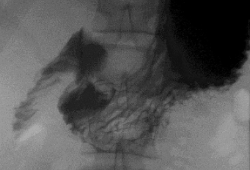
If the twisting at the base also obstructs flow in the superior mesenteric artery, the entire small intestine and proximal colon may become acutely ischemic and subsequently necrotic within a few hours. Abnormal cecal attachments to the right upper peritoneal cavity (i.e., Ladd bands) can cross the second portion of the duodenum creating an extraluminal low-grade obstruction of the duodenum, which may present with signs of partial obstruction.
Patients with malrotation are at risk for volvulus and should be identified whenever possible to allow for proper therapy.
History and exam
Key diagnostic factors
- bilious vomiting
- abdominal pain
Other diagnostic factors
- infant age <1 year
- normal abdominal exam
- abdominal distension
- abdominal tenderness
- tachycardia with hypertension
- tachycardia with hypotension
- tachypnea
- weight loss
- dark blood in diaper
Risk factors
- embryologic abnormality
Diagnostic tests
1st tests to order
- upper gastrointestinal contrast series
- abdominal plain films
Tests to consider
- ultrasound
- lower gastrointestinal (GI) contrast series
- CT abdomen (with oral and intravenous contrast)
- ABG (including lactate)
- Coagulation studies, type and screen, or cross-match
- Blood chemistries
- CBC
- CRP
Treatment algorithm
obstruction with ischemia
obstruction without ischemia
intermittent or partial volvulus or obstructing Ladd bands
questionable malrotation or asymptomatic finding
Contributors
Authors
Michael Stanton, MB BS, MD, FRCS (Paed Surg)
Consultant Paediatric Surgeon and Honorary Senior Lecturer
Department of Paediatric Surgery
University Hospital Southampton
Southampton
UK
Disclosures
MS declares that he has no competing interests.
Acknowledgements
Dr Michael Stanton would like to gratefully acknowledge Dr Stephen Shew, Dr S.D. St Peter, Dr Fizan Abdullah, and Dr Omar Karim, previous contributors to this topic.
Disclosures
SS is the author of two references cited in this topic. SDSP is the co-author of one reference cited in this topic. FA and OK declared that they had no competing interests.
Peer reviewers
Casey M. Calkins, MD
Assistant Professor of Pediatric Surgery
The Medical College of Wisconsin
Children's Hospital and Health System
Milwaukee
WI
Disclosures
CC declares that he has no competing interests.
Steve Rothenberg, MD
Chief of Pediatric Surgery
Chairman Department of Pediatrics
The Rocky Mountain Hospital for Children at Presbyterian/St. Luke's
Denver
CO
Disclosures
SR declares that he has no competing interests.
KuoJen Tsao, MD
Assistant Professor
Department of Pediatric Surgery
University of Texas Health Science Center at Houston
Houston
TX
Disclosures
KT declares that he has no competing interests.
Eric Nicholls, MD
Consultant Paediatric Surgeon
Paediatric Surgery
St George's Hospital
London
UK
Disclosures
EN declares that he has no competing interests.
Peer reviewer acknowledgements
BMJ Best Practice topics are updated on a rolling basis in line with developments in evidence and guidance. The peer reviewers listed here have reviewed the content at least once during the history of the topic.
Disclosures
Peer reviewer affiliations and disclosures pertain to the time of the review.
References
Key articles
Shew SB. Surgical concerns in malrotation and midgut volvulus. Pediatr Radiol. 2009;39(suppl 2):S167-71. Abstract
Expert Panel on Pediatric Imaging, Alazraki AL, Rigsby CK, et al. ACR appropriateness criteria® vomiting in infants. J Am Coll Radiol. 2020 Nov;17(11s):S505-15.Full text Abstract
Graziano K, Islam S, Dasgupta R, et al. Asymptomatic malrotation: diagnosis and surgical management: an American Pediatric Surgical Association outcomes and evidence based practice committee systematic review. J Pediatr Surg. 2015 Oct;50(10):1783-90. Abstract
Ooms N, Matthyssens LE, Draaisma JM, et al. Laparoscopic treatment of intestinal malrotation in children. Eur J Pediatr Surg. 2016 Aug;26(4):376-81.Full text Abstract
Reference articles
A full list of sources referenced in this topic is available to users with access to all of BMJ Best Practice.
Differentials
- Duodenal atresia/web
- Intussusception
- Gastroesophageal reflux
More DifferentialsGuidelines
- ACR appropriateness criteria® vomiting in infants
- Clinical practice guidelines for antimicrobial prophylaxis in surgery
More GuidelinesVideos
Nasogastric tube insertion animated demonstration
More videos Log in or subscribe to access all of BMJ Best Practice
Use of this content is subject to our disclaimer