Summary
Definition
History and exam
Key diagnostic factors
- vomiting
- explosive passage of stool/gas
- abdominal distension
- delayed passage of meconium
- faltering growth
- chronic constipation
Other diagnostic factors
- fever
- diarrhea
- bloody stool
- abdominal tenderness
- septic shock
- cecal or appendiceal perforation
- meconium plug syndrome
Risk factors
- Down syndrome
- male sex
- family history
- Shan-Waardenburg syndrome
- Mowat-Wilson syndrome
- Haddad syndrome
- multiple endocrine neoplasia type 2 (MEN2)
Diagnostic tests
1st tests to order
- plain abdominal x-ray
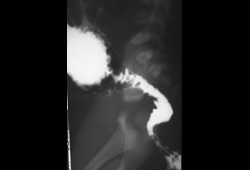
- contrast enema
Tests to consider
- rectal biopsy
- anorectal manometry
Treatment algorithm
short-segment/long-segment disease: without enterocolitis
short-segment/long-segment disease: with enterocolitis
total colonic aganglionosis
Contributors
Authors
Lily S. Cheng, MD
Assistant Professor
University of Virginia
Charlottesville
VA
Disclosures
LSC is the co-author of a reference cited in this topic.
Kristy Lynn Rialon, MD
Associate Professor of Surgery
Division of Pediatric Surgery
Texas Children’s Hospital
Baylor College of Medicine
Houston
TX
Disclosures
KLR declares that she has no competing interests.
Acknowledgements
Dr Lily S. Cheng and Dr Kristy Lynn Rialon would like to gratefully acknowledge Dr Andrea Bischoff and Dr Alberto Peña, the previous contributors to this topic. AB and AP are co-authors of several references cited in this topic.
Peer reviewers
Ivo de Blaauw, MD, PHD
Pediatric Surgeon
Radboud University Nijmegen
Academic Medical Center
Nijmegen
Netherlands
Disclosures
IdB declares that he has no competing interests.
Jose Manuel Tovilla, MD
Colorectal Pediatric Surgeon
Chief of the Colorectal Clinic
Hospital Infantil de Mexico Federico Gomez
Mexico
Disclosures
JMT declares that he has no competing interests.
Daniel P. Doody, MD
Pediatric Surgeon
Department of Pediatric Surgery
Massachusetts General Hospital
Boston
MA
Disclosures
DPD declares that he has no competing interests.
Peer reviewer acknowledgements
BMJ Best Practice topics are updated on a rolling basis in line with developments in evidence and guidance. The peer reviewers listed here have reviewed the content at least once during the history of the topic.
Disclosures
Peer reviewer affiliations and disclosures pertain to the time of the review.
References
Key articles
Montalva L, Cheng LS, Kapur R, et al. Hirschsprung disease. Nat Rev Dis Primers. 2023 Oct 12;9(1):54. Abstract
Kawaguchi AL, Guner YS, Sømme S, et al. Management and outcomes for long-segment Hirschsprung disease: a systematic review from the APSA outcomes and evidence based practice committee. J Pediatr Surg. 2021 Sep;56(9):1513-23.Full text Abstract
Gosain A, Frykman PK, Cowles RA, et al. Guidelines for the diagnosis and management of Hirschsprung-associated enterocolitis. Pediatr Surg Int. 2017 May 33(5):517-21.Full text Abstract
Kyrklund K, Sloots CEJ, de Blaauw I, et al. ERNICA guidelines for the management of rectosigmoid Hirschsprung's disease. Orphanet J Rare Dis. 2020 Jun 25;15(1):164.Full text Abstract
Granström AL, Irvine W, Hoel AT, et al. Ernica clinical consensus statements on total colonic and intestinal aganglionosis. J Pediatr Surg. 2024 Oct;59(10):161565.Full text Abstract
Reference articles
A full list of sources referenced in this topic is available to users with access to all of BMJ Best Practice.
Differentials
- Meconium-plug syndrome
- Cystic fibrosis (meconium ileus)
- Small left colon syndrome
More DifferentialsGuidelines
- Management and outcomes for long-segment Hirschsprung disease: a systematic review from the APSA outcomes and evidence based practice committee
- Guidelines for the diagnosis and management of Hirschsprung-associated enterocolitis
More Guidelines Log in or subscribe to access all of BMJ Best Practice
Use of this content is subject to our disclaimer