Summary
Definition
GA is an uncommon benign condition of unclear etiology.[1] Lesions are typically described as dermal papules, which coalesce to form rings, and may be skin-colored, pink, or violaceous; commonly found on the back of hands, ankles, knees, and elbows. [Figure caption and citation for the preceding image starts]: Classic localized granuloma annulareFrom the collection of Susmita Mukherjee, BSc, MBBS, MRCP; used with permission [Citation ends].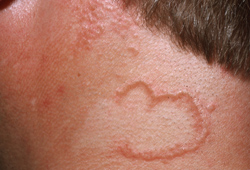 A number of clinical variants exist.[2] Histology is characteristic. Most cases are self-limited.[3]
History and exam
Key diagnostic factors
- asymptomatic grouped annular pink or flesh-colored dermal papules
Other diagnostic factors
- flesh-colored, pink, or brown macules or small papules
- soft-tissue nodules
- perforating papules, crusting or ulcerated lesions
- erythematous patches
Risk factors
- diabetes mellitus
- hematologic malignancy
- herpes zoster
- HIV
- hepatitis
- hyperlipidemia
- thyroid disease
- drugs
Diagnostic tests
1st tests to order
- clinical diagnosis
Tests to consider
- skin biopsy
- fasting blood sugar
- thyroid function tests
- lipid screening
- hepatitis serology
- HIV testing
Treatment algorithm
localized variant (classic annular rash)
generalized variant (widespread macular rash)
subcutaneous variant (soft nodule)
patch variant (erythematous plaques)
perforating variant (crusted or ulcerated lesion)
Contributors
Authors
Misha Rosenbach, MD
Professor
Dermatology and Internal Medicine (Rheumatology)
University of Pennsylvania
Philadelphia, PA
Disclosures
MR has received consulting fees from Merck, Johnson & Johnson, Novartis, and Processa Pharma, not related to granuloma annulare.
Acknowledgements
Dr Misha Rosenbach would like to gratefully acknowledge Dr Susmita Mukherjee, a previous contributor to this topic.
Disclosures
SM declares that she has no competing interests.
Peer reviewers
Aisha Sethi, MD
Assistant Professor of Medicine
Associate Residency Program Director
University of Chicago
Chicago
IL
Disclosures
AS declares that she has no competing interests.
Robert Herd, MSc, MD, FRCP
Consultant Dermatologist
Department of Dermatology
Nuffield Hospital
Glasgow
UK
Disclosures
RH declares that he has no competing interests.
Brenda L. Pellicane, MD
Dermatologist
Wayne State University School of Medicine
Department of Dermatology
Detroit, MI
Disclosures
BLP declares that she has no competing interests.
Peer reviewer acknowledgements
BMJ Best Practice topics are updated on a rolling basis in line with developments in evidence and guidance. The peer reviewers listed here have reviewed the content at least once during the history of the topic.
Disclosures
Peer reviewer affiliations and disclosures pertain to the time of the review.
References
Key articles
Piette EW, Rosenbach M. Granuloma annulare: clinical and histologic variants, epidemiology, and genetics. J Am Acad Dermatol. 2016 Sep;75(3):457-65. Abstract
Kachlik Z, Kaczmarek A, Grych K. et al. Granuloma annulare: a clinical update. Curr Derm Rep. 2024 May 22;13:183-97.Full text
Piette EW, Rosenbach M. Granuloma annulare: pathogenesis, disease associations and triggers, and therapeutic options. J Am Acad Dermatol. 2016 Sep;75(3):467-79. Abstract
Wang J, Khachemoune A. Granuloma annulare: a focused review of therapeutic options. Am J Clin Dermatol. 2018 Jun;19(3):333-44. Abstract
Reference articles
A full list of sources referenced in this topic is available to users with access to all of BMJ Best Practice.
Differentials
- Annular lichen planus
- Dermatophyte infections
- Mycosis fungoides
More Differentials Log in or subscribe to access all of BMJ Best Practice
Use of this content is subject to our disclaimer