Resumo
Definição
Ichthyosis is a descriptive term for dry, scaly skin that in some cases may resemble the scales on a fish (ichthys is the Greek root for fish). The inherited ichthyoses are a group of diseases that feature scaling skin as part of their clinical presentation. The underlying defect, mode of inheritance, character, and extent of scaling differ among the various types. Because of these differences, workup and treatment varies depending on the clinical presentation.
Ichthyosis can also be acquired as a result of underlying diseases or use of certain drugs. [Figure caption and citation for the preceding image starts]: Thick, plate-like scaling of the lower extremity of a patient with ichthyosis vulgarisFrom the collection of Dr Timothy Patton; used with permission [Citation ends].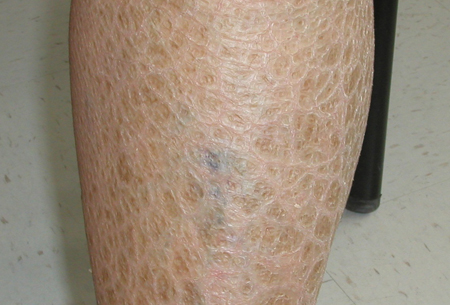
In 2025, the terminology Epidermal Differentiation Disorders (EDDs) was proposed to replace the term ichthyosis, as it more adequately describes this large family of diseases and its pathogenesis.[1]
História e exame físico
Principais fatores diagnósticos
- scaling
- skin changes at birth (in congenital ichthyosis)
- onset in infancy (in ichthyosis vulgaris and X-linked ichthyosis)
- adult onset (in acquired ichthyosis)
- male sex
- family history of ichthyosis
Outros fatores diagnósticos
- history of atopy
- history of associated systemic disease
- history of associated infection
- use of certain drugs
- history of lymphoma or other malignancy
- alopecia and ectropion in lamellar ichthyosis
- cryptorchidism and corneal opacities
- deafness, intellectual disability, limb defects, epilepsy, short stature
Fatores de risco
- positive family history
- parental consanguinity
- use of certain drugs
- history of lymphoma or other malignancy
- history of associated systemic disease
- history of HIV or leprosy
Investigações diagnósticas
Primeiras investigações a serem solicitadas
- genetic testing
- serum cholesterol sulfate
- lipoprotein electrophoresis
- steroid sulfatase activity
Investigações a serem consideradas
- serum phytanic acid
- imaging studies or other tests
Algoritmo de tratamento
primary (genetic)
secondary (acquired)
Colaboradores
Autores
Fernanda Bellodi Schmidt, MD
Assistant Professor
Director of Pediatric Dermatology
Dr. Phillip Frost Department of Dermatology and Cutaneous Surgery
University of Miami Miller School of Medicine
Miami, FL
Declarações
FBS is a principal investigator in an ichthyosis clinical trial sponsored by Timber Pharmaceuticals and is a principal investigator in an epidermolysis bullosa clinical trial sponsored by Anterogen Co. FBS lectures on various topics within the area of pediatric dermatology at the World Congress of Pediatric Dermatology, American Academy of Dermatology Annual Conference, American Academy of Dermatology Innovation Academy, and Masters of Pediatric Dermatology.
Elisa Secamilli, MD, PhD
Assistant Professor
Director of Pediatric Dermatology
Division of Dermatology, Department of Internal Medicine
University of Campinas
Brazil
Declarações
ES has no competing interests.
Agradecimentos
Dr Fernanda Schmidt and Dr Elisa Secamilli would like to gratefully acknowledge Dr Timothy Patton, Dr Brittany Craiglow, and Dr Moise Levy, previous contributors to this topic.
Declarações
TP declared that he had no competing interests. BC declared that she is a member of the Foundation for Ichthyosis and Related Skin Types Advisory Board. BC is an author of a reference cited in this topic. MLL declared that he is the Drug Monitoring Committee Chair for Amgen, is on the advisory board for Arcutis, Pelthos, and Regeneron, has participated or will participate as an investigator for Castle Creek, Janssen, and Rheacell, and is a section editor and author for UpToDate. MLL also holds a patent for "Identification of Mutations in the Nemo Gene in Human Incontinentia Pigmenti" (US patent #6,824,972).
Revisores
David Cassarino, MD, PhD
Assistant Professor
Department of Pathology and Laboratory Medicine
University of California
Los Angeles, CA
Divulgaciones
DC declares that he has no competing interests.
Thierry Simonart, MD, PhD
Physician
Department of Dermatology
Erasme University Hospital
Brussels
Belgium
Divulgaciones
TS declares that he has no competing interests.
Agradecimiento de los revisores por pares
Los temas de BMJ Best Practice se actualizan de forma continua de acuerdo con los desarrollos en la evidencia y en las guías. Los revisores por pares listados aquí han revisado el contenido al menos una vez durante la historia del tema.
Divulgaciones
Las afiliaciones y divulgaciones de los revisores por pares se refieren al momento de la revisión.
Referencias
Artículos principales
Akiyama M, Choate K, Hernández-Martín Á, et al. Nonsyndromic epidermal differentiation disorders: a new classification toward pathogenesis-based therapy. Br J Dermatol. 2025 Sep 18;193(4):619-41.Texto completo Resumen
Butala S, Mazereeuw-Hautier J, Paller AS. Ichthyosis: presentation and management. Curr Opin Pediatr. 2023 Aug 1;35(4):467-74. Resumen
Oji V, Tadini G, Akiyama M, et al. Revised nomenclature and classification of inherited ichthyoses: results of the First Ichthyosis Consensus Conference in Sorèze 2009. J Am Acad Dermatol. 2010 Oct;63(4):607-41. Resumen
Mazereeuw-Hautier J, Paller AS, Dreyfus I, et al. Management of congenital ichthyoses: guidelines of care: part one: 2024 update. Br J Dermatol. 2025 Jun 20;193(1):16-27. Resumen
Mazereeuw-Hautier J, Paller AS, O'Toole E, et al. Management of congenital ichthyoses: guidelines of care: part two: 2024 update. Br J Dermatol. 2025 Jun 20;193(1):28-43.Texto completo Resumen
Artículos de referencia
Una lista completa de las fuentes a las que se hace referencia en este tema está disponible para los usuarios con acceso a todo BMJ Best Practice.
Diferenciales
- Asteatotic dermatitis (eczema craquele)
- Atopic dermatitis
- Psoriasis
Más DiferencialesGuías de práctica clínica
- Management of congenital ichthyoses: guidelines of care: part one: 2024 update
- Management of congenital ichthyoses: guidelines of care: part two: 2024 update
Más Guías de práctica clínica Inicie sesión o suscríbase para acceder a todo el BMJ Best Practice
El uso de este contenido está sujeto a nuestra cláusula de exención de responsabilidad