Summary
Definition
Cutaneous SCC is the proliferation of atypical, transformed keratinocytes in the skin with malignant behavior. It ranges from in situ tumors (also known as Bowen disease) to invasive tumors and metastatic disease. Precursor lesions for SCCs are called actinic (or sun-damage) keratosis.[Figure caption and citation for the preceding image starts]: Squamous cell carcinoma on the dorsal hand with evidence of extensive sun damageFrom the private collection of Dr Nwaneshiudu and Dr Soltani [Citation ends].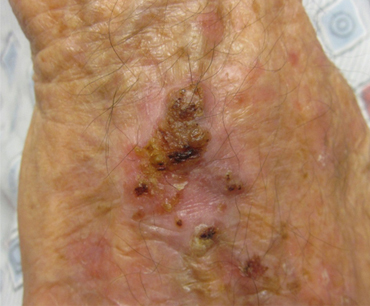
The management of metastatic disease is beyond the scope of the topic.
History and exam
Key diagnostic factors
- growing tumors
Other diagnostic factors
- previous skin cancer
- bleeding
- crusting
- evidence of sun damage to skin
- tender or itchy nonhealing wound originally caused by trauma
- erythematous papules or plaques
- thin, flesh-colored or erythematous plaques
- dome-shaped nodule
- exophytic, fungating, verrucous nodules, or plaques
- ulcerated tumors
- lymphadenopathy
- bone pain
- hepatomegaly
- neurologic signs
Risk factors
- ultraviolet radiation exposure
- solid organ transplant recipient
- immunosuppression
- Fitzpatrick skin phototype
- hereditary skin conditions
- older age
- male sex
- exposure to carcinogens
- actinic keratosis
- previous skin cancer
- exposure to ionizing radiation
- human papillomavirus
- tobacco smoking
- use of thiazide diuretics or cardiac drugs
- tattoos
Diagnostic tests
1st tests to order
- biopsy
Tests to consider
- CT scan
- MRI scan
- CBC with differential
- LFTs
Treatment algorithm
SCC in situ (Bowen disease)
low-risk invasive SCC
high/very-high-risk invasive SCC with high likelihood of cure
high/very-high-risk invasive SCC with significant risk of recurrence or metastasis
locally advanced SCC
immunocompromised or high risk of metastatic disease
Contributors
Authors
Keyoumars Soltani, MD

Professor
Department of Medicine
Director of Immunopathology
Laboratory Section of Dermatology
The University of Chicago
Chicago, IL
Disclosures
KS declares that he has no competing interests.
Adaobi Nwaneshiudu Obasi, MD, PhD, FAAD

Medical Director, Dermatologist, and Dermatopathologist
Cutis Wellness Dermatology & Dermatopathology, PLLC
Preceptor
University of the Incarnate Word
Department of Family Medicine
Laredo, TX
Disclosures
ANO has received honorarium for lectures at 2020 Cynosure and PCCA meetings.
Acknowledgements
Prof K. Soltani and Dr A. I. Nwaneshiudu would like to gratefully acknowledge Dr Carlos Paz and Dr Jessica M. Sheehan, the previous co-contributors to this topic.
Disclosures
CP and JMS declare that they have no competing interests.
Peer reviewers
Catherine G. Chung, MD
Professor of Dermatology and Pathology
The Ohio State University
Wexner Medical Center, OH
Disclosures
CGC declares she has no competing interests.
Peer reviewer acknowledgements
BMJ Best Practice topics are updated on a rolling basis in line with developments in evidence and guidance. The peer reviewers listed here have reviewed the content at least once during the history of the topic.
Disclosures
Peer reviewer affiliations and disclosures pertain to the time of the review.
References
Key articles
National Comprehensive Cancer Network. NCCN clinical practice guidelines in oncology: squamous cell skin cancer [internet publication].Full text
Kim JYS, Kozlow JH, Mittal B, et al. Guidelines of care for the management of cutaneous squamous cell carcinoma. J Am Acad Dermatol. 2018 Mar;78(3):560-78.Full text Abstract
Keohane SG, Botting J, Budny PG, et al. British Association of Dermatologists guidelines for the management of the people with cutaneous squamous cell carcinoma 2020. Br J Dermatol 2021;184:401-14.Full text Abstract
Stratigos AJ, Garbe C, Dessinioti C, et al. European consensus-based interdisciplinary guideline for invasive cutaneous squamous cell carcinoma: part 2. Treatment - update 2023. Eur J Cancer. 2023 Nov;193:113252.Full text Abstract
Reference articles
A full list of sources referenced in this topic is available to users with access to all of BMJ Best Practice.
Differentials
- Actinic keratosis
- Basal cell carcinoma
- Seborrheic keratosis
More DifferentialsGuidelines
- NCCN clinical practice guidelines in oncology: penile cancer (squamous cell carcinoma)
- NCCN clinical guidelines in oncology: vaginal cancer
More GuidelinesPatient information
Skin cancer (squamous cell)
Staying safe in the sun
More Patient information Log in or subscribe to access all of BMJ Best Practice
Use of this content is subject to our disclaimer