Summary
Definition
Myocarditis is clinically and pathologically defined as inflammation of the myocardium in the absence of the predominant acute or chronic ischemia characteristic of coronary artery disease. It is a clinical syndrome of nonischemic myocardial inflammation resulting from a heterogeneous group of infectious, immune, and nonimmune diseases. Histopathologically, it is characterized by an inflammatory cellular infiltrate with or without evidence of myocyte injury.[1][Figure caption and citation for the preceding image starts]: Histologic findings in a patient with giant cell myocarditis. A: severe myocardial necrosis and fibrotic replacement of the cardiomyocytes with granulation tissue and fibrosis is present in a section from the anterolateral left ventricular wall; B: a sharp demarcating border between vital and necrotic myocardium is seen, confirmed by additional immunohistochemical staining for myoglobin; C: at the inflammatory border, cells consisting of prominent multinucleated giant cells, macrophages, lymphocytes, and eosinophilic granulocytes are seen in close proximity to vital myocardium; D: immunohistochemical staining for complement 4d is positive in all vessels, suggestive of complement cascade activationFrom: Rasmussen TB, Dalager S, Andersen NH, et al. BMJ Case Reports 2009; doi:10.1136/bcr.09.2008.0997 [Citation ends].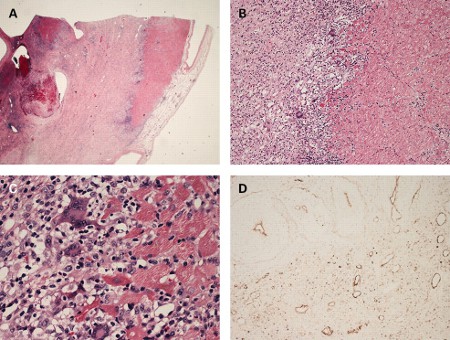
History and exam
Key diagnostic factors
- viral syndrome (prior)
- autoimmune disease
- infectious disease
- use of certain drugs and exposure to toxins
Other diagnostic factors
- age <50 years
- chest pain
- dyspnea
- orthopnea
- fatigue
- palpitations
- rales
- elevated neck veins
- S3 gallop
- sinus tachycardia
- atrial and ventricular arrhythmias
- tachypnea
- hepatomegaly
- syncope
- fever
- gastrointestinal issues
- rhinorrhea
- cough
- S3 and S4 summation gallop
- pericardial friction rub
- peripheral hypoperfusion
- hypotension
- altered sensorium
- lymphadenopathy
- respiratory distress
Risk factors
- infection (non-HIV)
- HIV infection
- autoimmune/immune-mediated diseases
- peripartum and postpartum periods
- use of certain drugs and exposure to toxins
- genetic variants
Diagnostic tests
1st tests to order
- 12-lead ECG
- CXR
- serum CK
- serum CK-MB
- serum troponin (I or T)
- serum B-type natriuretic peptide
- two-dimensional echocardiogram
Tests to consider
- endomyocardial biopsy (EMB)
- coronary angiography
- 18F-fluorodeoxyglucose positron emission tomography-computed tomography (FDG PET-CT)
- cardiac MRI
- viral polymerase chain reaction (PCR)
- genetic testing
Emerging tests
- MRI-guided EMB
Treatment algorithm
hemodynamically stable: no evidence of LV systolic dysfunction
hemodynamically stable: evidence of LV systolic dysfunction
hemodynamically unstable: adults
hemodynamically unstable: children
end-stage heart failure or refractory life-threatening arrhythmias
Contributors
Authors
Shriprasad R. Deshpande, MBBS, MS
Medical Director
Heart Transplant and Advanced Cardiac Therapies Program
Children's National Hospital
Associate Professor of Pediatrics
The George Washington University
Washington
DC
Disclosures
SRD declares that he has no competing interests.
Bibhuti Das, MBBS, MD, FAAP, FACC
Director of Heart Failure and Heart Transplant
Pediatric Cardiology
Methodist Children’s Hospital
San Antonio
TX
Disclosures
BD declares that he has no competing interests.
Acknowledgements
Dr Shriprasad R. Deshpande and Dr Bibhuti Das would like to gratefully acknowledge Dr Katherine C. Wu, Dr James E. Harvey, and Dr Arman T. Askari, previous contributors to this topic. KCW, JEH, and ATA declare that they have no competing interests.
Peer reviewers
David A. Leaf, MD, MPH
Professor of Medicine
School of Medicine
VA Greater Los Angeles Healthcare System
UCLA
Los Angeles
CA
Disclosures
DAL declares that he has no competing interests.
John Charpie, MD, PhD
Associate Professor of Pediatrics
Medical Director
Pediatric Cardiothoracic Intensive Care Unit
University of Michigan Congenital Heart Center
Ann Arbor
MI
Disclosures
JC declares that he has no competing interests.
Lokesh Tejwani, MD, FACC
Assistant Professor of Clinical Medicine
University of Missouri Hospitals and Clinics
Harry S. Truman VA Hospital
Columbia
MO
Disclosures
LT declares that he has no competing interests.
Peer reviewer acknowledgements
BMJ Best Practice topics are updated on a rolling basis in line with developments in evidence and guidance. The peer reviewers listed here have reviewed the content at least once during the history of the topic.
Disclosures
Peer reviewer affiliations and disclosures pertain to the time of the review.
References
Key articles
Lieberman EB, Hershkowitz A, Rose NR, et al. A clinicopathologic description of myocarditis. Clin Immunol Immunopathol. 1993 Aug;68(2):191-6. Abstract
Law YM, Lal AK, Chen S, et al. Diagnosis and management of myocarditis in children: a scientific statement from the American Heart Association. Circulation. 2021 Aug 10;144(6):e123-35.Full text Abstract
Writing Committee, Drazner MH, Bozkurt B, et al. 2024 ACC Expert Consensus Decision Pathway on strategies and criteria for the diagnosis and management of myocarditis: a report of the American College of Cardiology Solution Set Oversight Committee. J Am Coll Cardiol. 2025 Feb 4;85(4):391-431.Full text Abstract
Bozkurt B, Colvin M, Cook J, et al. Current diagnostic and treatment strategies for specific dilated cardiomyopathies: a scientific statement from the American Heart Association. Circulation. 2016 Nov 3;134(23):e579-646.Full text Abstract
Heidenreich PA, Bozkurt B, Aguilar D, et al. 2022 AHA/ACC/HFSA guideline for the management of heart failure: a report of the American College of Cardiology/American Heart Association Joint Committee on Clinical Practice Guidelines. Circulation. 2022 May 3;145(18):e895-1032.Full text Abstract
Aretz HT, Billingham ME, Edwards WD, et al. Myocarditis. A histopathologic definition and classification. Am J Cardiovasc Pathol. 1987 Jan;1(1):3-14. Abstract
Reference articles
A full list of sources referenced in this topic is available to users with access to all of BMJ Best Practice.
Differentials
- Acute coronary syndrome
- Dilated cardiomyopathy
- Pericarditis
More DifferentialsGuidelines
- 2024 ACC Expert Consensus Decision Pathway on strategies and criteria for the diagnosis and management of myocarditis
- 2022 ESC Guidelines on cardio-oncology
More Guidelines Log in or subscribe to access all of BMJ Best Practice
Use of this content is subject to our disclaimer