
Tests
1st tests to order
CXR
Test
Order a CXR as soon as possible in all patients admitted to hospital with suspected community-acquired pneumonia (CAP) to confirm or exclude the diagnosis. In general, performing a CXR in outpatients with suspected CAP is not routinely necessary.
Posteroanterior and latero-lateral projections increase the likelihood of diagnosis of pneumonia and are useful in establishing the severity of the illness.[84][Figure caption and citation for the preceding image starts]: Posterior-anterior chest radiograph showing right upper lobe consolidation in a patient with community-acquired pneumoniaDurrington HJ, et al. Recent changes in the management of community acquired pneumonia in adults. BMJ 2008 Jun 21;336(7658):1429-33. [Citation ends].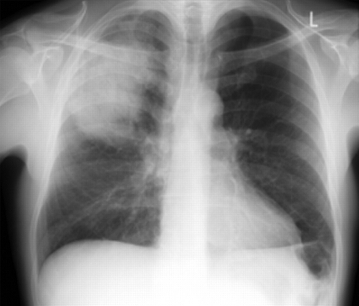
Result
new infiltrate provides definitive diagnosis of pneumonia
CBC
Test
Order in all hospitalized patients. Elevated white cell count is suggestive of infective process. Neutrophil predominance, especially if immature neutrophils, is suggestive of bacterial infection even with a normal or low white cell count. Hematocrit and leukopenia are used as factors in severity scoring.[79][80]
Result
leukocytosis or leukopenia
serum electrolytes/BUN
Test
Order in all hospitalized patients. Baseline blood should be taken. Provides information about renal function. Sodium and BUN are used in severity scoring.[97][98] Chronic kidney disease is a significant risk factor for mortality in patients with community-acquired pneumonia.[79][80]
Result
usually normal
LFTs
Test
Order in all hospitalized patients. Baseline blood should be taken. Provides information about liver function. Pneumonia is common in hospitalized patients with cirrhosis, and chronic liver disease is a risk factor for pulmonary complication in patients hospitalized due to pneumococcal pneumonia.[69]
Result
usually normal
blood glucose
arterial blood gases/oximetry
Test
Measure in all severely ill or hospitalized patients. Indicates severity of the pneumonia.
Oximetry is noninvasive and can be used continually.
Result
may reveal low arterial oxygen saturation
blood culture
Test
Obtain pretreatment blood cultures in the following patients in the hospital setting:[79][94]
Patients with severe CAP as defined by American Thoracic Society/Infectious Diseases Society of America criteria for defining severe CAP (see Diagnostic criteria), especially if they are intubated.
Patients being empirically treated for methicillin-resistant Staphylococcus aureus (MRSA) or Pseudomonas aeruginosa.
Patients who have been previously infected with MRSA or P aeruginosa, especially those with a prior respiratory tract infection.
Patients who have been hospitalized and received parenteral antibiotics in the past 90 days.
Result
growth of causative bacterial species
sputum culture
Test
Obtain pretreatment Gram stain and culture of lower respiratory secretions in the following patients in the hospital setting:[79][94]
Patients with severe community-acquired pneumonia (CAP) as defined by American Thoracic Society/Infectious Diseases Society of America criteria for defining severe CAP (see Diagnostic criteria), especially if they are intubated.
Patients being empirically treated for methicillin-resistant Staphylococcus aureus (MRSA) or Pseudomonas aeruginosa.
Patients who have been previously infected with MRSA or P aeruginosa, especially those with a prior respiratory tract infection.
Patients who have been hospitalized and received parenteral antibiotics in the past 90 days.
Sputum Gram stain is sensitive and highly specific for identifying the causative pathogens in patients with CAP. One meta-analysis found that this test is highly specific for identifying Streptococcus pneumoniae, Haemophilus influenzae, S aureus, and gram-negative bacilli. However, the proportion of false-negative results ranged from 22% (for H influenzae) to 44% (for S pneumoniae), indicating that a negative result does not conclusively confirm the absence of causative pathogens.[95] Poor quality specimens also may provide misleading results and thus should be rejected. Endotracheal aspirates or bronchoscopically obtained samples may be required in the hospitalized patient who is intubated or unable to produce an adequate sputum sample.[94]
Result
growth/visualization of causative bacterial species
Tests to consider
point-of-care lung ultrasound
Test
Consider ordering if the CXR is negative and the patient is older and frail or the clinical suspicion is uncertain.[85]
The American College of Physicians recommends point-of-care ultrasound (POCUS) if there is diagnostic uncertainty in patients with acute dyspnea.[86] The American College of Radiology further notes that POCUS has particular utility when access to CT is limited, either due to a need for rapid assessment or a critical condition that limits patient mobility and transportation to the radiology suite.[84]
Depending on availability, lung ultrasound may represent an easy and accessible technique for the diagnosis of community-acquired pneumonia (CAP), and is an alternative imaging modality if the clinician has appropriate training and equipment. It is radiation-free, and its use is especially valuable when CXR is not available. The diagnosis of CAP via bedside lung ultrasound mainly depends on detecting consolidation. However, consolidation is not always present in CAP, because pneumonia may be interstitial or present as diffuse pulmonary infiltrations.[87] Evidence shows that lung ultrasound can diagnose pneumonia in adults with excellent accuracy, including in the emergency department.[88][89][90] The 2025 American Thoracic Society clinical guidelines state that for adults with suspected CAP, lung ultrasound is an acceptable diagnostic alternative to CXR in medical centers where appropriate clinical expertise is available.[92]
Result
consolidation may be seen
CT chest
Test
Consider ordering in patients who have an uncertain diagnosis after CXR.
The primacy of CXR in making the diagnosis of community-acquired pneumonia (CAP) has been challenged by studies using CT scanning. The utilization of chest CT may improve the diagnosis of CAP and can provide detailed information about the lung parenchyma and the mediastinum. However, the principal limitations include exposure to radiation, high cost, and the impossibility of bedside testing. One study has reported that in patients presenting to the emergency department with suspected CAP, early CT scan findings, when CT is used in addition to CXR, markedly affect both diagnosis and clinical management.[93] The American College of Radiology recommends that CT should be reserved for hospitalized, symptomatic patients with high risk factors, increased comorbidities and suspected complications, such as those with indeterminate findings on CXR, or suspected parapneumonic effusion or abscess.[84]
Result
consolidation, cavitation, effusions, neoplasm
urinary antigen testing for Legionella and pneumococcus
Test
Test urine for pneumococcal antigen in patients with severe community-acquired pneumonia (CAP).[79]
Test urine for Legionella antigen in patients with epidemiologic factors (e.g., association with legionella outbreak or recent travel) or patients with severe CAP.[94] Collect lower respiratory tract secretions for Legionella culture or nucleic acid amplification in patients with severe CAP at the same time.[79]
Result
positive for Legionella or pneumococcal antigens
serum CRP
Test
Consider ordering. A sensitive marker of progress in pneumonia; should be measured regularly in severely ill patients. High levels at initial presentation represent a risk factor for inadequate response to treatment, whereas low levels are protective.[103][104]
Result
may be elevated; level >10 mg/dL makes pneumonia likely
serum procalcitonin
Test
Do not order without an established, evidence-based protocol.[101] The American College of Emergency Physicians and American Thoracic Society (ATS)/Infectious Diseases Society of America (IDSA) do not recommend the routine use of procalcitonin when deciding on administration of antibiotics in the emergency department.[79][102]
High levels at initial presentation represent a risk factor for inadequate response to treatment, whereas low levels are protective.[103] Can be elevated in cases of pneumococcal pneumonia.[105][106]
Initial empiric antibiotic therapy should be started in patients with clinically suspected and radiographically confirmed community-acquired pneumonia regardless of the initial serum procalcitonin level.[79] Initial procalcitonin measurement is not recommended by the IDSA/ATS and has not been found to reduce antibiotic use among patients admitted to the emergency department.[99][100]
Result
may be elevated
thoracocentesis and pleural fluid culture
Test
Consider ordering in all patients with a pleural effusion. Positive Gram stain of pleural fluid indicates an empyema.[107]
Result
exudate; growth of causative bacterial species in case of empyema
bronchoscopy
Test
Consider ordering in immunosuppressed patients, in patients with severe community-acquired pneumonia, and in cases of treatment failure. Additionally, studies have shown that polymerase chain reaction testing of the lavage sample may aid in diagnosis and management.[109]
The most common techniques are bronchoalveolar lavage (BAL) and protected specimen brushing (PSB).
Result
BAL: 10⁴ colony-forming units (CFU)/mL indicates infection; PSB: 10³ CFU/mL has been recommended to distinguish colonization from infection
tests for respiratory viruses
Test
There is a strong recommendation to obtain influenza virus testing during periods of community spread.[96] Test for influenza virus using a rapid influenza molecular assay (rather than antigen-based detection tests) when influenza viruses are circulating in the community. Testing may also be considered during periods of low influenza activity.[79]
Rapid antigen testing or direct fluorescent antibody testing can be used to detect other respiratory viruses and can help with decisions regarding antiviral therapy and may reduce the use of antibacterial agents. Do not order broad respiratory pathogen panels unless the result will directly influence management decisions.[101]
Result
detection of viral antigens or antibodies
molecular microbiological techniques
Test
Includes polymerase chain reaction. Used for bacteria (including atypical pathogens) and respiratory viruses. These tests are rapid and the results may help to guide antimicrobial therapy. Also, new techniques offer antimicrobial resistance patterns and quantified bacteria loads, which may be linked to the degree of infection, as has been shown particularly in pneumococcal infection. The American Thoracic Society recommends nucleic acid-based testing of respiratory samples for viral pathogens other than influenza only in hospitalized patients with suspected community-acquired pneumonia (CAP) who either have severe CAP or are immunocompromised based upon the reported findings of high inpatient mortality associated with noninfluenza viruses in these vulnerable populations.[94][114] Routine use of nucleic acid-based testing is not recommended in outpatients with suspected CAP.[114]
Result
detection of pathogenic organism
Use of this content is subject to our disclaimer