
Summary
Worldwide, an estimated 604,000 new cases of cervical cancer were diagnosed in 2024, with approximately 280,000 deaths. WHO: cervical cancer Opens in new window Cervical cancer is the fifth most common cancer diagnosed in women and ranks second in resource-limited countries.
Cervical cancer is caused primarily by persistent infection of the cervix with human papillomavirus (HPV). HPV is a sexually transmitted infection and is common in sexually active individuals. Most infections resolve spontaneously, but persistent infection of the cervix, if untreated, can cause abnormal, precancerous cells to develop. Cervical screening can detect precancerous and cancerous lesions in asymptomatic women.[1][2][3][4][5]
Cervical cancer screening has been hailed as one of the most successful preventive medical strategies. It has been associated with a 70% reduction in cervical cancer mortality in developed countries since the introduction of the Papanicolaou (Pap) test in 1941.[6][7]
Cancer Research UK: cervical cancer mortality statistics
Opens in new window[Figure caption and citation for the preceding image starts]: Colposcopic view of cervical carcinomaCenters for Disease Control and Prevention (CDC) [Citation ends].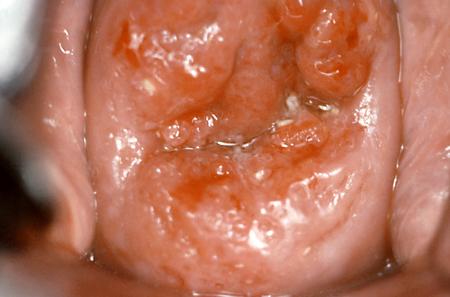 In addition, HPV vaccination reduces the risk of cervical cancer by nearly 90% when administered before adolescence.[8]
HPV infection of cervical epithelial cells is associated with characteristic morphologic changes, and the presence of HPV can, therefore, be indicated by histopathologic observation. HPV infection has been implicated in over 90% of high-grade cervical dysplasia and nearly 100% of cervical cancers.[9][10] Failure to clear HPV is likely to be a primary factor in the subsequent development of dysplasia. Oncogenic or high-risk subtypes of HPV are 16, 18, 31, 33, 35, 39, 45, 51, 52, 56, 58, 59, and 68.[11] Investigations have shown that HPV-16 and HPV-18 are associated with significantly more high-grade (at least CIN 2) lesions than other high-risk subtypes.[12]
HPV tests, either alone or with cytology, are a newer method of cervical cancer screening.
Cervical cancer is rare in women age under 21 years. In the US, routine screening is generally recommended for those with a cervix ages 21-65 years.[1][4][5] Screening may be clinically indicated in women over the ages 65 years who have not had adequate prior screening or are at high risk of cervical cancer. Women who have undergone total hysterectomy (i.e., their cervix has been removed) no longer need cervical cancer screening, as long as they have no previous history of cervical cancer or dysplasia. Women of any age who have a limited life expectancy can also discontinue cervical cancer screening.[1][3][4][5]
National Cancer Institute: cervical cancer screening Opens in new window
ACOG: cervical cancer screening FAQs Opens in new window
See Cervical cancer
Details
- Cervical sampling techniques
- Cervical cancer screening
- HPV vaccination
- Colposcopy
- Guidelines
Contributors
Authors
Richard T. Penson, MD, MRCP
Medical Gynecologic Oncology
Division of Hematology Oncology
Massachusetts General Hospital
Boston
MA
Disclosures
RTP reports personal fees for advisory boards from Aadi Bioscience, AstraZeneca, GSK Inc., ImmunoGen Inc., Merck & Co., Mersana, Novacure, Roche Pharma, Sutro Biopharma, and Vascular Biogenics Ltd; serves on Drug Safety and Monitoring Boards for AstraZeneca, EQRx, and Roche Pharma; Institutional research funding (as Principal Investigator) for Array BioPharma Inc., AstraZeneca., Eisai Inc., Genentech, Inc., Vascular Biogenics Ltd; and royalties from BMJ Publishing, UptoDate, Elsevier Ltd., Wolters Kluwer Health, and Wiley Blackwell. Payment for educational events: Research to Practice, ExpertConnect, ReachMD, CMEO Outfitters.
Marcela G. del Carmen, MD, MPH
President
Massachusetts General Physicians Organization
Division of Gynecologic-Oncology
Massachusetts General Hospital
Professor
Department of Obstetrics, Gynecology and Reproductive Biology
Harvard Medical School
Boston
MA
Disclosures
MDC declares that she has no competing interests.
Peer reviewers
Diane M. Harper, MD, MPH, MS
Professor
Departments of Family Medicine and Obstetrics and Gynecology
University of Michigan
Ann Arbor
MI
Disclosures
DMH has been paid through a grant from Roche to the University of Michigan.
Deirdre Lyons, MB, BCh, BAO, MRCOG
Consultant in Obstetrics & Gynaecology
Lead Clinician in Colposcopy
Imperial College Healthcare NHS Trust
London
UK
Disclosures
DL declares that she has no competing interests.
Matejka Rebolj, PhD
Scientific Researcher
Centre for Epidemiology and Screening
Institute of Public Health
University of Copenhagen
Copenhagen
Denmark
Disclosures
MR declares that she has no competing interests.
Peer reviewer acknowledgements
BMJ Best Practice topics are updated on a rolling basis in line with developments in evidence and guidance. The peer reviewers listed here have reviewed the content at least once during the history of the topic.
Disclosures
Peer reviewer affiliations and disclosures pertain to the time of the review.
References
Key articles
Perkins RB, Guido RS, Castle PE, et al. 2019 ASCCP risk-based management consensus guidelines for abnormal cervical cancer screening tests and cancer precursors. J Low Genit Tract Dis. 2020 Apr;24(2):102-31.Full text Abstract
Fontham ETH, Wolf AMD, Church TR, et al. Cervical cancer screening for individuals at average risk: 2020 guideline update from the American Cancer Society. CA Cancer J Clin. 2020 Sep;70(5):321-46.Full text Abstract
Sawaya GF, Kulasingam S, Denberg TD, et al. Cervical cancer screening in average-risk women: best practice advice from the clinical guidelines committee of the American College of Physicians. Ann Intern Med. 2015 Jun;162:851-9.Full text Abstract
US Preventive Services Task Force, Curry SJ, Krist AH, et al. Screening for cervical cancer: US Preventive Services Task Force recommendation statement. JAMA. 2018 Aug 21;320(7):674-86.Full text Abstract
Reference articles
A full list of sources referenced in this topic is available to users with access to all of BMJ Best Practice.
Use of this content is subject to our disclaimer