Resumo
Definição
Pityriasis lichenoides is an uncommon, acquired, idiopathic skin condition. It is a challenging disorder to diagnose, categorize, and treat due to its varied presentation and uncertain course. Pityriasis lichenoides manifests as diffuse polymorphic, papulosquamous dermatitis that varies in severity, temporal onset and development, and prognosis. The scope of presentations is classified along a continuum of 3 subtypes, including pityriasis lichenoides et varioliformis acuta, pityriasis lichenoides chronica, and febrile ulceronecrotic Mucha-Habermann disease.[1][Figure caption and citation for the preceding image starts]: Acute form of pityriasis lichenoides on the trunk and arm of a young boyFrom the collection of Dr A. Khachemoune, SUNY Downstate Medical Center, Brooklyn. [Citation ends].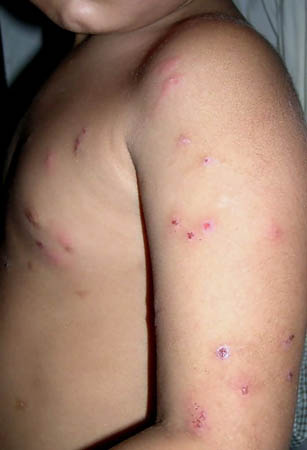
História e exame físico
Principais fatores diagnósticos
- acute to subacute recurrent skin eruption
- polymorphic, generalized, nonpruritic skin eruption
Outros fatores diagnósticos
- scars or pigment changes
- immunosuppression
- recent illness
- family history of pityriasis lichenoides
- headache
- myalgias/arthralgias
- malaise
- burning/pruritus
- multiorgan failure
Fatores de risco
- childhood to early adult age
- male sex
- HIV
Investigações diagnósticas
Primeiras investigações a serem solicitadas
- dermoscopy
- skin biopsy
Investigações a serem consideradas
- antistreptolysin titers
- Epstein-Barr virus IgM/IgG viral capsid antigen and nuclear antigen antibody
- monospot or heterophil antibody test
- hepatitis B surface antigen, antisurface antibody, and anticore IgM
- hepatitis C virus antibody
- HIV screening
- rapid plasma reagin
- throat cultures
- toxoplasma Sabin-Feldman dye test, indirect immunofluorescence/hemagglutination
- erythrocyte sedimentation rate
- CRP
- serum LDH
- WBC count
- serum albumin
Algoritmo de tratamento
mild to moderate disease
severe disease or treatment resistance
Colaboradores
Autores
Amy Musiek, MD
Professor of Dermatology
Division of Dermatology
Washington University School of Medicine in St. Louis
St. Louis
MO
Declarações
AM is a paid lecturer in cutaneous T-cell lymphoma for Dermatology Week, is the author of the UpToDate article on Pityriasis lichenoides chronica, and is an investigator for multiple industry sponsored studies all unrelated to pityriasis lichenoides.
Agradecimentos
Dr Amy Musiek would like to gratefully acknowledge Dr Amer Khachemoune and Dr Marianna Blyumin-Karasik, previous contributors to this topic.
Declarações
AK and MB-K declare that they have no competing interests.
Revisores
Andrew D. Lee, MD
Resident
Department of Dermatology
Wake Forest University School of Medicine
Winston-Salem
NC
Declarações
ADL declares that he has no competing interests.
Abdulhafez Selim, MD
Assistant Professor
King Fahd University of Petroleum and Minerals
Dhahran
Saudi Arabia
Declarações
AS declares that he has no competing interests.
Créditos aos pareceristas
Os tópicos do BMJ Best Practice são constantemente atualizados, seguindo os desenvolvimentos das evidências e das diretrizes. Os pareceristas aqui listados revisaram o conteúdo pelo menos uma vez durante a história do tópico.
Declarações
As afiliações e declarações dos pareceristas referem--se ao momento da revisão.
Referências
Principais artigos
Khachemoune A, Blyumin ML. Pityriasis lichenoides: pathophysiology, classification, and treatment review. Am J Clin Dermatol. 2007;8(1):29-36. Resumo
Bowers S, Warshaw EM. Pityriasis lichenoides and its subtypes. J Am Acad Dermatol. 2006 Oct;55(4):557-72; quiz 573-6. Resumo
Bellinato F, Maurelli M, Gisondi P, et al. A systematic review of treatments for pityriasis lichenoides. J Eur Acad Dermatol Venereol. 2019 Nov;33(11):2039-49. Resumo
Jung F, Sibbald C, Bohdanowicz M, et al. Systematic review of the efficacies and adverse effects of treatments for pityriasis lichenoides. Br J Dermatol. 2020 Dec;183(6):1026-32. Resumo
Artigos de referência
Uma lista completa das fontes referenciadas neste tópico está disponível para os usuários com acesso total ao BMJ Best Practice.
Differentials
- Lymphomatoid papulosis
- Guttate psoriasis
- Drug eruption
More Differentials Log in or subscribe to access all of BMJ Best Practice
Use of this content is subject to our disclaimer