FDA approves new oral antibiotics effective against resistant strains of gonorrhea
Two new oral antibiotics, zoliflodacin and gepotidacin, have been approved by the Food and Drug Administration (FDA) for treating patients with uncomplicated urogenital gonorrhea in patients age 12 years and older. The gepotidacin approval is restricted to patients with few or no other treatment choices because of limited safety data.
Zoliflodacin and gepotidacin have novel mechanisms of action, which means they are effective against strains of Neisseria gonorrhoeae that are resistant to currently recommended antibiotics. Gepotidacin and zoliflodacin act by inhibiting bacterial DNA replication.
The new antibiotics provide oral treatment options and alternative treatments for resistant strains of N gonorrhoeae.
Resumo
Definição
Inflammation of the urethra, usually caused by a STI or, less often, by trauma or a chemical irritant. Urethritis typically presents as dysuria, urethral discharge, and/or pruritus at the end of the urethra. Urethral discharge is the classic physical finding. Women may have associated cervicitis or vaginitis, presenting with vaginal discharge and/or bleeding.[1][2][3]
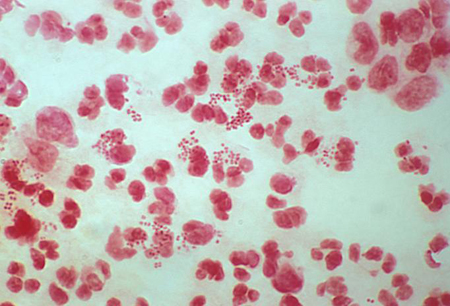
Clinical diagnosis of urethritis may be based on observation of urethral discharge on exam, along with abnormal numbers of polymorphonuclear leukocytes on Gram stain of urethral discharge, or microscopy of urine sediment, or positive urine leukocyte esterase test.[1]
Urethritis is categorized as GU if N gonorrhoeae is isolated; NGU if N gonorrhoeae is not isolated. The most common etiologic agents in NGU are C trachomatis and Mycoplasma genitalium.[1]
This topic focuses on infectious causes of urethritis.[Figure caption and citation for the preceding image starts]: Gonorrhea with penile meatal dischargeCDC Image Library; Susan Lindsley [Citation ends].
História e exame físico
Principais fatores diagnósticos
- urethral discharge
- urethral erythema, irritation and/or itching
- dysuria
- vaginal discharge and/or bleeding
Outros fatores diagnósticos
- orchialgia
- testicular or epididymal pain
- pelvic pain (women)
Fatores de risco
- age 15-24 years
- men who have sex with men
- new or multiple sex partners
- prior or current STI
- unprotected sex
- circumcision
Investigações diagnósticas
Primeiras investigações a serem solicitadas
- Gram stain of urethral discharge
- urinalysis
- nucleic acid amplification testing
- HIV test
- syphilis test
Investigações a serem consideradas
- urine flow cytometry
- urine culture
- nucleic acid amplification testing for Trichomonas vaginalis
- wet mount or culture for Trichomonas vaginalis
- extragenital nucleic acid amplification testing
- nucleic acid amplification testing for other organisms
- potassium hydroxide prep of urethral discharge
- antibiotic susceptibility testing
Algoritmo de tratamento
presumptive diagnosis: nonpregnant
presumptive diagnosis: pregnant
confirmed urethritis: nonpregnant
confirmed urethritis: pregnant
recurrent or resistant urethritis
Colaboradores
Autores
Lisa Istorico Sanders, MD
Associate Professor
Pediatric Infectious Diseases
University of South Florida Morsani College of Medicine
Executive Director
Ybor Youth Clinic
Tampa, FL
Declarações
LIS is part of the Adolescent Medicine Trials Network grant at the University of South Florida Department of Pediatrics. LIS is involved in a study (ATN 173) of doxycycline prophylaxis for sexually transmitted infections (STIs) in those identified as female at birth at risk for acquiring STIs.
Agradecimentos
Dr Lisa Istorico Sanders would like to gratefully acknowledge Dr Sheldon Morris and Dr Christina Bailey previous contributors to this topic.
Declarações
CB declares that she has no competing interests.
Revisores
Vani Dandolu, MD, MPH
Associate Professor
Ob/Gyn and Urology
Director
Division of Urogynecology
Associate Residency Program Director
Temple University Hospital
Philadelphia, PA
Declarações
VD declares that he has no competing interests.
Khalil Ghanem, MD, PhD
Assistant Professor of Medicine
Associate Fellowship Program Director
Division of Infectious Diseases
Johns Hopkins University School of Medicine
Baltimore, MD
Declarações
KG declares that he has no competing interests.
Christopher Fairley, PhD
Professor of Sexual Health
University of Melbourne
Director
Melbourne Sexual Health Centre
Carlton
Victoria
Australia
Declarações
CF is an author of a number of references cited in this topic. CF has received program grants of 6 figures US$.
Créditos aos pareceristas
Os tópicos do BMJ Best Practice são constantemente atualizados, seguindo os desenvolvimentos das evidências e das diretrizes. Os pareceristas aqui listados revisaram o conteúdo pelo menos uma vez durante a história do tópico.
Declarações
As afiliações e declarações dos pareceristas referem--se ao momento da revisão.
Referências
Principais artigos
Workowski KA, Bachmann LH, Chan PA, et al. Sexually transmitted infections treatment guidelines, 2021. MMWR Recomm Rep. 2021 Jul 23;70(4):1-187.Texto completo Resumo
Crofts M, Blee K, Evans C, et al. British Association of Sexual Health and HIV national guideline on the management of non-gonococcal urethritis (NGU), 2026. Int J STD AIDS. 2026 Jun;37(7):690-703.Texto completo Resumo
European Association of Urology. Guidelines on urological infections. Mar 2026 [internet publication].Texto completo
Soni S, Fifer H, Al-Shakarchi Y, et al. British Association of Sexual Health and HIV national guideline for the management of infection with Mycoplasma genitalium, 2025. Int J STD AIDS. 2026 May;37(6):576-88.Texto completo Resumo
Horner PJ, Blee K, Falk L, et al; International Union against Sexually Transmitted Infections. 2016 European guideline on the management of non-gonococcal urethritis. Int J STD AIDS. 2016 Oct;27(11):928-37.Texto completo
Artigos de referência
Uma lista completa das fontes referenciadas neste tópico está disponível para os usuários com acesso total ao BMJ Best Practice.
Diagnósticos diferenciais
- Urinary tract infection
- Candida balanitis or vaginitis
- Noninfectious urethritis
Mais Diagnósticos diferenciaisDiretrizes
- Guidelines on urological infections
- Canadian guidelines on sexually transmitted and blood-borne infections
Mais DiretrizesFolhetos informativos para os pacientes
Chlamydia
Gonorrhea
Mais Folhetos informativos para os pacientes Conectar-se ou assinar para acessar todo o BMJ Best Practice
O uso deste conteúdo está sujeito ao nosso aviso legal