Dysmenorrhea is one of the most common gynecological symptoms affecting the quality of life of women who menstruate.[1]Fernández-Martínez E, Onieva-Zafra MD, Parra-Fernández ML. The impact of dysmenorrhea on quality of life among Spanish female university students. Int J Environ Res Public Health. 2019 Feb 27;16(5):713.
https://www.doi.org/10.3390/ijerph16050713
http://www.ncbi.nlm.nih.gov/pubmed/30818861?tool=bestpractice.com
[2]Iacovides S, Avidon I, Bentley A, et al. Reduced quality of life when experiencing menstrual pain in women with primary dysmenorrhea. Acta Obstet Gynecol Scand. 2014 Feb;93(2):213-7.
https://www.doi.org/10.1111/aogs.12287
http://www.ncbi.nlm.nih.gov/pubmed/24266425?tool=bestpractice.com
[3]Al-Jefout M, Seham AF, Jameel H, et al. Dysmenorrhea: prevalence and impact on quality of life among young adult Jordanian females. J Pediatr Adolesc Gynecol. 2015 Jun;28(3):173-85.
http://www.ncbi.nlm.nih.gov/pubmed/26046607?tool=bestpractice.com
[4]Iacovides S, Avidon I, Baker FC. What we know about primary dysmenorrhea today: a critical review. Hum Reprod Update. 2015;21:762-78.
http://www.ncbi.nlm.nih.gov/pubmed/26346058?tool=bestpractice.com
People with dysmenorrhea typically experience lower abdominal pain or uterine cramps that occur in the days prior to and/or during menstruation, and subside by the end of menstruation.
Dysmenorrhea is subcategorized into primary and secondary, although it is not always easy to distinguish between the two based on history and exam alone:
The true prevalence of dysmenorrhea is difficult to determine, as studies use varying definitions and diagnostic criteria. In some studies, even mild menstrual pain has been considered sufficient to define dysmenorrhea, while others have considered dysmenorrhea as menstrual pain associated with the need for drug and the inability to function normally. Also, dysmenorrhea is often underestimated and undertreated.[5]Proctor M, Farquhar C. Diagnosis and management of dysmenorrhoea. BMJ. 2006;332:1134-1138.
http://www.ncbi.nlm.nih.gov/pubmed/16690671?tool=bestpractice.com
[6]Burnett M. Guideline no. 345: primary dysmenorrhea. J Obstet Gynaecol Can. 2025 May;47(5):102840.
http://www.ncbi.nlm.nih.gov/pubmed/40216328?tool=bestpractice.com
One systematic review and meta-analysis examining data from 70 countries reported a pooled global prevalence of dysmenorrhea of 71%.[7]de Arruda GT, Barbosa-Silva J, Driusso P, et al. Worldwide prevalence of dysmenorrhea: a systematic review and meta-analysis across 70 countries. Pain. 2026 Jan 1;167(1):41-55.
http://www.ncbi.nlm.nih.gov/pubmed/41031966?tool=bestpractice.com
A greater prevalence is generally observed in young women compared with older women, with estimates ranging from 55.1% to 89.0% for those ages 14-19 years.[8]Reid-McCann R, Poli-Neto OB, Stein K, et al. Longitudinal association between dysmenorrhoea in adolescence and chronic pain in adulthood: a UK population-based study. Lancet Child Adolesc Health. 2025 Nov;9(11):766-75.
https://www.thelancet.com/journals/lanchi/article/PIIS2352-4642(25)00213-5/fulltext
http://www.ncbi.nlm.nih.gov/pubmed/40902609?tool=bestpractice.com
[9]Gambadauro P, Hadlaczky G, Wasserman D, et al. Dysmenorrhea and adolescent mental health: a school-based cross-sectional study. BJOG. 2025 Aug;132(9):1278-84.
https://obgyn.onlinelibrary.wiley.com/doi/10.1111/1471-0528.18187
http://www.ncbi.nlm.nih.gov/pubmed/40270448?tool=bestpractice.com
[10]Cameron L, Mikocka-Walus A, Sciberras E, et al. Menstrual pain in Australian adolescent girls and its impact on regular activities: a population-based cohort analysis based on longitudinal study of Australian children survey data. Med J Aust. 2024 May 20;220(9):466-71.
https://onlinelibrary.wiley.com/doi/10.5694/mja2.52288
http://www.ncbi.nlm.nih.gov/pubmed/38717022?tool=bestpractice.com
Estimates of the prevalence in women age 18 and over also vary, ranging from 60% to 96%.[11]Ju H, Jones M, Mishra G. The prevalence and risk factors of dysmenorrhea. Epidemiol Rev. 2014;36:104-13.
http://www.ncbi.nlm.nih.gov/pubmed/24284871?tool=bestpractice.com
[12]Burnett MA, Antao V, Black A, et al. Prevalence of primary dysmenorrhea in Canada. J Obstet Gynaecol Can. 2005;27:765-770.
http://www.ncbi.nlm.nih.gov/pubmed/16287008?tool=bestpractice.com
[13]Wellbeing of Women. "Just a period": calling time on heavy and painful periods. Feb 2025 [internet publication].
https://www.wellbeingofwomen.org.uk/news/just-a-period-calling-time-on-heavy-and-painful-periods
Dysmenorrhea can lead to absenteeism from work or school, with 50% of women with primary dysmenorrhea reporting at least one episode of absence, and 5% to 14% reporting frequent absence due to their symptoms.[12]Burnett MA, Antao V, Black A, et al. Prevalence of primary dysmenorrhea in Canada. J Obstet Gynaecol Can. 2005;27:765-770.
http://www.ncbi.nlm.nih.gov/pubmed/16287008?tool=bestpractice.com
Factors that correlate positively with dysmenorrhea are smoking, early menarche, nulliparity, and family history.[14]Harlow SD, Park M. A longitudinal study of risk factors for the occurrence, duration and severity of menstrual cramps in a cohort of college women. Br J Obstet Gynaecol. 1996;103:1134-42.
http://www.ncbi.nlm.nih.gov/pubmed/8917003?tool=bestpractice.com
[15]Sundell G, Milsom I, Andersch B. Factors influencing the prevalence and severity of dysmenorrhoea in young women. Br J Obstet Gynaecol. 1990;97:588-594.
http://www.ncbi.nlm.nih.gov/pubmed/2390501?tool=bestpractice.com
Dysmenorrhea is not associated with the duration of the menstrual cycle, but often coexists with heavy menstrual bleeding. Many women experience delays in diagnosis and management.[16]Chen CX, Draucker CB, Carpenter JS. What women say about their dysmenorrhea: a qualitative thematic analysis. BMC Womens Health. 2018 Mar 2;18(1):47.
https://www.doi.org/10.1186/s12905-018-0538-8
http://www.ncbi.nlm.nih.gov/pubmed/29499683?tool=bestpractice.com
A survey of more than 7500 women and girls in the UK found that one half of respondents felt their symptoms related to menstruation had been dismissed by friends, family, colleagues, and even health care professionals.[13]Wellbeing of Women. "Just a period": calling time on heavy and painful periods. Feb 2025 [internet publication].
https://www.wellbeingofwomen.org.uk/news/just-a-period-calling-time-on-heavy-and-painful-periods
Validated questionnaires such as the Women’s Health Questionnaire, or the Menstrual Distress Questionnaire may be useful in the initial assessment of dysmenorrhea and in assessing response to treatment.[17]Gray TG, Moores KL, James E, et al. Development and initial validation of an electronic personal assessment questionnaire for menstrual, pelvic pain and gynaecological hormonal disorders (ePAQ-MPH). Eur J Obstet Gynecol Reprod Biol. 2019 Jul;238:148-156.
http://www.ncbi.nlm.nih.gov/pubmed/31132692?tool=bestpractice.com
Primary dysmenorrhea
Primary dysmenorrhea often begins in adolescence once ovulatory cycles have been established, 6-24 months after the menarche.[18]Kho KA, Shields JK. Diagnosis and management of primary dysmenorrhea. JAMA. 2020 Jan 21;323(3):268-9.
http://www.ncbi.nlm.nih.gov/pubmed/31855238?tool=bestpractice.com
Pain due to primary dysmenorrhea is usually lower abdominal and cramping in nature and may radiate to the back and inner thighs. It usually occurs at the onset of menstruation, or precedes it by only a few hours, and typically lasts between 8 and 72 hours. The pain is commonly associated with other systemic symptoms such as vomiting, nausea, diarrhea, fatigue, and headache.[6]Burnett M. Guideline no. 345: primary dysmenorrhea. J Obstet Gynaecol Can. 2025 May;47(5):102840.
http://www.ncbi.nlm.nih.gov/pubmed/40216328?tool=bestpractice.com
Patients may also have increased sensitivity to pain.[4]Iacovides S, Avidon I, Baker FC. What we know about primary dysmenorrhea today: a critical review. Hum Reprod Update. 2015;21:762-78.
http://www.ncbi.nlm.nih.gov/pubmed/26346058?tool=bestpractice.com
The diagnosis can be made clinically after available investigations fail to reveal an underlying pelvic pathology.
Secondary dysmenorrhea
Secondary dysmenorrhea often occurs several years after the onset of menarche. It may arise as a new symptom in the third or fourth decade, associated with identifiable pelvic pathology or disease. The pain may not be consistently related to menstruation alone, and may occur throughout the menstrual cycle. It may also worsen as menstruation progresses rather than being confined to the first 24-48 hours. Accompanying symptoms, such as irregular or heavy bleeding, vaginal discharge and dyspareunia can be suggestive of an underlying pelvic pathology.[19]Dawood MY. Dysmenorrhea. Clin Obstet Gynecol. 1990;33:168-178.
http://www.ncbi.nlm.nih.gov/pubmed/2178834?tool=bestpractice.com
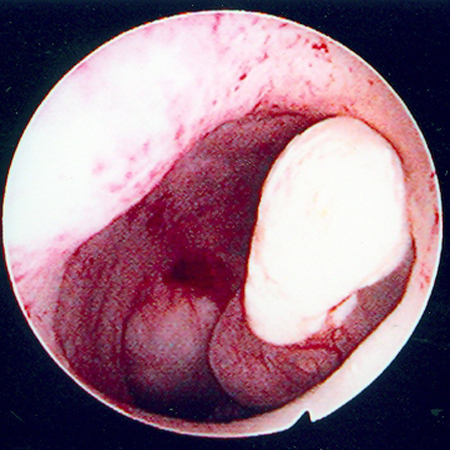
Common causes of secondary dysmenorrhea are endometriosis, chronic pelvic inflammatory disease, adenomyosis, intrauterine polyps and fibroids. The presence of an intrauterine contraceptive device (IUD) is a potential iatrogenic cause. Less common causes include congenital uterine abnormalities, cervical stenosis, and ovarian pathology.
 Log in or subscribe to access all of BMJ Best Practice