Summary
Definition
History and exam
Key diagnostic factors
- Raynaud phenomenon
- digital pits or ulcers
- swelling of the hands and feet
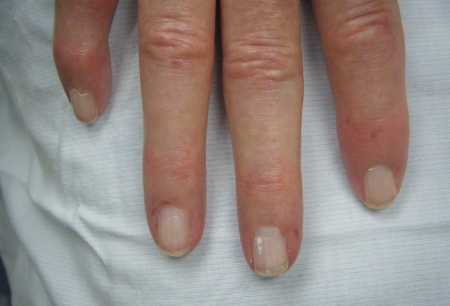
- skin thickening
- loss of function of hands
- sclerodactyly
- heartburn, reflux, and dysphagia
- bloating
- fecal incontinence
- arthralgias and myalgias
- abnormal nail-fold capillaroscopy
- telangiectasia
- subcutaneous calcinosis
- dyspnea
- dry crackles at lung bases
- tendon friction rub
- abrupt onset moderate/marked hypertension
Other diagnostic factors
- fatigue
- dry cough
- decreased exercise tolerance
- weight loss
- inflammatory arthritis
- proximal muscular weakness (inflammatory myositis)
- synovitis
- increased accentuation of the pulmonic component of S2 heart sound
- signs of melena/anemia
Risk factors
- family history of scleroderma
- immune dysregulation (e.g., positive ANA)
- exposure to environmental substances and toxins (e.g., silica dust or solvents)
Diagnostic tests
1st tests to order
- serum autoantibodies
- CBC
- BUN and serum creatinine
- ESR
- CRP
- urine microscopy
- complete pulmonary function tests (spirometry, lung volumes, and diffusing capacity measurement)
- ECG
- echocardiogram
- high-resolution CT scan of chest
- barium swallow
Tests to consider
- chest x-ray
- upper gastrointestinal endoscopy ± biopsy
- serum muscle enzymes
- electromyogram/nerve conduction studies
- muscle biopsy
Treatment algorithm
systemic sclerosis renal crisis
cardiac tamponade
Raynaud phenomenon: no ulcers
Raynaud phenomenon: with digital ulcer development
generalized skin involvement
GI involvement
myopathy
synovitis, tendon friction rub, or inflammatory arthritis
interstitial lung disease
pericardial effusion
pulmonary arterial hypertension
Contributors
Authors
Maureen D. Mayes, MD, MPH

Professor of Medicine
Division of Rheumatology and Clinical Immunogenetics
University of Texas Health Science Center
Houston Medical School
Houston, TX
Disclosures
MDM has been a member of an Advisory Board for Amgen, BMS, Cantargia, and Cabaletta. Additionally, MDM is an unpaid member of the Medical and Scientific Committee of the nonprofit U.S. National Scleroderma Foundation. MDM has also provided training in the modified Rodnan Skin Score for clinical trial investigators for Novartis and GSK. MDM has also participated as an investigator for clinical trials (payment to the University) for Boehringer-Ingelheim, Horizon, Prometheus/Merck, ATyr, AstraZenica, BMS, Celgene.
Acknowledgements
Dr Maureen D. Mayes would like to gratefully acknowledge Dr Rajpreet K. Arora-Singh, a previous contributor to this topic. RKA declares that she has no competing interests.
Peer reviewers
Chris T. Derk, MD, MS
Professor of Clinical Medicine
University of Pennsylvania
Pennsylvania, PA
Disclosures
CTD has had research funding from GSK and Cytori.
Mary Ellen Csuka, MD
Associate Professor of Medicine
Department of Rheumatology
Medical College of Wisconsin
Milwaukee, WI
Disclosures
MEC has been reimbursed by: Actelion International (and is a member of its speakers bureau); Encysive Pharmaceuticals; and MediQuest Therapeutics. She is local principal investigator for the SCOT trial, sponsored by NIH.
Jerry Molitor, MD, PhD
Associate Professor
Division of Rheumatic and Autoimmune Diseases
Department of Medicine
University of Minnesota
Minneapolis, MN
Disclosures
JM declares that he has no competing interests.
Bridget Griffiths, MD, FRCP(UK)
Consultant Rheumatologist
Department of Rheumatology
Freeman Hospital
Newcastle Upon Tyne
UK
Disclosures
BG declares that she has no competing interests.
Ariane L. Herrick, MD, FRCP
Reader in Rheumatology and Consultant Rheumatologist
Musculoskeletal Research Group
University of Manchester
Manchester
UK
Disclosures
ALH declares that she has no competing interests.
Peer reviewer acknowledgements
BMJ Best Practice topics are updated on a rolling basis in line with developments in evidence and guidance. The peer reviewers listed here have reviewed the content at least once during the history of the topic.
Disclosures
Peer reviewer affiliations and disclosures pertain to the time of the review.
References
Key articles
van den Hoogen F, Khanna D, Fransen J, et al. 2013 classification criteria for systemic sclerosis: an American College of Rheumatology/European League Against Rheumatism collaborative initiative. Ann Rheum Dis. 2013 Nov;72(11):1747-55.Full text Abstract
Parodis I, Girard-Guyonvarc'h C, Arnaud L, et al. EULAR recommendations for the non-pharmacological management of systemic lupus erythematosus and systemic sclerosis. Ann Rheum Dis. 2024 May 15;83(6):720-9.Full text Abstract
Del Galdo F, Lescoat A, Conaghan PG, et al. EULAR recommendations for the treatment of systemic sclerosis: 2023 update. Ann Rheum Dis. 2025 Jan;84(1):29-40.Full text Abstract
American College of Rheumatology. 2023 American College of Rheumatology (ACR) guideline for the treatment of interstitial lung disease in people with systemic autoimmune rheumatic disease. Aug 2023 [internet publication].Full text
Reference articles
A full list of sources referenced in this topic is available to users with access to all of BMJ Best Practice.
Differentials
- Primary Raynaud phenomenon
- Localized scleroderma (morphea)
- Mixed connective tissue disease
More DifferentialsGuidelines
- Approach to the evaluation and management of interstitial lung abnormalities: an official American Thoracic Society clinical statement
- 2024 British Society for Rheumatology guideline for the management of systemic sclerosis
More Guidelines Log in or subscribe to access all of BMJ Best Practice
Use of this content is subject to our disclaimer