Resumen
Definición
Anamnesis y examen
Principales factores de diagnóstico
- presencia de factores de riesgo
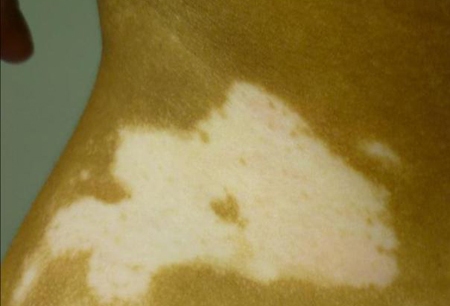
- despigmentación de la piel de la zona acral y perioral
- despigmentación de la piel de la zona perianal y genital
- edad <30 años
- traumatismo cutáneo reciente
- dolor localizado por quemadura solar
- potenciación y fluorescencia tras la exposición a la radiación ultravioleta A
- nevo con halo
- despigmentación universal
Factores de riesgo
- antecedentes familiares de vitiligo
- enfermedad autoinmune
- contacto químico
Pruebas diagnósticas
Primeras pruebas diagnósticas para solicitar
- diagnóstico clínico
Pruebas diagnósticas que deben considerarse
- Examen con lámpara de Wood
- biopsia de piel
Algoritmo de tratamiento
vitíligo segmentario: activo en los últimos 12 meses
vitíligo no segmentario: activo en los últimos 6 meses
vitíligo segmentario: estable en los últimos 12 meses
vitíligo no segmentario: estable durante los últimos 6 meses
Colaboradores
Autores
Sancy A. Leachman, MD, PhD
Professor
Department of Dermatology
University of Utah
Salt Lake CIty, UT
Divulgaciones
SAL has acted as a consultant and/or investigator for Orlucent, Pathology Watch, Veriskin, and Merck, and has received an unrestricted educational grant from Castle Biosciences to support the War on Melanoma.
Annalise Abiodun, MD
Mohs Micrographic Surgery & Reconstructive Surgery/Dermatology
Tysons Corner, MidAtlantic Permanente Medical Group
McLean, VA
Divulgaciones
AA declares that she has no competing interests.
Agradecimientos
Professor Sancy A. Leachman and Dr Annalise Abiodun would like to gratefully acknowledge Professor John E. Harris, Dr Mehdi Rashighi, and Dr Bernhard Ortel, previous contributors to this topic.
Divulgaciones
JEH has acted as a consultant and/or investigator for Pfizer, Genzyme/Sanofi, Aclaris Therapeutics Inc., Incyte, Rheos Medicines, Sun Pharmaceuticals, LEO Pharma, Villaris Therapeutics Inc., Dermavant, Temprian, AbbVie Inc., Janssen, TeVido, BioDevices, EMD Serono, Almirall, Boston Pharma, Sonoma Biotherapeutics Inc., Methuselah Health, Twi Biotech, Pandion, Cogen Therapeutics Inc., Admirx, BridgeBio, AnaptysBio, Avita, and Frazier Management. He has equity in TeVido Biodevices, Rheos, and Villaris Therapeutics Inc., and is the Scientific Founder of Villaris Therapeutics Inc. JEH is an author of a number of references cited in this topic. MR has received consulting fees and/or research grants from the following: Pfizer, AbbVie, Dermavant, LEO Pharma, and Almirall. MR is an author of a reference cited in this topic. BO declares that he has no competing interests.
Revisores por pares
Iltefat Hamzavi, MD
Senior Staff Physician
Multicultural Dermatology Center
Henry Ford Hospital
Detroit, MI
Divulgaciones
IH is an author of a number of references cited in this topic.
Piergiacomo Calzavara-Pinton, MD
Chair
Dermatology Department
University of Brescia
Brescia
Italy
Divulgaciones
PC-P is an author of a number of references cited in this topic.
Agradecimiento de los revisores por pares
Los temas de BMJ Best Practice se actualizan de forma continua de acuerdo con los desarrollos en la evidencia y en las guías. Los revisores por pares listados aquí han revisado el contenido al menos una vez durante la historia del tema.
Divulgaciones
Las afiliaciones y divulgaciones de los revisores por pares se refieren al momento de la revisión.
Referencias
Artículos principales
Ezzedine K, Lim HW, Suzuki T, et al. Revised classification/nomenclature of vitiligo and related issues: the Vitiligo Global Issues Consensus Conference. Pigment Cell Melanoma Res. 2012 May;25(3):E1-13.Texto completo Resumen
van Geel N, Speeckaert R, Taïeb A, et al. Worldwide expert recommendations for the diagnosis and management of vitiligo: position statement from the International Vitiligo Task Force Part 1: towards a new management algorithm. J Eur Acad Dermatol Venereol. 2023 Nov;37(11):2173-84.Texto completo Resumen
Taieb A, Alomar A, Böhm M, et al; Vitiligo European Task Force (VETF); European Academy of Dermatology and Venereology (EADV); Union Européenne des Médecins Spécialistes (UEMS). Guidelines for the management of vitiligo: the European Dermatology Forum consensus. Br J Dermatol. 2013 Jan;168(1):5-19.Texto completo Resumen
Seneschal J, Speeckaert R, Taïeb A, et al. Worldwide expert recommendations for the diagnosis and management of vitiligo: position statement from the International Vitiligo Task Force-Part 2: specific treatment recommendations. J Eur Acad Dermatol Venereol. 2023 Nov;37(11):2185-95.Texto completo Resumen
Rodrigues M, Ezzedine K, Hamzavi I, et al. Current and emerging treatments for vitiligo. J Am Acad Dermatol. 2017 Jul;77(1):17-29. Resumen
Artículos de referencia
Una lista completa de las fuentes a las que se hace referencia en este tema está disponible para los usuarios con acceso a todo BMJ Best Practice.
Diferenciales
- Piebaldismo
- Síndrome de Waardenburg
- Esclerosis tuberosa
Más DiferencialesGuías de práctica clínica
- Worldwide expert recommendations for the diagnosis and management of vitiligo: position statement from the International Vitiligo Task Force Part 1: towards a new management algorithm
- Worldwide expert recommendations for the diagnosis and management of vitiligo: position statement from the international Vitiligo Task Force-Part 2: specific treatment recommendations
Más Guías de práctica clínica Inicie sesión o suscríbase para acceder a todo el BMJ Best Practice
El uso de este contenido está sujeto a nuestra cláusula de exención de responsabilidad