Resumo
Definição
História e exame físico
Principais fatores diagnósticos
- male sex
- age <30 years
- meningismus
- headache
- cranial nerve palsy
- positive Kernig or Brudzinski sign
- fever
- increased head circumference (infants)
- bulging fontanelles (infants)
Outros fatores diagnósticos
- neurological deficit
- papilledema
Fatores de risco
- sinusitis
- otitis media
- dental procedure/infection
- meningitis
- recent head and neck surgery or neurosurgery
- congenital heart disease
- endocarditis
- diverticular disease
- hereditary hemorrhagic telangiectasia or arteriovenous malformation
- diabetes mellitus
- HIV or immunocompromise
- intravenous drug use
- chronic granulomatous disease
- hemodialysis
- birth prematurity
- cystic fibrosis
Investigações diagnósticas
Primeiras investigações a serem solicitadas
- CBC
- serum erythrocyte sedimentation rate (ESR)
- serum CRP
- serum PT, PTT, and INR
- blood culture
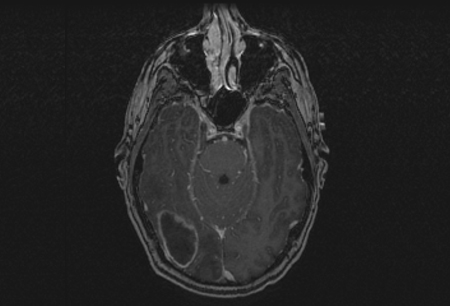
- MRI with contrast
- CT head with and without contrast
- ultrasound head (infants)
Investigações a serem consideradas
- serum toxoplasma titer
- magnetic resonance spectroscopy (MRS)
- lumbar puncture (LP) with cerebrospinal fluid (CSF) analysis
- CT chest, abdomen, and pelvis
- bone scan
- mammogram
Algoritmo de tratamento
presumed brain abscess
suspected or confirmed bacterial etiology
confirmed fungal etiology
suspected or confirmed parasitic etiology
cryptogenic brain abscess
Colaboradores
Autores
Walter A. Hall, MD, MBA
Professor
Department of Neurosurgery
SUNY Upstate Medical University
Syracuse
NY
Declarações
WAH is an author of a number of references cited in this topic.
Agradecimentos
Dr Walter A. Hall would like to gratefully acknowledge Dr Peter D. Kim, a previous contributor to this topic. PDK declares that he has no competing interests.
Revisores
Stephen Haines, MD
Professor and Head
Department of Neurosurgery
University of Minnesota
Minneapolis
MN
Declarações
SH and WAH were colleagues on a faculty of the University of Minnesota between 1991 and 1997 and again between 2004 and 2006. They have coauthored articles on neurosurgical infection.
Sabrina Ravaglia, MD, PhD
Staff Physician
Department of Neurological Sciences
Institute of Neurology C. Mondino
Pavia
Italy
Declarações
SR declares that she has no competing interests.
Créditos aos pareceristas
Os tópicos do BMJ Best Practice são constantemente atualizados, seguindo os desenvolvimentos das evidências e das diretrizes. Os pareceristas aqui listados revisaram o conteúdo pelo menos uma vez durante a história do tópico.
Declarações
As afiliações e declarações dos pareceristas referem--se ao momento da revisão.
Referências
Principais artigos
Hall WA, Truwit CL. The surgical management of infections involving the cerebrum. Neurosurgery. 2008 Feb;62(2 suppl):519-30. Resumo
Brouwer MC, Coutinho JM, van de Beek D. Clinical characteristics and outcome of brain abscess: systematic review and meta-analysis. Neurology. 2014 Mar 4;82(9):806-13. Resumo
Goodkin HP, Harper MB, Pomeroy SL. Intracerebral abscess in children: historical trends at Children's Hospital Boston. Pediatrics. 2004 Jun;113(6):1765-70. Resumo
Expert Panel on Neurologic Imaging; Whitehead MT, Cardenas AM, et al. ACR Appropriateness Criteria® headache. J Am Coll Radiol. 2019 Nov;16(11s):S364-77.Texto completo Resumo
American College of Radiology. ACR-ASNR-SPR practice parameter for the performance and interpretation of magnetic resonance spectroscopy of the central nervous system. 2019 [internet publication].Texto completo
Infection in Neurosurgery Working Party of the British Society for Antimicrobial Chemotherapy. The rational use of antibiotics in the treatment of brain abscess. Br J Neurosurg. 2000 Dec;14(6):525-30. Resumo
Mampalam TJ, Rosenblum ML. Trends in the management of bacterial brain abscesses: a review of 102 cases over 17 years. Neurosurgery. 1988 Oct;23(4):451-8. Resumo
Artigos de referência
Uma lista completa das fontes referenciadas neste tópico está disponível para os usuários com acesso total ao BMJ Best Practice.
Diagnósticos diferenciais
- Primary central nervous system neoplasm
- Metastatic lesion
- Recurrent tumor/radiation necrosis in a postsurgical patient
Mais Diagnósticos diferenciais Conectar-se ou assinar para acessar todo o BMJ Best Practice
O uso deste conteúdo está sujeito ao nosso aviso legal