Summary
Definition
History and exam
Key diagnostic factors
- acute pain related to trauma
- history of sports-related or overuse injury
- positive anterior impingement test (FADIR test)
- pain on adduction against resistance (neutral hip flexion)
- pain on palpation of adductor tendons
- pain on palpation of iliopsoas
Other diagnostic factors
- pain on passive range-of-motion testing of the hip joint
- snapping/clicking hip
- positive Trendelenburg test
- positive apprehension test
- positive modified Thomas test
- pain on palpation of inguinal canal
- pain on palpation of conjoined tendon at pubic tubercle
- decreased strength and increased pain with hip flexion against resistance (90˚)
- night pain/rest pain
Risk factors
- previous groin injury
- higher level of play
- reduced hip abductor and adductor strength
- lower levels of training
- increased age
- decreased range of motion of the hip
Diagnostic tests
1st tests to order
- plain radiographs (anteroposterior [AP] pelvis and AP and lateral hip)
Tests to consider
- ultrasound of the hip
- MRI of the hip
- MRI arthrogram of the hip
- CT of the hip
- isotope bone scan of the hip
- intra-articular injection corticosteroid ± local anesthetic agent
Treatment algorithm
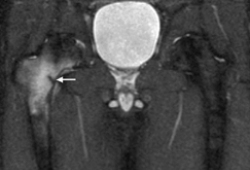
femoral neck stress fracture
traumatic or overuse injury: initial presentation
traumatic or overuse injury: not responding to initial management
Contributors
Authors
Per Hölmich, MD, DMSc
Professor of Orthopedic Surgery and Chief Surgeon
Sports Orthopedic Research Center – Copenhagen (SORC-C)
Arthroscopy Centre Hvidovre, Department of Orthopedics
Amager & Hvidovre Hospital
University of Copenhagen
Denmark
Disclosures
PH is an author of a number of references cited in this topic. PH declares that he has no other competing interests.
Acknowledgements
Dr Per Hölmich would like to gratefully acknowledge Dr Cedric J Ortiguera and Dr Juan M Raposo, the previous contributors to this topic. CJO and JMR declare that they have no competing interests.
Peer reviewers
Carlos Guanche, MD
Specialist in Arthroscopy of the Shoulder, Hip, and Knee; Traditional and Reverse Shoulder Replacement; and Sports Medicine
Southern California Orthopedic Institute
Van Nuys
CA
Disclosures
CG declares that he has no competing interests.
Peer reviewer acknowledgements
BMJ Best Practice topics are updated on a rolling basis in line with developments in evidence and guidance. The peer reviewers listed here have reviewed the content at least once during the history of the topic.
Disclosures
Peer reviewer affiliations and disclosures pertain to the time of the review.
References
Key articles
European Society of Sports Traumatology, Knee Surgery and Arthroscopy. A formal ESSKA-EHPA-ESMA consensus: hip and groin pain in physically active adults. Oct 2024 [internet publication].Full text
Hölmich P. Adductor-related groin pain in athletes. Sports Med Arthrosc. 1997;5:285-291.
Hölmich P, Uhrskou P, Ulnits L, et al. Effectiveness of active physical training as treatment for long-standing adductor-related groin pain in athletes: randomized trial. Lancet. 1999;353:439-443. Abstract
Reference articles
A full list of sources referenced in this topic is available to users with access to all of BMJ Best Practice.
Differentials
- Hip dysplasia
- Nerve entrapment
- Bursitis
More DifferentialsGuidelines
- Hip and groin pain in physically active adults
More Guidelines Log in or subscribe to access all of BMJ Best Practice
Use of this content is subject to our disclaimer