Resumo
Definição
História e exame físico
Principais fatores diagnósticos
- scalp pruritus
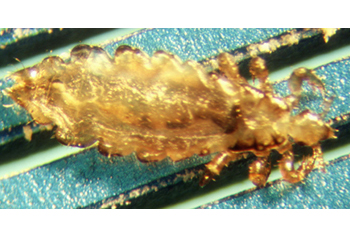
- live nymphal or adult louse
- eggs visible on hair shaft within 1 cm of scalp
Outros fatores diagnósticos
- small red papules under hairline at nape of neck
- lymphadenopathy
- erythema with honey-colored crust on scalp
Fatores de risco
- 3 to 12 years of age
- female sex
- close contact with an infested individual
- overcrowding or close living conditions
- low socioeconomic status
- poor hygiene
- contact with contaminated clothes, hair care items, bedding
Investigações diagnósticas
Primeiras investigações a serem solicitadas
- no tests required
Algoritmo de tratamento
children <2 months of age
children ≥2 months and <2 years of age
children ≥2 years of age and adults
Colaboradores
Autores
Aicha Salhi, MD
Professor of Dermatology
Faculty of Medicine
University of Algiers
Algeria
Declarações
AS declares that she has no competing interests.
Agradecimentos
Professor Aicha Salhi would like to gratefully acknowledge Professor Hermann Feldmeier and Professor Barbara L. Frankowski, previous contributors to this topic.
Declarações
HF has received consultant and lecture fees from Pohl-Boskamp GmbH, and Co KG, Hohenlockstedt, Germany, and Almirall Hermal GmbH, Reinbek, Germany; both companies produce various anti-head louse compounds. He is also an author of several references cited in this topic. BLF is an author of a reference cited in this topic.
Revisores
Richard J. Pollack, PhD
Research Associate
Laboratory of Public Health Entomology
Department of Immunology and Infectious Diseases
Harvard School of Public Health
Boston
MA
Declarações
RJP has received a research donation by Taro Pharmaceuticals (manufacturer of Ovide) and has been compensated as an independent consultant for scientific review services by Topaz Pharmaceuticals, Hatchtech, and ParaPro, each developing products for the US market. RJP holds no financial interest in any of these companies or their products. RJP is an author of several references cited in this topic.
Ian F. Burgess, MSc, MPhil
Professor
Director
Medical Entomology Centre
University of Cambridge
Cambridge
UK
Declarações
IFB has been a consultant to various manufacturers of pharmaceutical products, alternative therapies, and combs for treating louse infections. IFB is an author of a number of references cited in this topic.
Kosta Y. Mumcuoglu, PhD
Professor
Department of Parasitology
Hebrew University-Hadassah Medical School
Jerusalem
Israel
Declarações
KYM is an author of several references cited in this topic.
Créditos aos pareceristas
Os tópicos do BMJ Best Practice são constantemente atualizados, seguindo os desenvolvimentos das evidências e das diretrizes. Os pareceristas aqui listados revisaram o conteúdo pelo menos uma vez durante a história do tópico.
Declarações
As afiliações e declarações dos pareceristas referem--se ao momento da revisão.
Referências
Principais artigos
American Academy of Pediatrics, Nolt D, Moore S, et al. Head Lice. Pediatrics. 2022 Oct 1;150(4):e2022059282.Texto completo Resumo
Cummings C, Finlay JC, MacDonald NE et al. Head lice infestations: a clinical update. Paediatr Child Health. 2024 Jan 11;23(1):e18-24.Texto completo
Artigos de referência
Uma lista completa das fontes referenciadas neste tópico está disponível para os usuários com acesso total ao BMJ Best Practice.
Diagnósticos diferenciais
- Seborrheic dermatitis
- Other objects in hair
Mais Diagnósticos diferenciaisDiretrizes
- Treatment of head lice
- Clinical report: head lice
Mais DiretrizesFolhetos informativos para os pacientes
Head lice
Mais Folhetos informativos para os pacientes Conectar-se ou assinar para acessar todo o BMJ Best Practice
O uso deste conteúdo está sujeito ao nosso aviso legal