Summary
Definition
History and exam
Key diagnostic factors
- subjective decrease in vision
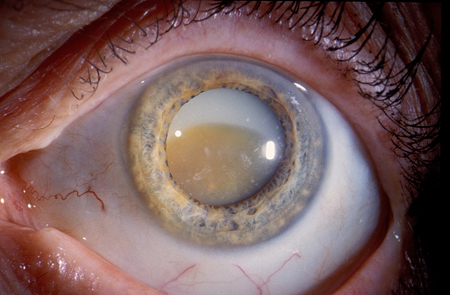
- blurred or cloudy vision
- glare
- washed-out color vision
- reduced visual acuity
- blunted red reflex
Other diagnostic factors
- inadequate glasses prescription
- disruption of activities of daily living
Risk factors
- age >60 years
- female sex
- smoking
- long-term UV exposure
- diabetes mellitus
- eye trauma
- long-term corticosteroid use
- family history of congenital cataract or congenital influences (e.g., toxins)
- uveitis
- myopia
- other metabolic or hereditary conditions
- exposure to ionizing radiation
- high body mass index (BMI)
Diagnostic tests
1st tests to order
- dilated fundus exam
- measurement of intraocular pressure
- glare vision test
- slit lamp exam of the anterior chamber
Tests to consider
- assessment of best visual potential
- B-scan ultrasonography
Treatment algorithm
cataract without concomitant eye pathology
cataract with concomitant eye pathology
postsurgical opacification of the posterior capsule + significant visual impairment
Contributors
Authors
Robert T. Chang, MD
Associate Professor of Ophthalmology
Byers Eye Institute
Stanford University School of Medicine
Stanford
CA
Disclosures
RTC declares that he is a consultant for Alcon, AbbVie, and Zeiss.
Acknowledgements
Dr Robert T. Chang would like to gratefully acknowledge Dr Creig Hoyt, Dr Leela V. Raju, and Dr M. Bowes Hamill, previous contributors to this topic.
Disclosures
CH, LVR, and MBH declare that they have no competing interests.
Peer reviewers
Michael P. Ehrenhaus, MD
Assistant Professor of Ophthalmology
Cornea External Disease and Refractive Surgery Local Director
Long Island College Hospital Eye Center
Brooklyn
NY
Disclosures
MPE declares that he has no competing interests.
Parwez Hossain, PhD, FRC Ophth, FRCS(Ed)
Associate Professor/Consultant in Ophthalmology
University of Southampton
Southampton
UK
Disclosures
PH declares that he has no competing interests.
Bob Avery, MD, PhD
Assistant Professor
Ophthalmology
University of New Mexico Medical School
Albuquerque
NM
Disclosures
BA declares that he has no competing interests.
Peer reviewer acknowledgements
BMJ Best Practice topics are updated on a rolling basis in line with developments in evidence and guidance. The peer reviewers listed here have reviewed the content at least once during the history of the topic.
Disclosures
Peer reviewer affiliations and disclosures pertain to the time of the review.
References
Key articles
American Academy of Ophthalmology. Preferred practice pattern: cataract in the adult eye. Nov 2021 [internet publication].Full text
National Institute for Health and Care Excellence (UK). Cataracts in adults: management. Oct 2017 [internet publication].Full text
Reference articles
A full list of sources referenced in this topic is available to users with access to all of BMJ Best Practice.
Differentials
- Refractive error
- Dry eye
- Glaucoma
More DifferentialsGuidelines
- Comprehensive adult medical eye evaluation preferred practice pattern
- Cataract/anterior segment summary benchmark - 2025
More GuidelinesPatient information
Cataracts: should I have surgery?
Cataracts: questions to ask your doctor
More Patient information Log in or subscribe to access all of BMJ Best Practice
Use of this content is subject to our disclaimer