Resumen
Definición
Anamnesis y examen
Principales factores de diagnóstico
- debilidad unilateral o parálisis en la cara, el brazo o la pierna
- pérdida sensorial (entumecimiento)
- disfasia
- disartría
- alteración visual
- fotofobia
- cefalea
- ataxia
- Factores de riesgo
Otros factores de diagnóstico
- vértigo
- náuseas y vómitos
- disminución del nivel de conciencia/coma
- confusión
- paresia de la mirada
Factores de riesgo
- hipertensión
- edad avanzada
- sexo masculino
- Asiático, negro y/o latino/hispano
- consumo excesivo de alcohol
- simpaticomiméticos ilegales
- antecedentes familiares de hemorragia intracerebral
- hemofilia
- angiopatía amiloide cerebral
- anemia falciforme
- mutaciones autosómicas dominantes en el gen COL4A1
- telangiectasia hemorrágica hereditaria
- mutaciones autosómicas dominantes en el gen KRIT1, el gen CCM2 o el gen PDCD10
- anticoagulación
- malformaciones vasculares
- enfermedad de Moyamoya
- embarazo
- tabaquismo
- antiinflamatorios no esteroideos (AINE)
- apnea obstructiva del sueño
- diabetes mellitus
- simpaticomiméticos
- vasculitis cerebral
- trombocitopenia
- leucemia
Pruebas diagnósticas
Primeras pruebas diagnósticas para solicitar
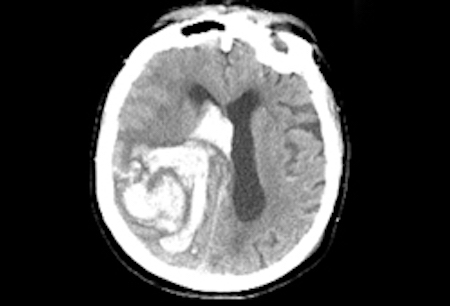
- tomografía computarizada (TC) de cabeza sin contraste.
- glucosa sérica
- electrolitos séricos
- urea y creatinina séricas
- pruebas de función hepática
- hemograma completo (HC)
- prueba de coagulación
- electrocardiograma (ECG)
Pruebas diagnósticas que deben considerarse
- cribado toxicológico en suero
- Angiografía por TC (ATC) o angiografía por resonancia magnética (ARM) de la cabeza
- Venografía por tomografía computarizada (TC) o venografía por resonancia magnética (VRM) de la cabeza
- Angiografía cerebral intraarterial
Algoritmo de tratamiento
sospecha de hemorragia intracerebral
hemorragia intracerebral confirmada
Colaboradores
Consejeros especializados
Matthew Jones, MD, FRCP
Consultant Neurologist
Manchester Centre for Clinical Neurosciences
Northern Care Alliance
Honorary Senior Lecturer
University of Manchester
Manchester
UK
Divulgaciones
MJ is the chair of the Association of British Neurologists Education Committee (unpaid position). MJ is a faculty member of an MRCP revision course. MJ has received honoraria from Eisai for educational talks.
Acknowledgements
BMJ Best Practice would like to gratefully acknowledge the previous expert contributors, whose work has been retained in parts of the content:
Fernando D. Goldenberg, MD
Clinical Associate of Neurology
Medical Director, Neuroscience ICU
Director, Neurocritical Care Education
Co-Director, Stroke Center
University of Chicago
Chicago
IL
Raisa C. Martinez, MD
Neurocritical Care Fellow
Department of Neurology
University of Chicago
Chicago
IL
Divulgaciones
FDG and RCM declare that they have no competing interests.
Revisores por pares
David Werring, FRCP, PhD, FESO
Professor of Clinical Neurology
Head of Research Department, Brain Repair and Rehabilitation
UCL Institute of Neurology
Honorary Consultant Neurologist
National Hospital for Neurology and Neurosurgery
University College Hospitals NHS Foundation Trust
North Thames Clinical Research Specialty Lead for Stroke
NIHR Clinical Research Network
London
UK
Divulgaciones
DW has received honoraria (speaking) from Bayer 2016, 2017, 2018 (talks or debates on intracerebral haemorrhage, atrial fibrillation, dementia) and honoraria (chairing) from Portola and Bayer 2019. DW has received consultancy fees from Bayer (2017; embolic stroke of undetermined source), JFB consulting (2018; PCSK9 inhibitors in stroke), Alnylam (2019; cerebral amyloid angiopathy), Portola (2019, 2020; andexanet alpha). JW was UCL Principle Investigator for NIHR clinical trials NAVIGATE-ESUS (Bayer, 2016-19), B2341002 (Pfizer 2014-2016), Action-2 (Biogen, 2016-19); Chief Investigator for OPTIMAS; steering committee and co-investigator for RESTART, TICH-2.
Agradecimiento de los revisores por pares
Los temas de BMJ Best Practice se actualizan de forma continua de acuerdo con los desarrollos en la evidencia y en las guías. Los revisores por pares listados aquí han revisado el contenido al menos una vez durante la historia del tema.
Divulgaciones
Las afiliaciones y divulgaciones de los revisores por pares se refieren al momento de la revisión.
Referencias
Artículos principales
Greenberg SM, Ziai WC, Cordonnier C, et al. 2022 Guideline for the management of patients with spontaneous intracerebral hemorrhage: a guideline from the American Heart Association/American Stroke Association. Stroke. 2022 Jul;53(7):e282-361.Texto completo Resumen
Intercollegiate Stroke Working Party. National clinical guideline for stroke for the UK and Ireland. May 2023 [internet publication].Texto completo
National Institute for Health and Care Excellence. Stroke and transient ischaemic attack in over 16s: diagnosis and initial management. Apr 2022 [internet publication].Texto completo
Royal College of Physicians. National Clinical Guideline for Stroke. Oct 2016 [internet publication].Texto completo
Artículos de referencia
Una lista completa de las fuentes a las que se hace referencia en este tema está disponible para los usuarios con acceso a todo BMJ Best Practice.
Diferenciales
- Accidente cerebrovascular isquémico
- Encefalopatía hipertensiva
- Hipoglucemia
Más DiferencialesGuías de práctica clínica
- National clinical guideline for stroke for the United Kingdom and Ireland
- Stroke and transient ischaemic attack in over 16s: diagnosis and initial management
Más Guías de práctica clínicaCalculadoras
Escala de accidente cerebrovascular del NIH
Escala de Coma de Glasgow
Más CalculadorasVideos
Demostración animada de venopunción y flebotomía
Demostración animada de como realizar un electrocardiograma (ECG)
Más vídeosFolletos para el paciente
Accidente cerebrovascular: tratamiento
preguntas para formularle al médico si ha sufrido un accidente cerebrovascular
Más Folletos para el paciente Inicie sesión o suscríbase para acceder a todo el BMJ Best Practice
El uso de este contenido está sujeto a nuestra cláusula de exención de responsabilidad